Department of Psychiatry, Icahn School of Medicine at Mount Sinai, New York, NY, USA.
Friedman Brain Institute, Nash Family Department of Neuroscience, Icahn School of Medicine at Mount Sinai, New York, NY, USA.
Genome Med. 2020 Feb 19;12(1):19. doi: 10.1186/s13073-020-0715-x.
Midbrain dopaminergic neurons (MDN) represent 0.0005% of the brain's neuronal population and mediate cognition, food intake, and metabolism. MDN are also posited to underlay the neurobiological dysfunction of schizophrenia (SCZ), a severe neuropsychiatric disorder that is characterized by psychosis as well as multifactorial medical co-morbidities, including metabolic disease, contributing to markedly increased morbidity and mortality. Paradoxically, however, the genetic risk sequences of psychosis and traits associated with metabolic disease, such as body mass, show very limited overlap.
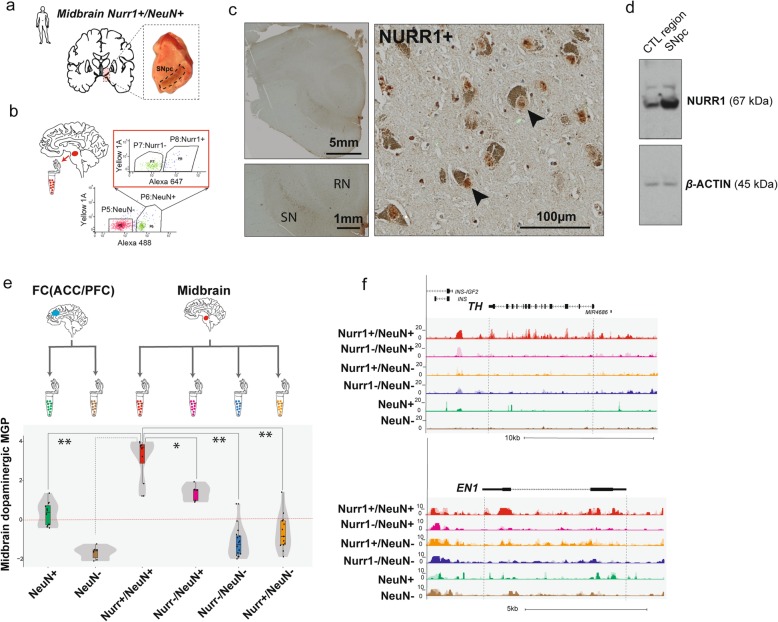
We investigated the genomic interaction of SCZ with medical conditions and traits, including body mass index (BMI), by exploring the MDN's "spatial genome," including chromosomal contact landscapes as a critical layer of cell type-specific epigenomic regulation. Low-input Hi-C protocols were applied to 5-10 × 10 dopaminergic and other cell-specific nuclei collected by fluorescence-activated nuclei sorting from the adult human midbrain.
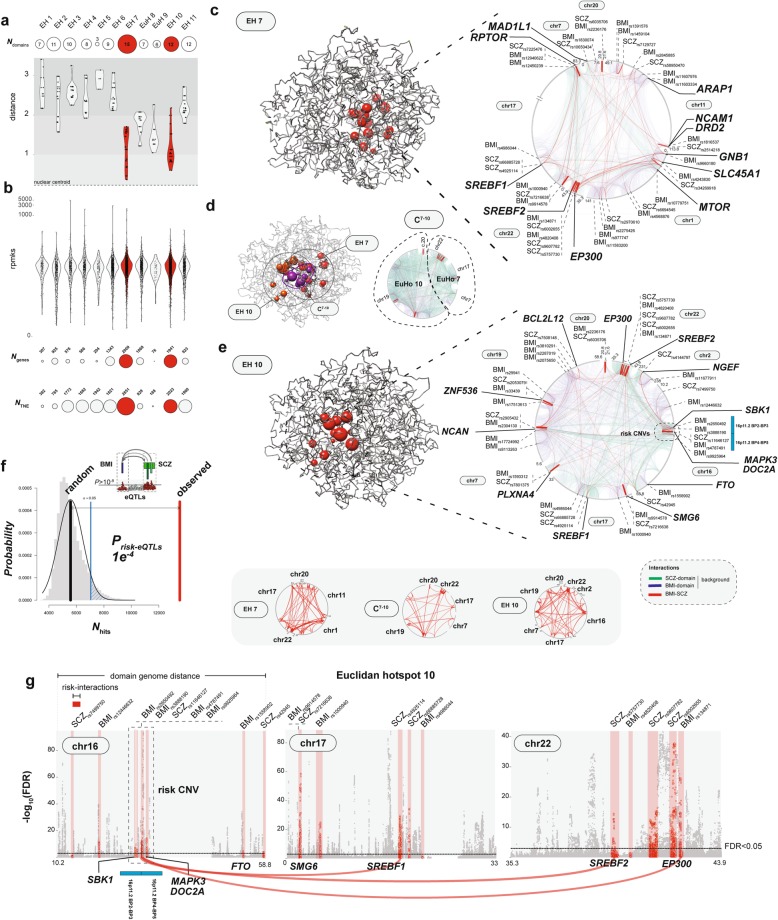
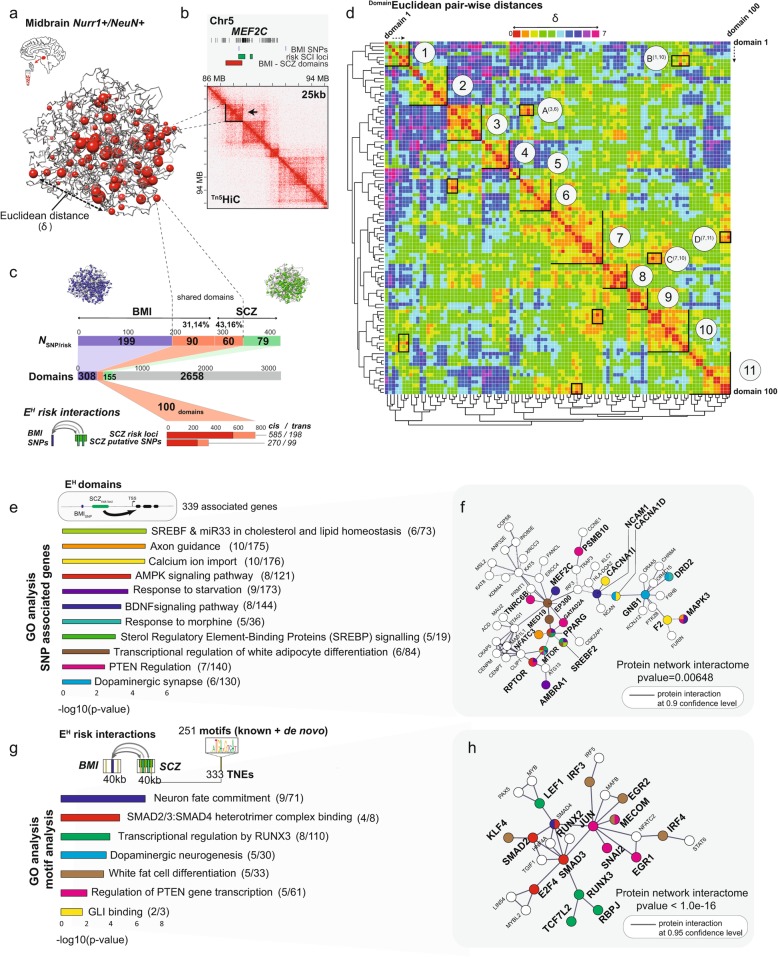
The Hi-C-reconstructed MDN spatial genome revealed 11 "Euclidean hot spots" of clustered chromatin domains harboring risk sequences for SCZ and elevated BMI. Inter- and intra-chromosomal contacts interconnecting SCZ and BMI risk sequences showed massive enrichment for brain-specific expression quantitative trait loci (eQTL), with gene ontologies, regulatory motifs and proteomic interactions related to adipogenesis and lipid regulation, dopaminergic neurogenesis and neuronal connectivity, and reward- and addiction-related pathways.
We uncovered shared nuclear topographies of cognitive and metabolic risk variants. More broadly, our PsychENCODE sponsored Hi-C study offers a novel genomic approach for the study of psychiatric and medical co-morbidities constrained by limited overlap of their respective genetic risk architectures on the linear genome.
中脑多巴胺能神经元(MDN)占大脑神经元群体的 0.0005%,介导认知、食物摄入和代谢。MDN 也被认为是精神分裂症(SCZ)的神经生物学功能障碍的基础,精神分裂症是一种严重的神经精神疾病,其特征是精神病以及多种因素的医学合并症,包括代谢疾病,导致发病率和死亡率明显增加。然而,具有精神分裂症遗传风险序列的个体和与代谢疾病相关的特征,如体重指数(BMI),其重叠非常有限。
我们通过探索 MDN 的“空间基因组”,包括作为细胞类型特异性表观遗传调控关键层的染色体接触景观,研究了 SCZ 与包括 BMI 在内的医疗条件和特征的基因组相互作用。低输入 Hi-C 方案应用于通过荧光激活核分选从成人中脑收集的 5-10×多巴胺能和其他细胞特异性核。
Hi-C 重建的 MDN 空间基因组揭示了 11 个具有 SCZ 和升高 BMI 风险序列的聚类染色质域的“欧几里得热点”。相互和染色体内接触连接 SCZ 和 BMI 风险序列的基因显示出大量与大脑特异性表达数量性状基因座(eQTL)的富集,其基因本体论、调节基序和蛋白质相互作用与脂肪生成和脂质调节、多巴胺能神经发生和神经元连接以及与奖励和成瘾相关的途径有关。
我们发现了认知和代谢风险变异的共享核拓扑结构。更广泛地说,我们的 PsychENCODE 赞助的 Hi-C 研究为研究精神疾病和医学合并症提供了一种新的基因组方法,这些疾病受其线性基因组上各自遗传风险结构的有限重叠的限制。