Blum Kenneth, McLaughlin Thomas, Bowirrat Abdalla, Modestino Edward J, Baron David, Gomez Luis Llanos, Ceccanti Mauro, Braverman Eric R, Thanos Panayotis K, Cadet Jean Lud, Elman Igor, Badgaiyan Rajendra D, Jalali Rehan, Green Richard, Simpatico Thomas A, Gupta Ashim, Gold Mark S
Division of Addiction Research & Education, Center for Psychiatry, Medicine, & Primary Care (Office of the Provost), Graduate College, Western University of Health Sciences, Pomona, CA 91766, USA.
Institute of Psychology, ELTE Eötvös Loránd University, 1075 Budapest, Hungary.
J Pers Med. 2022 Feb 21;12(2):321. doi: 10.3390/jpm12020321.
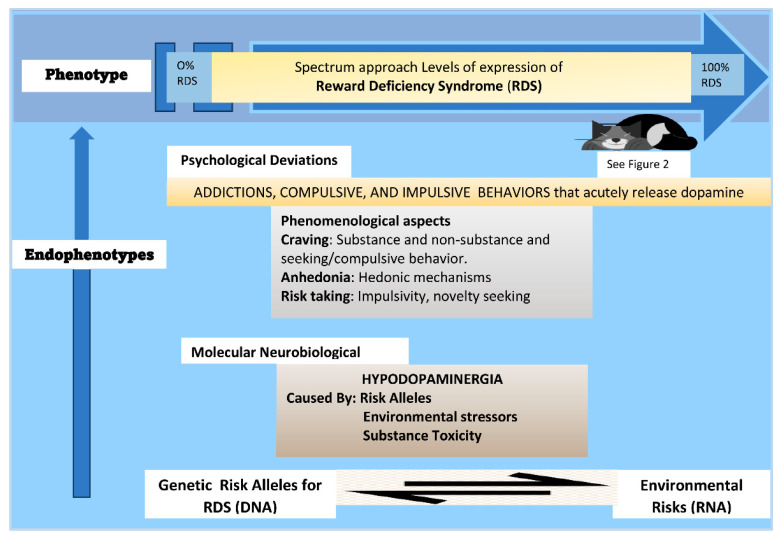
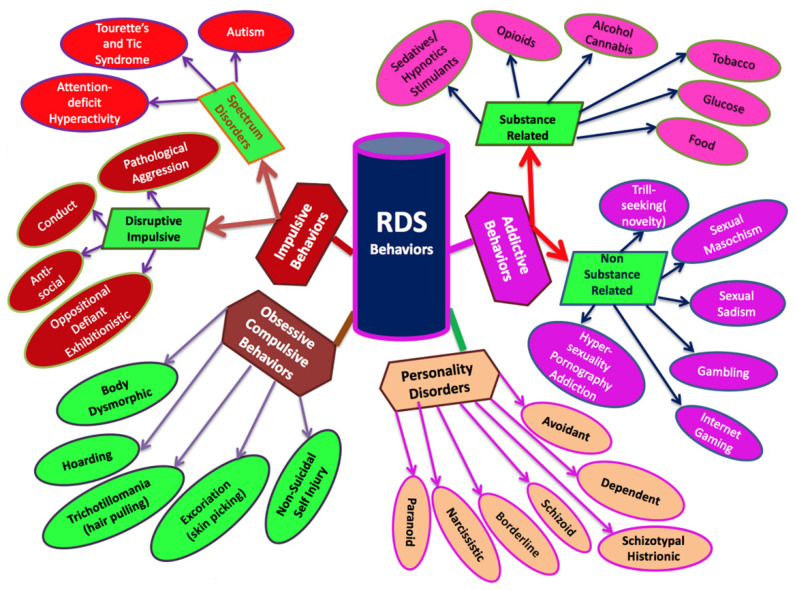
Reward Deficiency Syndrome (RDS) encompasses many mental health disorders, including a wide range of addictions and compulsive and impulsive behaviors. Described as an octopus of behavioral dysfunction, RDS refers to abnormal behavior caused by a breakdown of the cascade of reward in neurotransmission due to genetic and epigenetic influences. The resultant reward neurotransmission deficiencies interfere with the pleasure derived from satisfying powerful human physiological drives. Epigenetic repair may be possible with precision gene-guided therapy using formulations of KB220, a nutraceutical that has demonstrated pro-dopamine regulatory function in animal and human neuroimaging and clinical trials. Recently, large GWAS studies have revealed a significant dopaminergic gene risk polymorphic allele overlap between depressed and schizophrenic cohorts. A large volume of literature has also identified ADHD, PTSD, and spectrum disorders as having the known neurogenetic and psychological underpinnings of RDS. The hypothesis is that the true phenotype is RDS, and behavioral disorders are endophenotypes. Is it logical to wonder if RDS exists everywhere? Although complex, "the answer is blowin' in the wind," and rather than intangible, RDS may be foundational in species evolution and survival, with an array of many neurotransmitters and polymorphic loci influencing behavioral functionality.
奖赏缺乏综合征(RDS)涵盖多种心理健康障碍,包括广泛的成瘾行为以及强迫和冲动行为。RDS被描述为行为功能障碍的章鱼,指的是由于遗传和表观遗传影响导致神经传递中奖赏级联中断所引起的异常行为。由此产生的奖赏神经传递缺陷会干扰从满足强大的人类生理驱力中获得的愉悦感。使用营养保健品KB220制剂进行精确基因引导治疗可能实现表观遗传修复,KB220在动物和人类神经影像学及临床试验中已显示出促多巴胺调节功能。最近,大规模全基因组关联研究(GWAS)表明,抑郁症和精神分裂症队列之间存在显著的多巴胺能基因风险多态性等位基因重叠。大量文献还将注意力缺陷多动障碍(ADHD)、创伤后应激障碍(PTSD)和谱系障碍确定为具有RDS已知的神经遗传学和心理学基础。假说认为真正的表型是RDS,而行为障碍是内表型。不禁要问,RDS是否无处不在?尽管复杂,但“答案在风中飘荡”,而且RDS并非无形,它可能在物种进化和生存中具有基础性作用,有一系列神经递质和多态性位点影响行为功能。