McConnell Brain Imaging Centre, Montreal Neurological Institute and Hospital, McGill University, Montreal, H3A 2B4, Canada.
Department of Electrical and Computer Engineering, Sungkyunkwan University, Suwon, 16419, South Korea.
Sci Rep. 2020 Feb 19;10(1):2930. doi: 10.1038/s41598-020-60054-x.
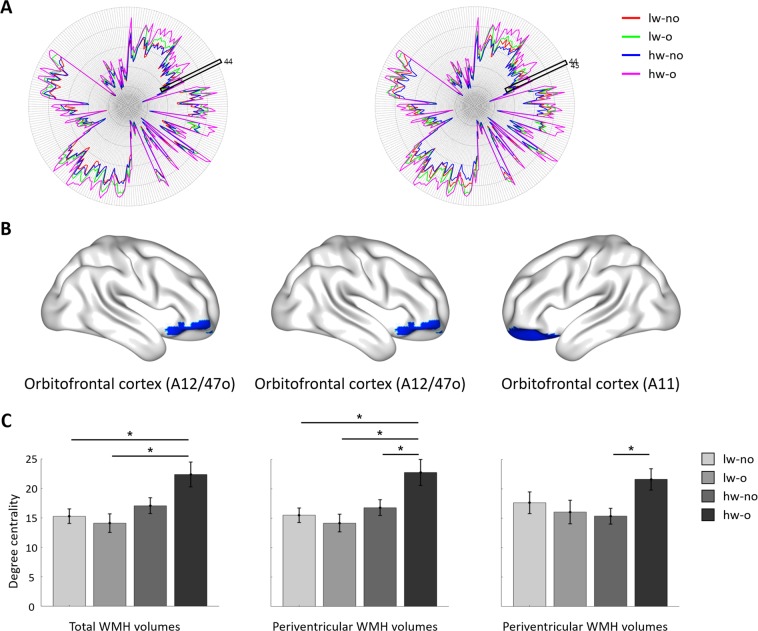
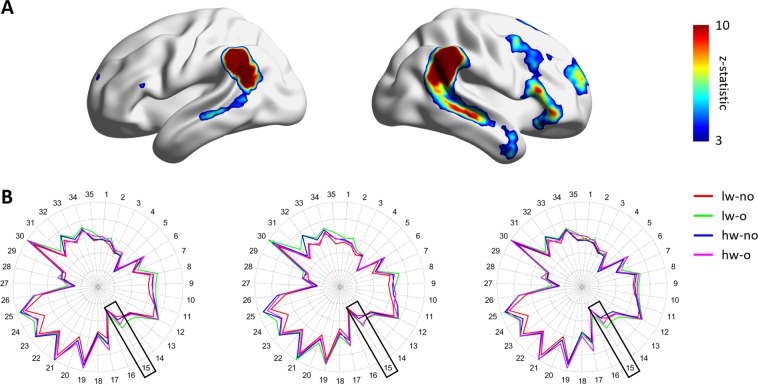
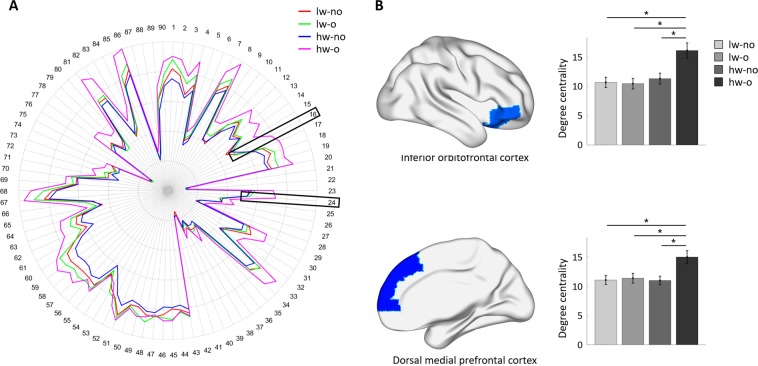
Many studies have linked dysfunction in cognitive control-related brain regions with obesity and the burden of white matter hyperintensities (WMHs). This study aimed to explore how functional connectivity differences in the brain are associated with WMH burden and degree of obesity using resting-state functional magnetic resonance imaging (fMRI) in 182 participants. Functional connectivity measures were compared among four different groups: (1) low WMH burden, non-obese; (2) low WMH burden, obese; (3) high WMH burden, non-obese; and (4) high WMH burden, obese. At a large-scale network-level, no networks showed significant interaction effects, but the frontoparietal network showed a main effect of degree of obesity. At a finer node level, the orbitofrontal cortex showed interaction effects between periventricular WMH burden and degree of obesity. Higher functional connectivity was observed when the periventricular WMH burden and degree of obesity were both high. These results indicate that the functional connectivity of the orbitofrontal cortex is affected by the mutual interaction between the periventricular WMHs and degree of obesity. Our results suggest that this region links obesity with WMHs in terms of functional connectivity.
许多研究将认知控制相关脑区的功能障碍与肥胖和脑白质高信号(WMHs)的负担联系起来。本研究旨在通过对 182 名参与者进行静息态功能磁共振成像(fMRI),探讨大脑功能连接差异如何与 WMH 负担和肥胖程度相关。功能连接测量值在四个不同的组之间进行比较:(1)WMH 负担低,不肥胖;(2)WMH 负担低,肥胖;(3)WMH 负担高,不肥胖;(4)WMH 负担高,肥胖。在大尺度网络层面,没有网络显示出显著的交互作用,但额顶网络显示出肥胖程度的主要作用。在更精细的节点层面,眶额皮层显示出脑室周围 WMH 负担和肥胖程度之间的交互作用。当脑室周围 WMH 负担和肥胖程度都较高时,观察到更高的功能连接。这些结果表明,眶额皮层的功能连接受到脑室周围 WMH 和肥胖程度之间相互作用的影响。我们的研究结果表明,该区域在功能连接方面将肥胖与 WMHs 联系起来。