Vettore Martina, De Marco Matteo, Pallucca Claudia, Bendini Matteo, Gallucci Maurizio, Venneri Annalena
Department of Neuroscience, University of Sheffield, Sheffield, United Kingdom.
Department of General Psychology, University of Padua, Padua, Italy.
Front Aging Neurosci. 2021 Oct 7;13:737359. doi: 10.3389/fnagi.2021.737359. eCollection 2021.
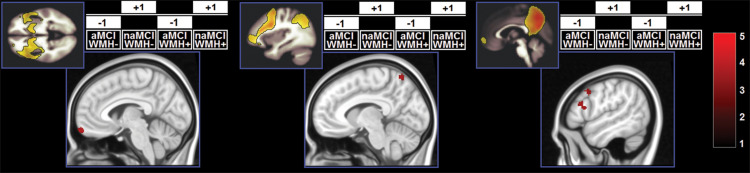
"Mild cognitive impairment" (MCI) is a diagnosis characterised by deficits in episodic memory (aMCI) or in other non-memory domains (naMCI). Although the definition of subtypes is helpful in clinical classification, it provides little insight on the variability of neurofunctional mechanisms (i.e., resting-state brain networks) at the basis of symptoms. In particular, it is unknown whether the presence of a high load of white-matter hyperintensities (WMHs) has a comparable effect on these functional networks in aMCI and naMCI patients. This question was addressed in a cohort of 123 MCI patients who had completed an MRI protocol inclusive of T1-weighted, fluid-attenuated inversion recovery (FLAIR) and resting-state fMRI sequences. T1-weighted and FLAIR images were processed with the Lesion Segmentation Toolbox to quantify whole-brain WMH volumes. The CONN toolbox was used to preprocess all fMRI images and to run an independent component analysis for the identification of four large-scale haemodynamic networks of cognitive relevance (i.e., default-mode, salience, left frontoparietal, and right frontoparietal networks) and one control network (i.e., visual network). Patients were classified based on MCI subtype (i.e., aMCI vs. naMCI) and WMH burden (i.e., low vs. high). Maps of large-scale networks were then modelled as a function of the MCI subtype-by-WMH burden interaction. Beyond the main effects of MCI subtype and WMH burden, a significant interaction was found in the salience and left frontoparietal networks. Having a low WMH burden was significantly more associated with stronger salience-network connectivity in aMCI (than in naMCI) in the right insula, and with stronger left frontoparietal-network connectivity in the right frontoinsular cortex. Vice versa, having a low WMH burden was significantly more associated with left-frontoparietal network connectivity in naMCI (than in aMCI) in the left mediotemporal lobe. The association between WMH burden and strength of connectivity of resting-state functional networks differs between aMCI and naMCI patients. Although exploratory in nature, these findings indicate that clinical profiles reflect mechanistic interactions that may play a central role in the definition of diagnostic and prognostic statuses.
“轻度认知障碍”(MCI)是一种以情景记忆缺陷(aMCI)或其他非记忆领域缺陷(naMCI)为特征的诊断。尽管亚型的定义有助于临床分类,但它对症状背后的神经功能机制(即静息态脑网络)的变异性提供的见解很少。特别是,尚不清楚高负荷的白质高信号(WMH)的存在对aMCI和naMCI患者的这些功能网络是否有类似的影响。在一组123名完成了包括T1加权、液体衰减反转恢复(FLAIR)和静息态功能磁共振成像序列的MRI检查的MCI患者中解决了这个问题。使用病变分割工具箱对T1加权和FLAIR图像进行处理,以量化全脑WMH体积。使用CONN工具箱对所有功能磁共振成像图像进行预处理,并进行独立成分分析,以识别四个具有认知相关性的大规模血流动力学网络(即默认模式、突显、左额顶叶和右额顶叶网络)和一个控制网络(即视觉网络)。根据MCI亚型(即aMCI与naMCI)和WMH负担(即低与高)对患者进行分类。然后将大规模网络的图谱建模为MCI亚型与WMH负担相互作用的函数。除了MCI亚型和WMH负担的主要影响外,在突显网络和左额顶叶网络中发现了显著的相互作用。在aMCI(相对于naMCI)中,低WMH负担与右侧岛叶更强的突显网络连通性显著相关,与右侧额岛叶皮层更强的左额顶叶网络连通性显著相关。反之,在naMCI(相对于aMCI)中,低WMH负担与左侧颞中叶的左额顶叶网络连通性显著相关。aMCI和naMCI患者中WMH负担与静息态功能网络连通性强度之间的关联有所不同。尽管本质上是探索性的,但这些发现表明临床特征反映了可能在诊断和预后状态定义中起核心作用的机制相互作用。