Kautz Todd M, Belant Jerrold L, Beyer Dean E, Strickland Bronson K, Duquette Jared F
Camp Fire Program in Wildlife Conservation State University of New York College of Environmental Science and Forestry Syracuse NY USA.
Wildlife Division Michigan Department of Natural Resources Marquette MI USA.
Ecol Evol. 2020 Jan 21;10(3):1666-1677. doi: 10.1002/ece3.6026. eCollection 2020 Feb.
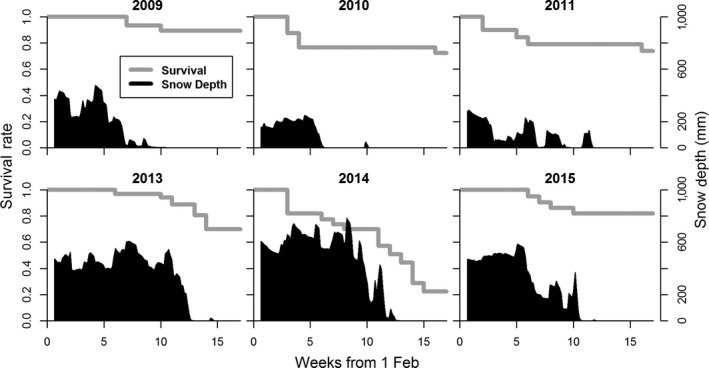
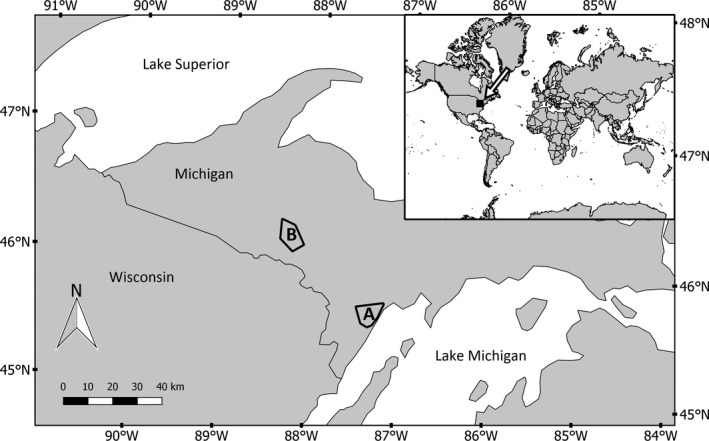
A relationship between winter weather and survival of northern ungulates has long been established, yet the possible roles of biological (e.g., nutritional status) and environmental (e.g., weather) conditions make it important to determine which potential limiting factors are most influential.Our objective was to examine the potential effects of individual (body mass and age) and extrinsic (winter severity and snowmelt conditions) factors on the magnitude and timing of mortality for adult (>2.5 years old) female white-tailed deer ( [Zimmerman, 1780]) during February-May in the Upper Peninsula of Michigan, USA.One hundred and fifty deer were captured and monitored during 2009-2015 in two areas with varying snowfall. February-May survival ranged from 0.24 to 0.89 (mean = 0.69) across years. Mortality risk increased 1.9% with each unit increase in cumulative winter severity index, decreased 8.2% with each cumulative snow-free day, and decreased 4.3% with each kg increase in body mass. Age and weekly snow depth did not influence weekly deer survival. Predation, primarily from coyote ( [Say, 1823]) and wolves ( [L., 1758]), accounted for 78% of known-cause mortalities.Our results suggest that cumulative winter severity, and possibly to a lesser degree deer condition entering winter, impacted deer winter survival. However, the timing of spring snowmelt appeared to be the most influential factor determining late-winter mortality of deer in our study. This supports the hypothesis that nutrition and energetic demands from weather conditions are both important to northern ungulate winter ecology. Under this model, a delay of several weeks in the timing of spring snowmelt could exert a large influence on deer survival, resulting in a survival bottleneck.
冬季天气与北方有蹄类动物的生存之间的关系早已确立,但生物(如营养状况)和环境(如天气)条件的潜在作用使得确定哪些潜在限制因素最具影响力变得很重要。我们的目标是研究个体因素(体重和年龄)和外在因素(冬季严酷程度和融雪条件)对美国密歇根州上半岛成年(>2.5岁)雌性白尾鹿([齐默尔曼,1780年])在2月至5月期间死亡数量和时间的潜在影响。2009年至2015年期间,在两个降雪量不同的地区捕获并监测了150头鹿。多年来,2月至5月的存活率在0.24至0.89之间(平均=0.69)。冬季累积严酷指数每增加一个单位,死亡风险增加1.9%;每增加一个无雪日,死亡风险降低8.2%;体重每增加1千克,死亡风险降低4.3%。年龄和每周积雪深度不影响鹿的周存活率。已知死因的死亡中,主要由郊狼([赛伊,1823年])和狼([林奈,1758年])造成的捕食占78%。我们的结果表明,冬季累积严酷程度,可能还有进入冬季时鹿的状况在较小程度上,影响了鹿的冬季生存。然而,春季融雪的时间似乎是我们研究中决定鹿冬末死亡率的最具影响力的因素。这支持了这样一种假设,即营养和来自天气条件的能量需求对北方有蹄类动物的冬季生态都很重要。在这种模式下,春季融雪时间推迟几周可能会对鹿的生存产生很大影响,导致生存瓶颈。