Yang Min, Du Wenwen, Yi Lixian, Wu Shaoxian, He Chunyan, Zhai Wensi, Yue Cuihua, Sun Runzi, Menk Ashley V, Delgoffe Greg M, Jiang Jingting, Lu Binfeng
Department of Tumor Biological Treatment, The Third Affiliated Hospital of Soochow University, Changzhou China.
Department of Immunology, School of Medicine, University of Pittsburgh, Pittsburgh PA, USA.
Oncoimmunology. 2020 Jan 30;9(1):1708064. doi: 10.1080/2162402X.2019.1708064. eCollection 2020.
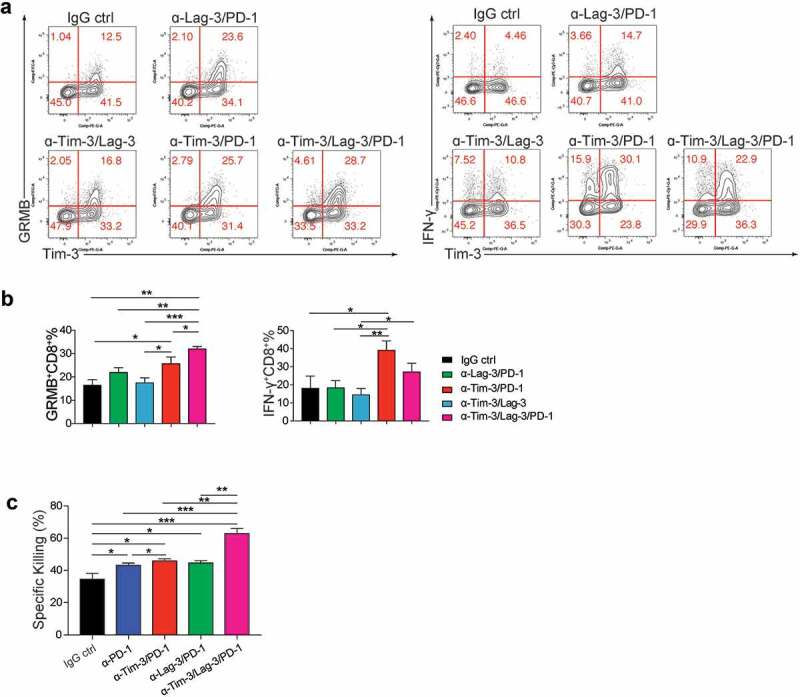
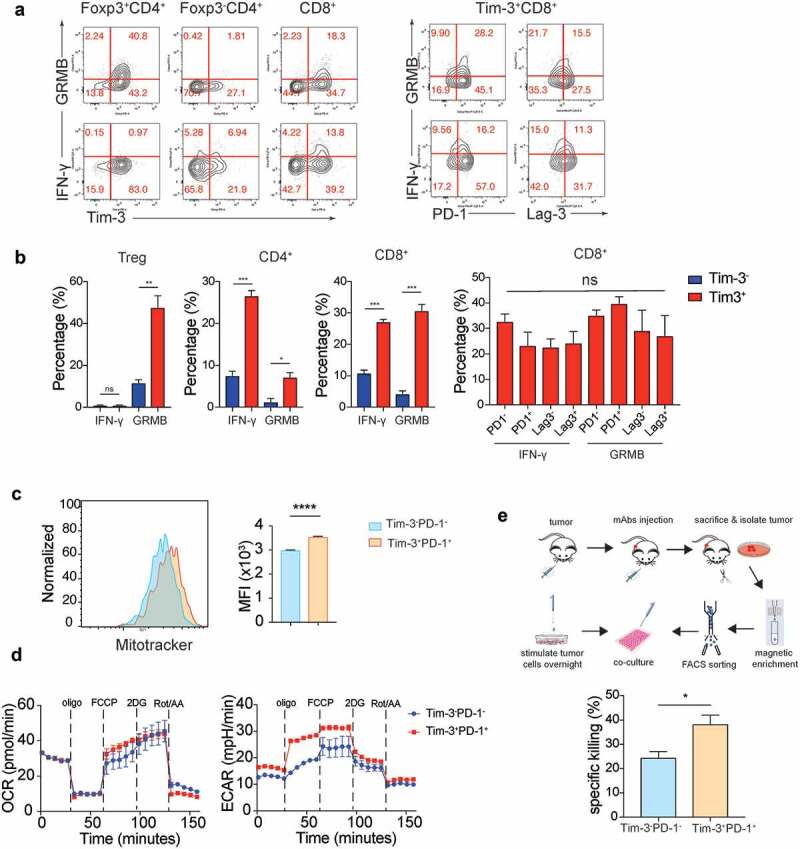
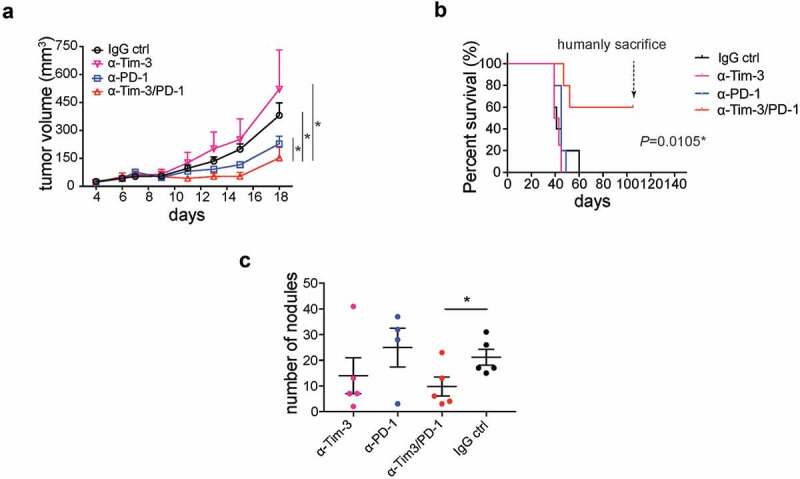
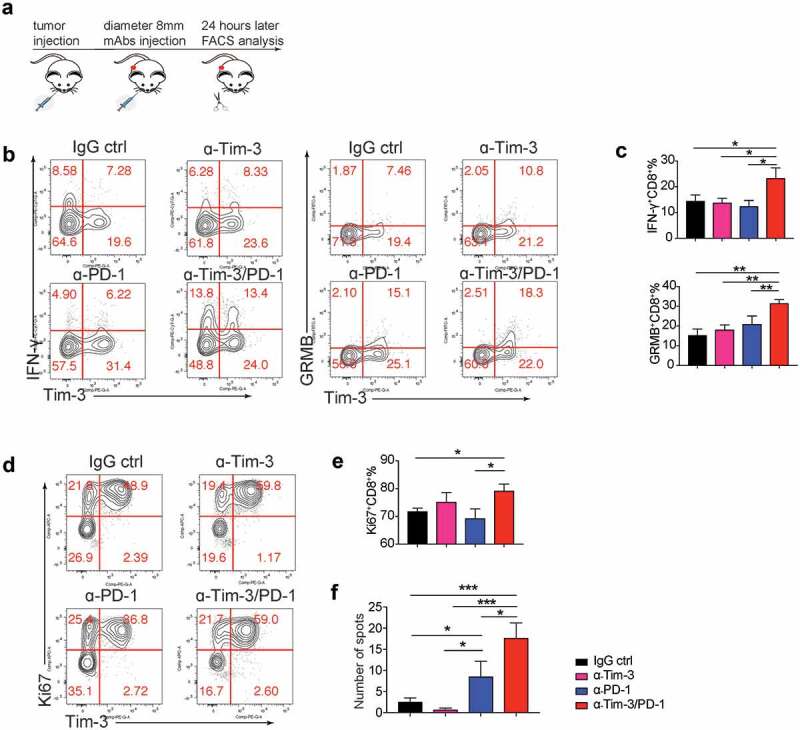
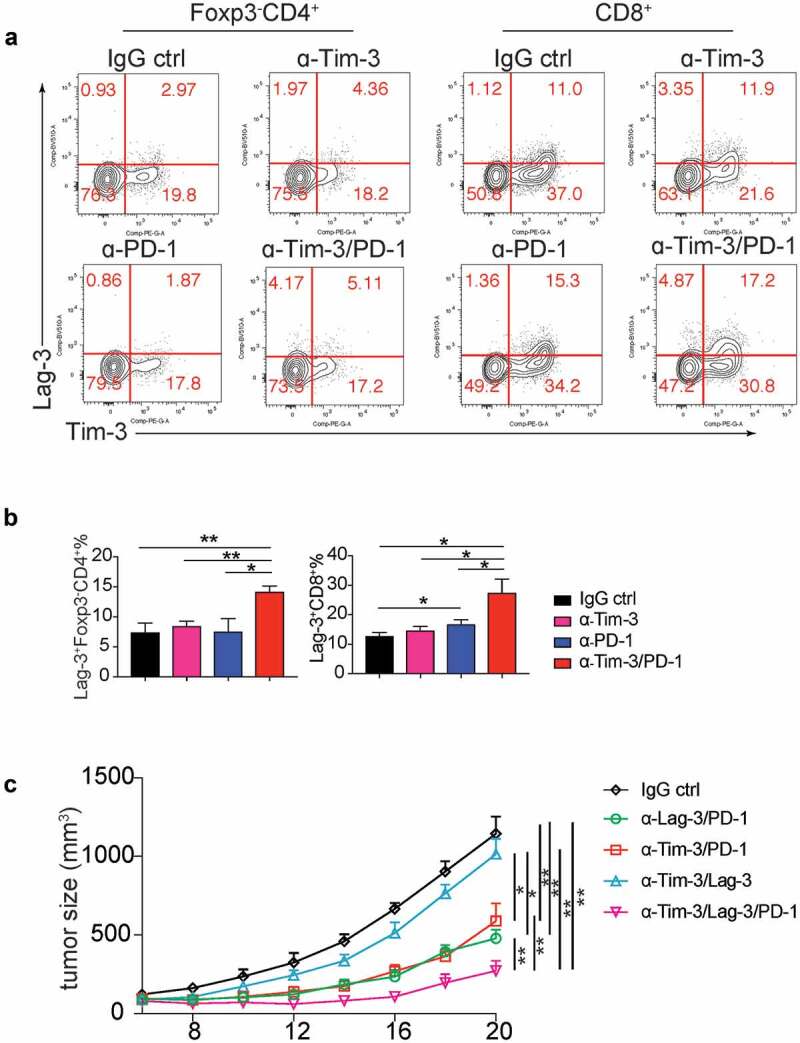
The immune checkpoint blockade (ICB) immunotherapy has prolonged overall survival for cancer patients but the response rates are low. The resistance to ICB is likely due to compensatory upregulation of additional immune inhibitory molecules. In this study, we first systematically examined Tim-3 expression in immune cells in mouse tumors and found that Tim-3 was specifically up-regulated in a large number of Treg, conventional CD4, CD8 T cells, dendritic cell 1 (DC1), and macrophage 1 (M1) in the tumor microenvironment (TME). Interestingly, Tim-3 T cells in the TME were phenotypically effector but not "exhausted" T cells because Tim-3 PD-1 CD8 T cells had a higher number of mitochondria, greater levels of glycolysis, and higher tumor-specific cytolytic activities compared to Tim-3 PD-1 CD8 T cells. The combination treatment with Tim-3 and PD-1 mAbs resulted in a synergistic antitumor activity but also increased the expression of Lag-3 and GITR in TIL, demonstrating cross-regulation between multiple checkpoint molecules. Furthermore, we found that the antitumor efficacy with triple combination of Tim-3, PD-1, and Lag3 mAbs was much greater than any two antibodies. Mechanistically, we demonstrated that simultaneous targeting of Tim-3, PD-1, and Lag-3 cooperatively increased the levels of granzyme B and tumor-specific cytolytic activities of CD8 TIL. Our data indicate that multiple checkpoint molecules are coordinately upregulated to inhibit the function of hyperactivated T cells in the TME and requirement for the simultaneous blockade of PD-1, Tim-3 and Lag3 for cancer treatment.
免疫检查点阻断(ICB)免疫疗法延长了癌症患者的总生存期,但有效率较低。对ICB的耐药性可能是由于其他免疫抑制分子的代偿性上调。在本研究中,我们首先系统地检测了小鼠肿瘤免疫细胞中Tim-3的表达,发现Tim-3在肿瘤微环境(TME)中的大量调节性T细胞(Treg)、传统CD4、CD8 T细胞、1型树突状细胞(DC1)和M1巨噬细胞中特异性上调。有趣的是,TME中的Tim-3 T细胞在表型上是效应性T细胞而非“耗竭”T细胞,因为与Tim-3⁻PD-1⁻ CD8 T细胞相比,Tim-3⁻PD-1⁺ CD8 T细胞具有更多的线粒体、更高的糖酵解水平和更高的肿瘤特异性细胞溶解活性。Tim-3和PD-1单克隆抗体联合治疗产生了协同抗肿瘤活性,但也增加了肿瘤浸润淋巴细胞(TIL)中Lag-3和糖皮质激素诱导肿瘤坏死因子受体(GITR)的表达,证明了多个检查点分子之间的交叉调节。此外,我们发现Tim-3、PD-1和Lag-3单克隆抗体三联组合的抗肿瘤疗效远大于任意两种抗体。从机制上讲,我们证明同时靶向Tim-3、PD-1和Lag-3可协同增加颗粒酶B水平和CD8 TIL的肿瘤特异性细胞溶解活性。我们的数据表明,多个检查点分子被协同上调以抑制TME中过度活化T细胞的功能,并且癌症治疗需要同时阻断PD-1、Tim-3和Lag-3。