Clinical Medical College, Southwest Medical University, Luzhou, China.
Department of Oncology, The Affiliated Hospital of Southwest Medical University, Luzhou, China.
Front Immunol. 2024 Feb 13;15:1362709. doi: 10.3389/fimmu.2024.1362709. eCollection 2024.
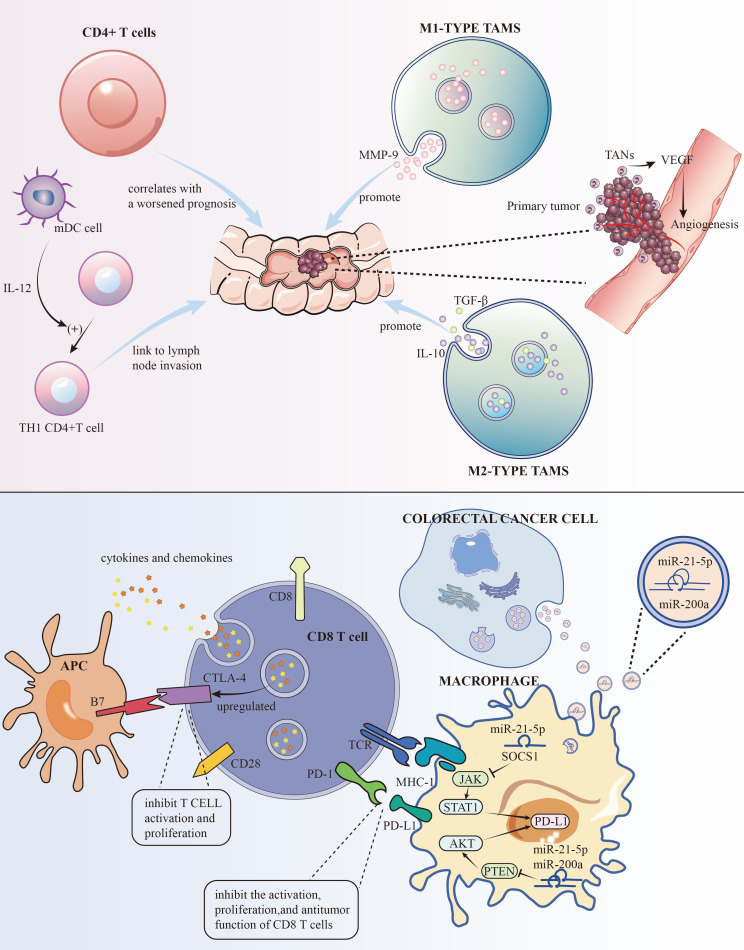
Colorectal cancer (CRC), known for its high metastatic potential, remains a leading cause of cancer-related death. This review emphasizes the critical role of immune responses in CRC metastasis, focusing on the interaction between immune cells and tumor microenvironment. We explore how immune cells, through cytokines, chemokines, and growth factors, contribute to the CRC metastasis cascade, underlining the tumor microenvironment's role in shaping immune responses. The review addresses CRC's immune evasion tactics, especially the upregulation of checkpoint inhibitors like PD-1 and CTLA-4, highlighting their potential as therapeutic targets. We also examine advanced immunotherapies, including checkpoint inhibitors and immune cell transplantation, to modify immune responses and enhance treatment outcomes in CRC metastasis. Overall, our analysis offers insights into the interplay between immune molecules and the tumor environment, crucial for developing new treatments to control CRC metastasis and improve patient prognosis, with a specific focus on overcoming immune evasion, a key aspect of this special issue.
结直肠癌(CRC)以其高转移潜能而闻名,仍然是癌症相关死亡的主要原因。本综述强调了免疫反应在 CRC 转移中的关键作用,重点关注免疫细胞与肿瘤微环境的相互作用。我们探讨了免疫细胞如何通过细胞因子、趋化因子和生长因子促进 CRC 转移级联反应,强调了肿瘤微环境在塑造免疫反应中的作用。该综述还探讨了结直肠癌的免疫逃逸策略,特别是程序性死亡受体 1(PD-1)和细胞毒性 T 淋巴细胞相关蛋白 4(CTLA-4)等检查点抑制剂的上调,突出了它们作为治疗靶点的潜力。我们还研究了先进的免疫疗法,包括检查点抑制剂和免疫细胞移植,以改变免疫反应并提高 CRC 转移的治疗效果。总的来说,我们的分析提供了对免疫分子与肿瘤环境相互作用的深入了解,这对于开发新的治疗方法来控制 CRC 转移和改善患者预后至关重要,特别是侧重于克服免疫逃逸,这是本期特刊的一个关键方面。