Kim Kyung Hwan, Hur Joon Young, Cho Jinhyun, Ku Bo Mi, Koh Jiae, Koh June Young, Sun Jong-Mu, Lee Se-Hoon, Ahn Jin Seok, Park Keunchil, Ahn Myung-Ju, Shin Eui-Cheol
Graduate School of Medical Science and Engineering, Korea Advanced Institute of Science and Technology, Daejeon, Republic of Korea.
Division of Hematology-Oncology, Department of Medicine, Samsung Medical Center, Sungkyunkwan University School of Medicine, Seoul, Republic of Korea.
Oncoimmunology. 2020 Feb 2;9(1):1722023. doi: 10.1080/2162402X.2020.1722023. eCollection 2020.
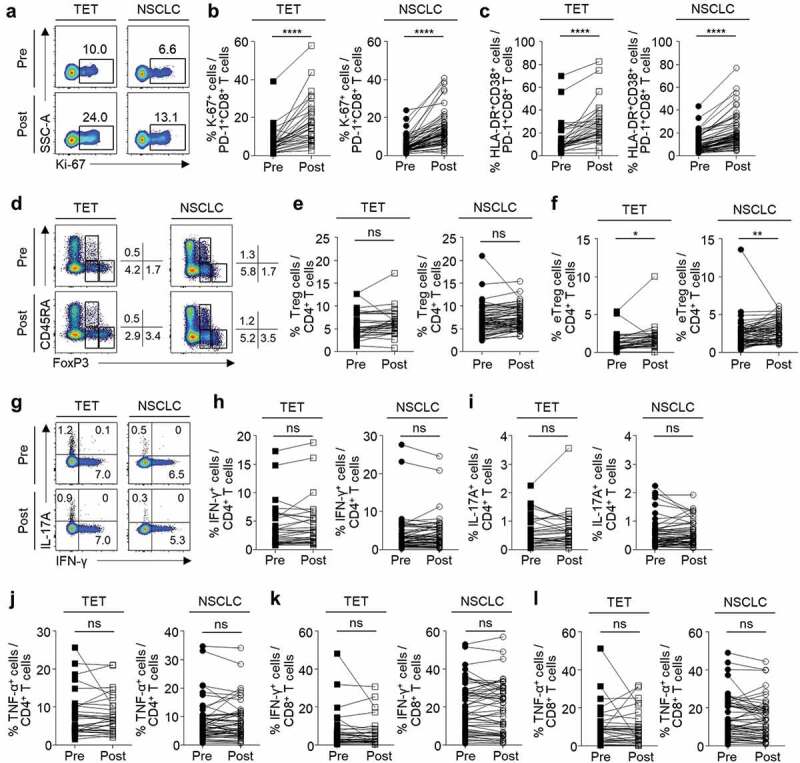
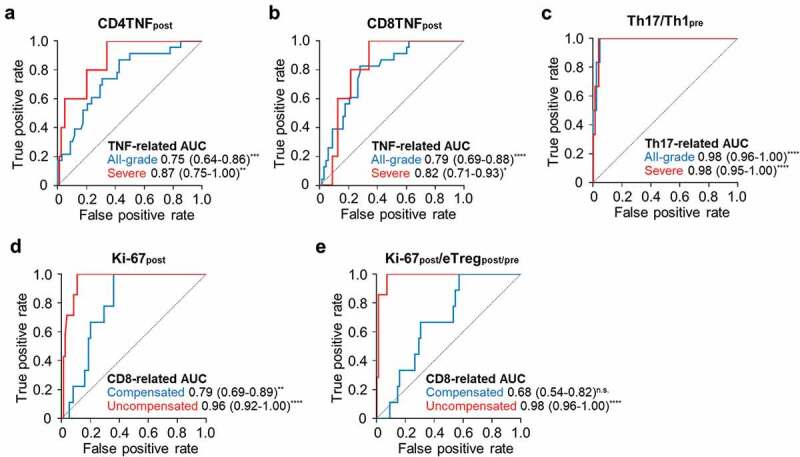
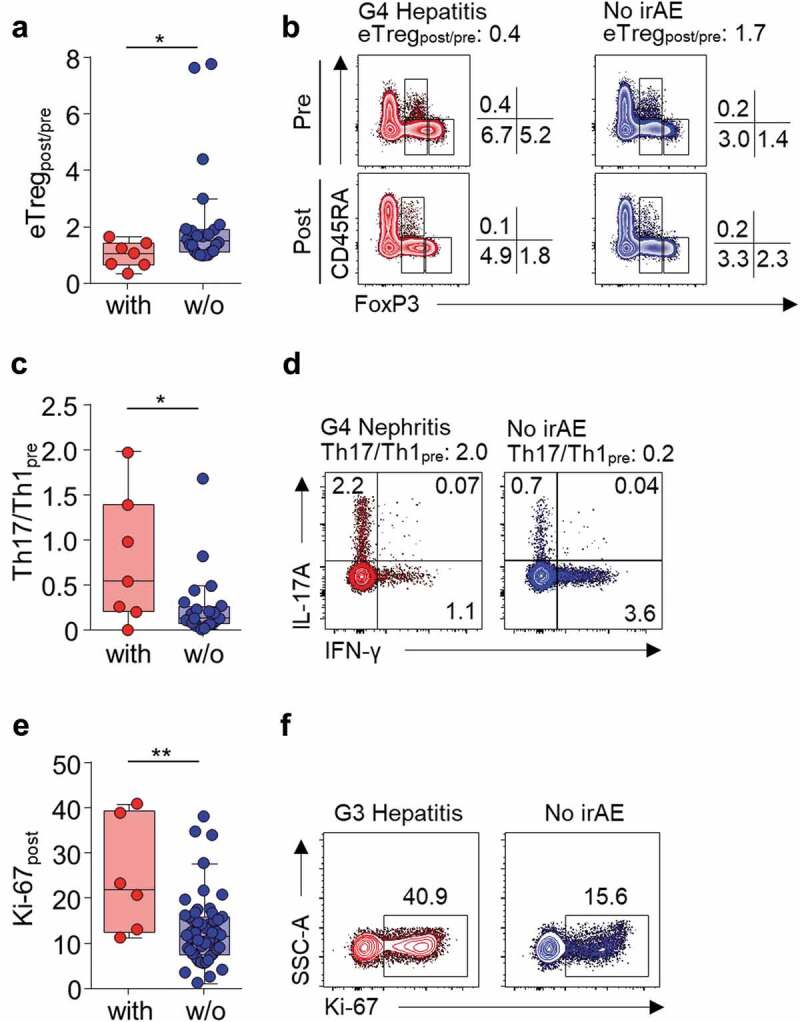
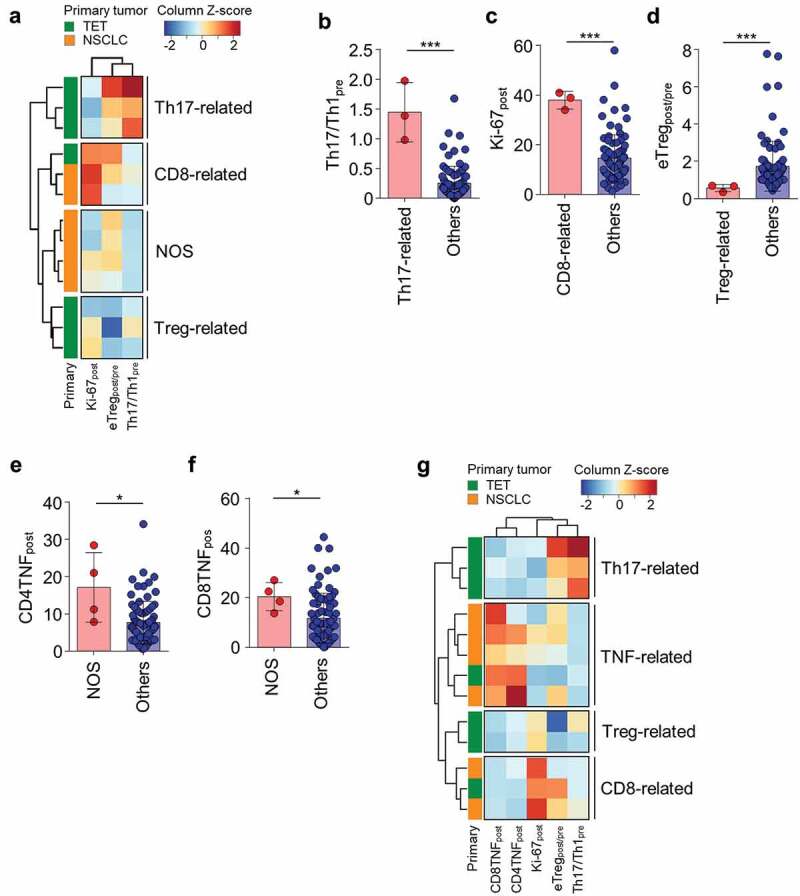
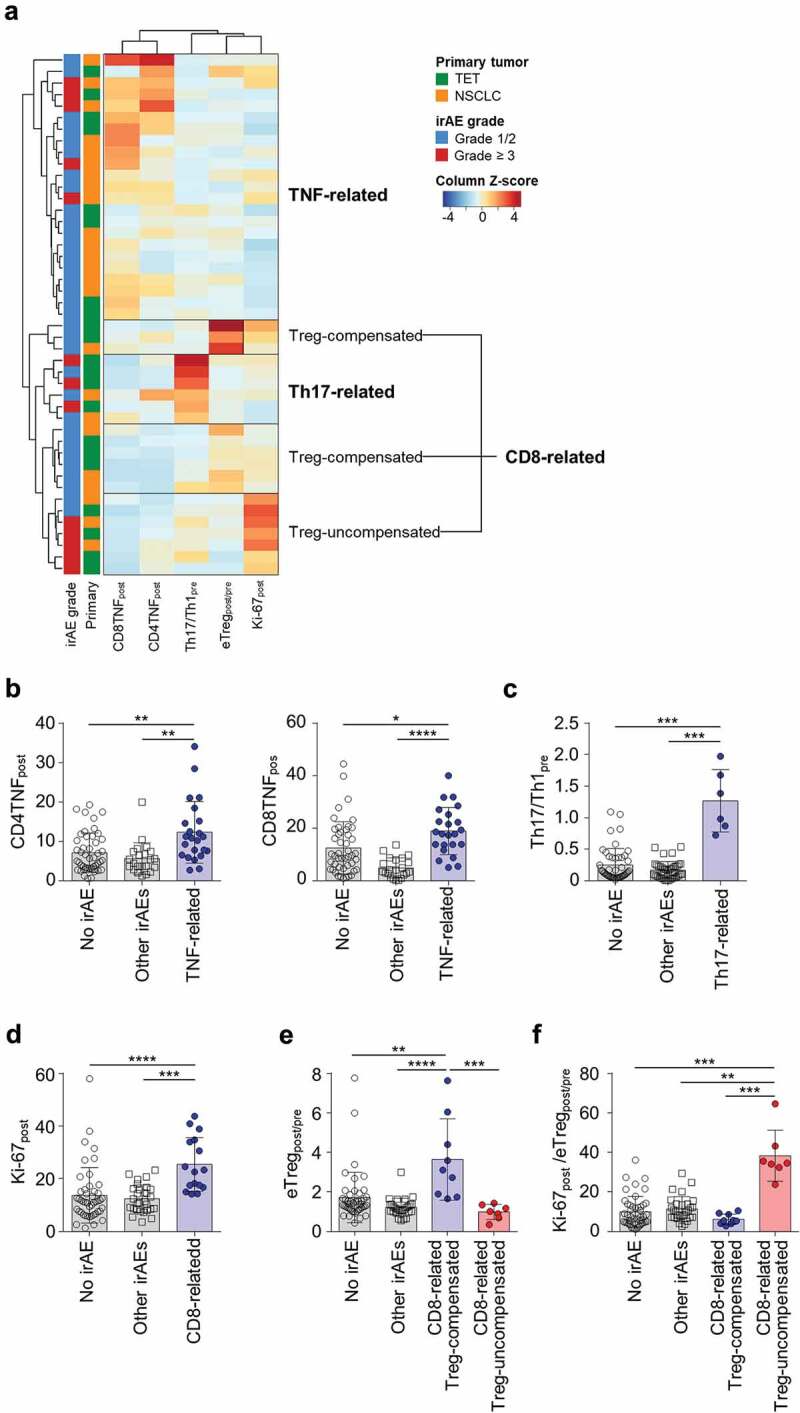
Although anti-programmed death-1 (PD-1) treatment has shown remarkable anti-tumor efficacy, immune-related adverse events (irAEs) develop with heterogeneous clinical manifestations. However, the immunological understanding of irAEs is currently limited. In the present study, we analyzed peripheral blood T cells obtained from cancer patients who received anti-PD-1 treatment to determine the immunological characteristics of irAEs. This study included 31 patients with refractory thymic epithelial tumor (TET) who were enrolled in a phase II trial of pembrolizumab (NCT02607631) and 60 patients with metastatic non-small cell lung cancer (NSCLC) who received pembrolizumab or nivolumab. T-cell profiling was performed by multicolor flow cytometry using peripheral blood obtained before treatment and 7 days after the first dose of anti-PD-1 antibodies. irAEs developed in 21 TET patients and 24 NSCLC patients. Severe (≥ grade 3) irAEs occurred in 7 TET patients (22.6%) and 6 NSCLC patients (10.0%). Patients with severe irAEs exhibited a significantly lower fold increase in the frequency of effector regulatory T (eTreg) cells after anti-PD-1 treatment, a higher ratio of T helper-17 (Th17) and T helper-1 cells at baseline, and a higher percentage of Ki-67 cells among PD-1CD8 T cells posttreatment. In clustering analysis using the T-cell parameters, patients with irAEs were grouped into four distinct subtypes: Th17-related, TNF-related, CD8-related Treg-compensated, and CD8-related Treg-uncompensated. The T-cell parameters showed a predictive value for the development of each subtype of severe irAEs. In conclusion, severe irAEs after anti-PD-1 treatment were clustered into four immunological subtypes, and potential biomarkers for early prediction of severe irAEs were proposed.
尽管抗程序性死亡蛋白1(PD-1)治疗已显示出显著的抗肿瘤疗效,但免疫相关不良事件(irAEs)的临床表现具有异质性。然而,目前对irAEs的免疫学认识有限。在本研究中,我们分析了接受抗PD-1治疗的癌症患者的外周血T细胞,以确定irAEs的免疫学特征。本研究纳入了31例难治性胸腺上皮肿瘤(TET)患者,这些患者参加了帕博利珠单抗的II期试验(NCT02607631),以及60例接受帕博利珠单抗或纳武利尤单抗治疗的转移性非小细胞肺癌(NSCLC)患者。使用治疗前和首次剂量抗PD-1抗体后7天获得的外周血,通过多色流式细胞术进行T细胞分析。21例TET患者和24例NSCLC患者发生了irAEs。7例TET患者(22.6%)和6例NSCLC患者(10.0%)出现了严重(≥3级)irAEs。发生严重irAEs的患者在抗PD-1治疗后效应调节性T(eTreg)细胞频率的增加倍数显著较低,基线时辅助性T细胞17(Th17)和辅助性T细胞1的比例较高,治疗后PD-1 CD8 T细胞中Ki-67细胞的百分比也较高。在使用T细胞参数的聚类分析中,发生irAEs的患者被分为四个不同的亚型:Th17相关型、TNF相关型、CD8相关Treg代偿型和CD8相关Treg失代偿型。T细胞参数对每种严重irAEs亚型的发生具有预测价值。总之,抗PD-1治疗后的严重irAEs被聚类为四种免疫亚型,并提出了早期预测严重irAEs的潜在生物标志物。