Department of Pathogen Diagnosis and Biosafety, Shanghai Public Health Clinical Center, Fudan University, Shanghai, People's Republic of China.
Key Laboratory of Medical Molecular Virology (MOE/NHC/CAMS), School of Basic Medicine, Shanghai Medical College, Fudan University, Shanghai, People's Republic of China.
Emerg Microbes Infect. 2020 Feb 21;9(1):427-438. doi: 10.1080/22221751.2020.1729665. eCollection 2020.
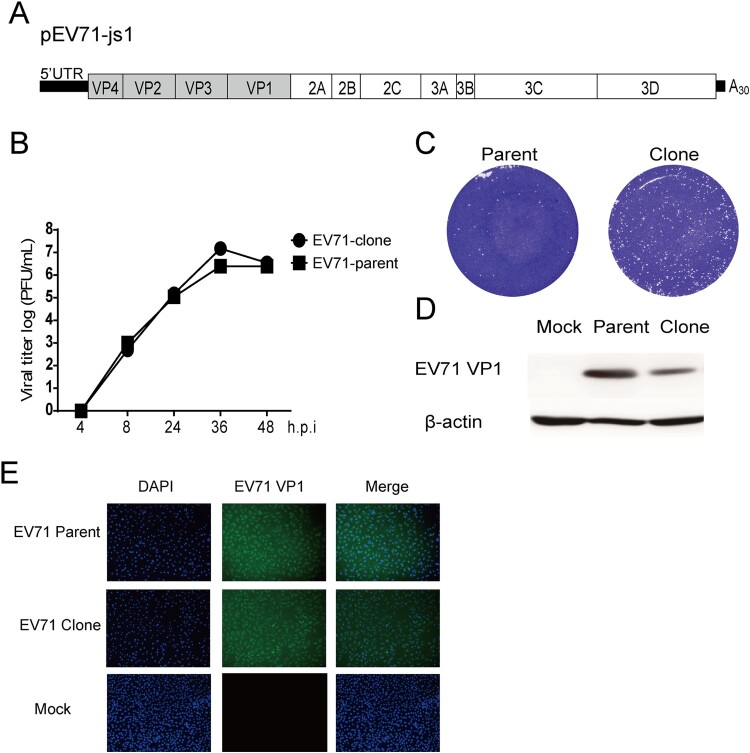
Enterovirus 71 (EV71) is a major pathogen that causes hand, foot and mouth disease (HFMD), which is a life threatening disease in certain children. The pathogenesis of EV71-caused HFMD is poorly defined due to the lack of simple and robust animal models with severe phenotypes that recapitulate symptoms observed in humans. Here, we generated the infectious clone of a clinical isolate from a severe HFMD patient. Virus rescued from the cDNA clone was infectious in cell lines. When administrated intraperitoneally to neonatal ICR, BALB/c and C57 immune competent mice at a dosage of1.4 × 10 pfu per mouse, the virus caused weight loss, paralysis and death in the infected mice after 4-5 days of infection. In the infected mice, detectable viral replication was detected in various tissues such as heart, liver, brain, lung, kidney, small intestine, leg skeletal muscle and medulla oblongata. The histology of the infected mice included massive myolysis, glomerular atrophy, villous blunting in small intestine, widened alveolar septum, diminished alveolar spaces and lymphocytes infiltration into the lung. By using the UV-inactivated virus as a control, we elucidated that the virus first amplified in the leg skeletal muscle tissue and the muscle tissue served as a primary viral replication site. In summary, we generated a stable EV71 infectious clone that is capable of infecting neonatal immune competent mice without adaptive mutations and provide a simple, valuable animal model for the studies of EV71pathogenesis and therapy.
肠道病毒 71 型(EV71)是引起手足口病(HFMD)的主要病原体,在某些儿童中是一种危及生命的疾病。由于缺乏能够重现人类观察到的症状的严重表型的简单而强大的动物模型,因此 EV71 引起的 HFMD 的发病机制尚未明确。在这里,我们生成了来自严重 HFMD 患者的临床分离株的感染性克隆。从 cDNA 克隆中拯救出的病毒在细胞系中具有感染性。当以 1.4×10 pfu/只的剂量腹膜内给予新生 ICR、BALB/c 和 C57 免疫功能正常的小鼠时,病毒在感染后 4-5 天会导致感染小鼠体重减轻、瘫痪和死亡。在感染的小鼠中,可在心脏、肝脏、大脑、肺、肾脏、小肠、腿部骨骼肌和延髓等各种组织中检测到可检测的病毒复制。感染小鼠的组织学包括大量肌溶解、肾小球萎缩、小肠绒毛变钝、肺泡间隔增宽、肺泡空间减少和淋巴细胞浸润到肺中。通过使用紫外线灭活的病毒作为对照,我们阐明了病毒首先在腿部骨骼肌组织中扩增,并且肌肉组织是病毒的主要复制部位。总之,我们生成了一种稳定的 EV71 感染性克隆,它能够在没有适应性突变的情况下感染新生免疫功能正常的小鼠,并为 EV71 发病机制和治疗的研究提供了一种简单、有价值的动物模型。