Department of Orthopedic Surgery, College of Medicine Seoul National University.
Department of Orthopedic Surgery, SMG-SNU Boramae Medical Center.
Clin Spine Surg. 2020 Aug;33(7):E322-E329. doi: 10.1097/BSD.0000000000000950.
This is a prospective, stratified randomized, multicenter, 4-year follow-up study.
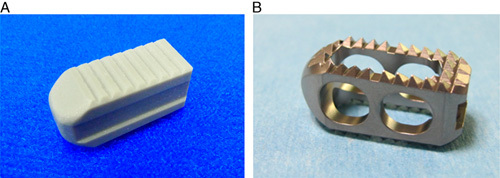
The authors aimed to evaluate the long-term clinical efficacy and safety of CaO-SiO2-P2O5-B2O3 glass ceramics (BGS-7) spacers in 1-level posterior lumbar interbody fusion (PLIF) at a 4-year follow-up.
According to 1-year follow-up results, BGS-7 spacer showed similar fusion rates and clinical outcomes compared with titanium cage. A long-term follow-up study beyond 2 years is necessary to investigate the status of intervertebral bone graft volumes. Moreover, longer follow-up is mandatory to also evaluate the safety and efficacy of BGS-7 spacers, because they remain in the intervertebral space for a long time.
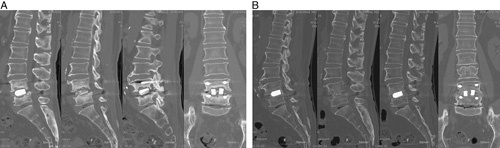
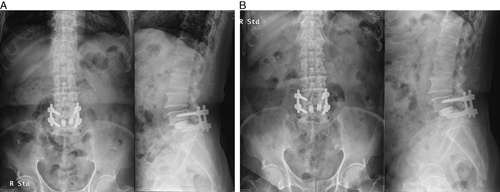
In this prospective, randomized, multicenter, 4-year follow-up study, we evaluated 62 of the 74 patients who underwent 1-level PLIF. During 1-level PLIF, titanium cages filled with autologous local bone were inserted into the control group patients and BGS-7 spacers were inserted to the experimental group patients. Bone fusion was evaluated by plain radiography and thin-section computed tomography. Visual Analog Scale (VAS), the Oswestry Disability Index (ODI), Short Form-36 Health Survey (SF-36), and evaluation of safety were conducted after 48 months.
Computed tomography scan showed a bone fusion rate of 90.6% in the BGS-7 spacer group and 93.3% in the control group, with no significant differences between groups. The BGS-7 spacer group showed a significantly larger area directly fused to the endplate than the control group (P<0.001). The BGS-7 spacer group showed a significant increase in the fused area compared with the titanium group at 1- and 4-year follow-up. The ODI, SF-36, back pain, and lower limb pain in both groups showed significant improvement after surgery, and no significant differences were observed between the groups. Both groups showed no additional adverse events.
The 4-year follow-up study showed similar fusion rates and clinical outcomes in both the BGS-7 spacer and autologous bone with a titanium cage in 1-level PLIF. However, the BGS-7 spacer implants showed a larger area of fusion with the endplates than that of autologous bone with a titanium cage. Therefore, the results demonstrated that the BGS-7 spacer can be considered as a novel intervertebral spacer to achieve successful spinal fusion without safety concerns for long-term use.
这是一项前瞻性、分层随机、多中心、4 年随访研究。
作者旨在评估 CaO-SiO2-P2O5-B2O3 玻璃陶瓷(BGS-7)椎间融合器在 1 级后路腰椎间融合术(PLIF)中的长期临床疗效和安全性。
根据 1 年随访结果,BGS-7 椎间融合器与钛笼相比,融合率和临床结果相似。需要进行超过 2 年的长期随访研究,以调查椎间植骨体积的情况。此外,由于 BGS-7 椎间融合器在椎间空间内留置时间较长,因此需要更长时间的随访来评估其安全性和疗效。
在这项前瞻性、随机、多中心、4 年随访研究中,我们评估了 74 例接受 1 级 PLIF 的患者中的 62 例。在 1 级 PLIF 中,对照组患者的钛笼内填充自体局部骨,实验组患者的钛笼内填充 BGS-7 椎间融合器。通过 X 线平片和薄层 CT 评估骨融合情况。在 48 个月时进行视觉模拟评分(VAS)、Oswestry 功能障碍指数(ODI)、健康调查简表 36 项(SF-36)和安全性评估。
CT 扫描显示 BGS-7 椎间融合器组的骨融合率为 90.6%,对照组为 93.3%,两组间无显著差异。BGS-7 椎间融合器组与对照组相比,直接与终板融合的面积明显更大(P<0.001)。BGS-7 椎间融合器组在 1 年和 4 年随访时与钛笼组相比,融合面积明显增加。两组术后 ODI、SF-36、腰背疼痛和下肢疼痛均明显改善,两组间无显著差异。两组均未出现其他不良事件。
4 年随访研究显示,在 1 级 PLIF 中,BGS-7 椎间融合器与自体骨加钛笼的融合率和临床结果相似。然而,BGS-7 椎间融合器植入物与钛笼加自体骨相比,与终板的融合面积更大。因此,结果表明,BGS-7 椎间融合器可以作为一种新型椎间融合器,在不影响安全性的情况下,长期使用可实现成功的脊柱融合。