Computational Biomedicine Section, Institute of Advanced Simulation IAS-5 and Institute of Neuroscience and Medicine INM-9, Forschungszentrum Jülich GmbH, 52425, Jülich, Germany.
Institute for Neuroscience and Medicine INM-11, Forschungszentrum Jülich, 52428, Jülich, Germany.
Sci Rep. 2020 Feb 20;10(1):3037. doi: 10.1038/s41598-020-59289-5.
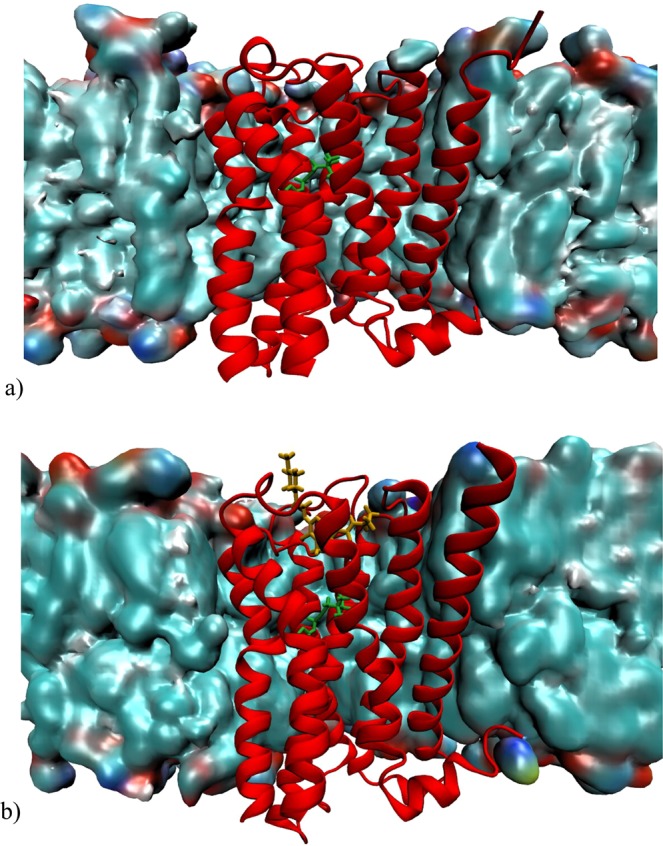
Allosteric modulation is involved in a plethora of diverse protein functions, which are fundamental for cells' life. This phenomenon can be thought as communication between two topographically distinct site of a protein structure. How this communication occurs is still matter of debate. Many different descriptions have been presented so far. Here we consider a specific case where any significant conformational change is involved upon allosteric modulator binding and the phenomenon is depicted as a vibrational energy diffusion process between distant protein regions. We applied this model, by employing computational tools, to the human muscarinic receptor M2, a transmembrane protein G-protein coupled receptor known to undergo allosteric modulation whose recently X-ray structure has been recently resolved both with and without the presence of a particular allosteric modulator. Our calculations, performed on these two receptor structures, suggest that for this case the allosteric modulator modifies the energy current between functionally relevant regions of the protein; this allows to identify the main residues responsible for this modulation. These results contribute to shed light on the molecular basis of allosteric modulation and may help design new allosteric ligands.
变构调节涉及大量不同的蛋白质功能,这些功能对细胞的生命至关重要。这种现象可以被认为是蛋白质结构两个不同拓扑位置之间的通讯。这种通讯是如何发生的仍然存在争议。到目前为止,已经提出了许多不同的描述。在这里,我们考虑一个特定的情况,即变构调节剂结合时涉及到任何显著的构象变化,并且该现象被描绘为蛋白质区域之间的振动能量扩散过程。我们通过使用计算工具将该模型应用于人类毒蕈碱受体 M2,毒蕈碱受体 M2 是一种跨膜蛋白 G 蛋白偶联受体,已知其经历变构调节,其最近的 X 射线结构已经分别在存在和不存在特定变构调节剂的情况下得到解决。我们对这两种受体结构进行的计算表明,对于这种情况,变构调节剂改变了蛋白质中功能相关区域之间的能量流;这允许鉴定负责这种调节的主要残基。这些结果有助于阐明变构调节的分子基础,并可能有助于设计新的变构配体。