Legenbauer Tanja, Radix Anne Kathrin, Naumann Eva, Blechert Jens
LWL University Hospital Hamm for Child and Adolescent Psychiatry, Ruhr-University Bochum, Hamm, Germany.
Department of Clinical Psychology and Psychotherapy, Eberhard Karls University of Tübingen, Tübingen, Germany.
Front Psychol. 2020 Jan 31;11:30. doi: 10.3389/fpsyg.2020.00030. eCollection 2020.
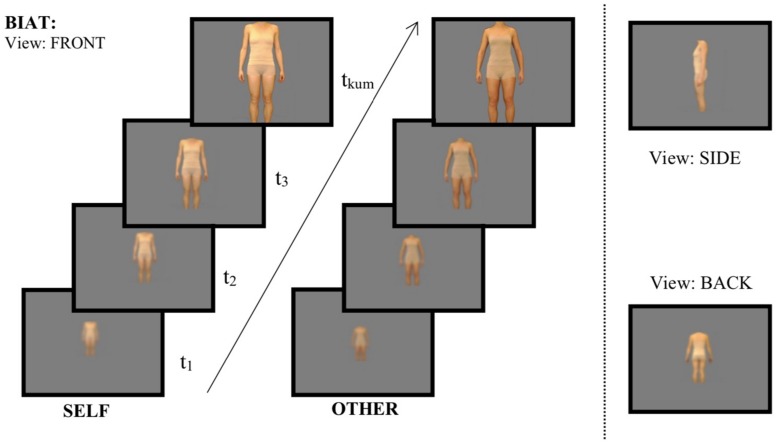
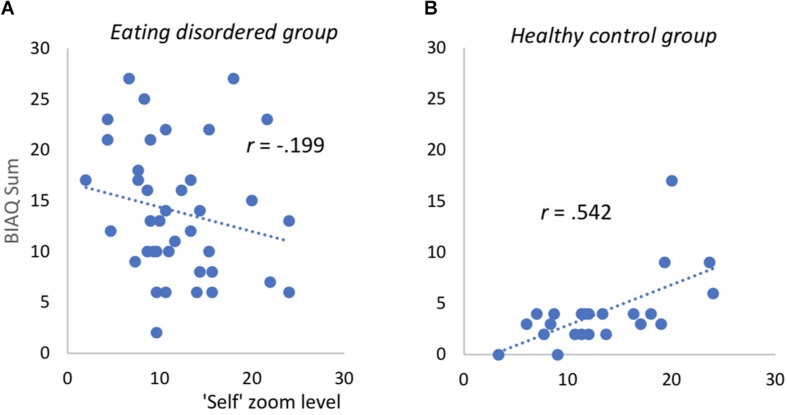
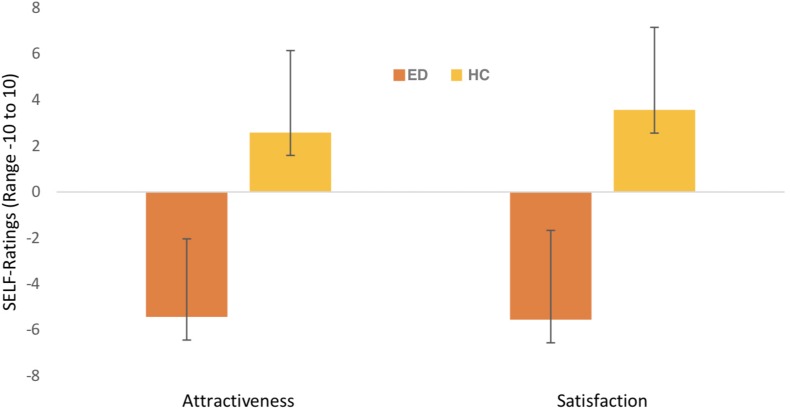
A disturbed body image with fluctuating behavioral patterns of body related avoidance (BA) and body checking (BC) characterizes individuals with eating disorders (EDs) such as anorexia (AN) or bulimia nervosa (BN). So far, these behavioral body image components are mostly assessed via self-report instruments thereby neglecting their behavioral and partially automatic characteristics. Therefore, behavioral measures of BA and BC are needed. The present study investigates a behavioral assessment task for BA and BC in a sample of patients with diagnosed EDs and healthy controls. The sample consisted of 40 women diagnosed with either BN ( = 19) or AN ( = 21; ED sample) and 24 non-eating disordered, healthy female controls (HC). Within the Body Image Approach Task (BIAT) participants viewed photos of their own body (self-image) and a matched control body (other-image) by zooming the photos closer toward them (image became more focused) on the screen. The BIAT yields zoom-levels recorded separately for self- relative to other-images. Further measures were attractiveness ratings of these body images as well as questionnaire measures of BA, BC, and general ED symptomatology. Results showed that despite strong body dissatisfaction and clearly negative ratings of self- relative to other-images in both EDs, no group differences were found in approach to self-images on zoom-level as measured with the BIAT. Correlational analysis in each group indicated that zoom-level was positively related to BA scores in the HC group only. Yet, stepwise regression analyses revealed that attractiveness ratings explained most of the variance accounted by BA in predicting zoom-level. In sum, the BIAT seems suitable to assess BA and self-rated body attractiveness, but only in healthy individuals with subclinical levels on these constructs. It does not seem to capture the body image satisfaction or the behavioral components of body image disturbances in AN or BN or it conflates the opposed influences of BA and BC. Further experimentation is needed to adapt measures of behavioral body image components to the processes evoked in patients with ED during confrontation with body images.
身体意象紊乱,伴有与身体相关的回避行为(BA)和身体检查行为(BC)的波动模式,是神经性厌食症(AN)或神经性贪食症(BN)等饮食失调(ED)患者的特征。到目前为止,这些行为性身体意象成分大多通过自我报告工具进行评估,从而忽略了它们的行为特征以及部分自动性特征。因此,需要对BA和BC进行行为测量。本研究在已确诊患有ED的患者样本和健康对照中,调查了一项针对BA和BC的行为评估任务。样本包括40名被诊断为BN(n = 19)或AN(n = 21;ED样本)的女性,以及24名无饮食失调的健康女性对照(HC)。在身体意象趋近任务(BIAT)中,参与者通过在屏幕上放大照片(图像变得更清晰)来观看自己身体的照片(自我意象)和匹配的对照身体照片(他人意象)。BIAT会分别记录自我意象与他人意象的放大级别。进一步的测量包括这些身体意象的吸引力评分,以及BA、BC和一般ED症状的问卷调查测量。结果显示,尽管两种ED患者都存在强烈的身体不满,且自我意象相对于他人意象的评分明显为负,但用BIAT测量的在放大级别上趋近自我意象方面未发现组间差异。每组的相关分析表明,仅在HC组中放大级别与BA分数呈正相关。然而,逐步回归分析显示,吸引力评分在预测放大级别时解释了BA所解释的大部分方差。总之,BIAT似乎适合评估BA和自我评定的身体吸引力,但仅适用于在这些构念上处于亚临床水平的健康个体。它似乎无法捕捉AN或BN患者的身体意象满意度或身体意象紊乱的行为成分,或者它混淆了BA和BC的相反影响。需要进一步的实验,以使行为性身体意象成分的测量适应ED患者在面对身体意象时所引发的过程。