Department of Pulmonary Medicine, Fudan University Zhongshan Hospital, Shanghai, China.
Shanghai Institute of Nutrition and Health, Chinese Academy of Sciences, Shanghai, China.
Front Immunol. 2020 Jan 30;11:11. doi: 10.3389/fimmu.2020.00011. eCollection 2020.
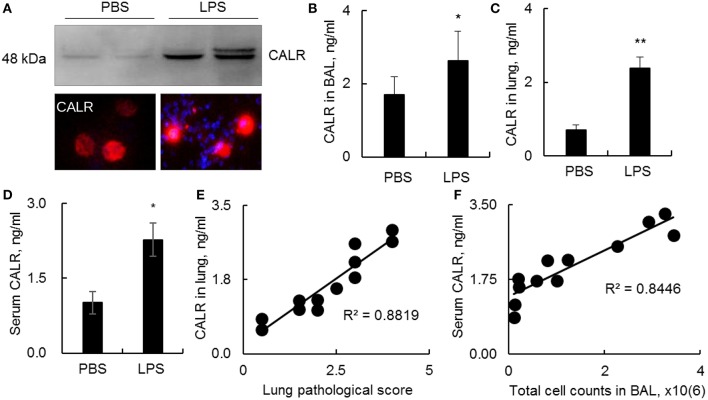
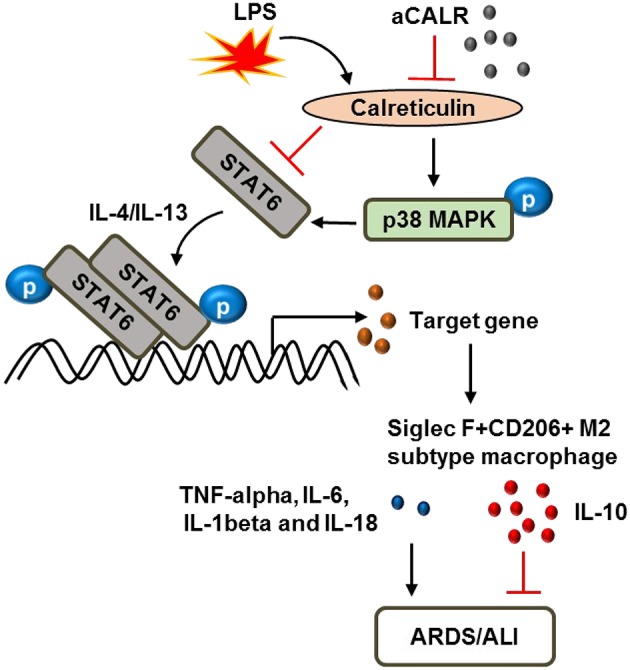
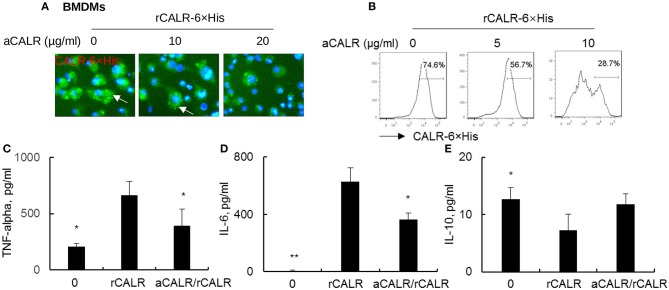
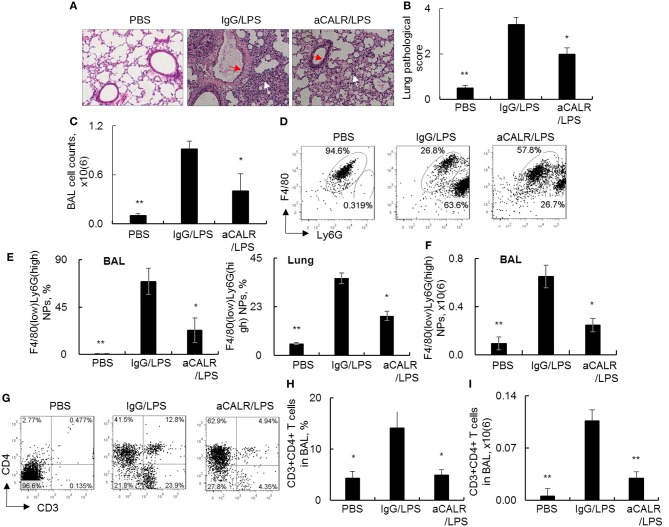
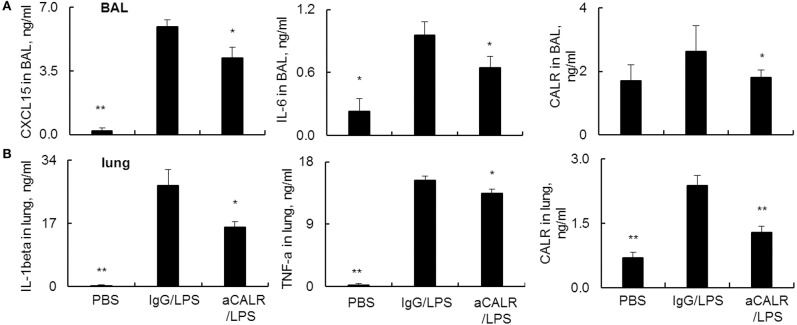
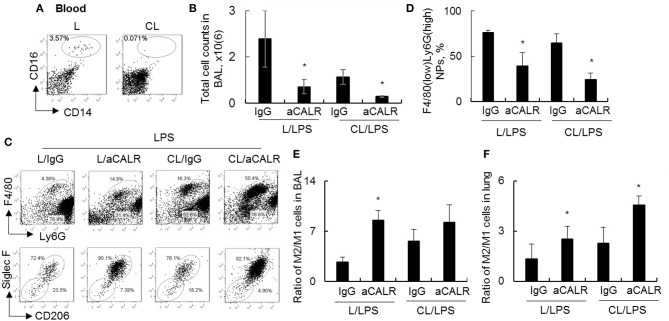
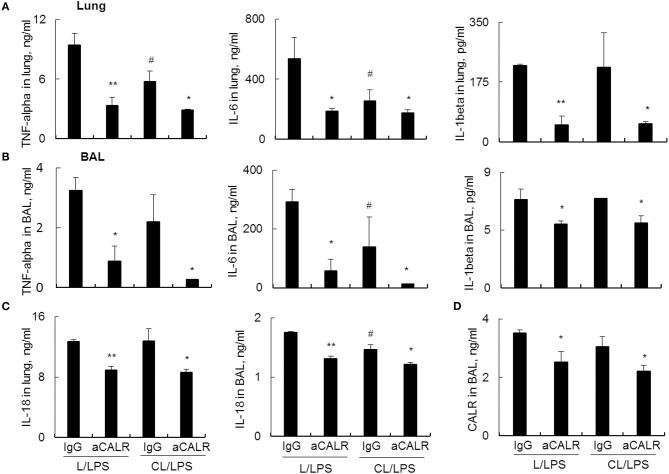
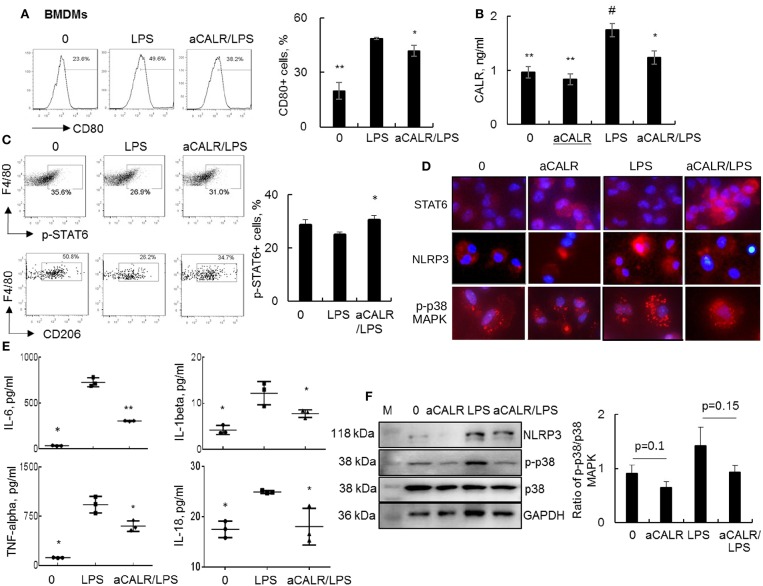
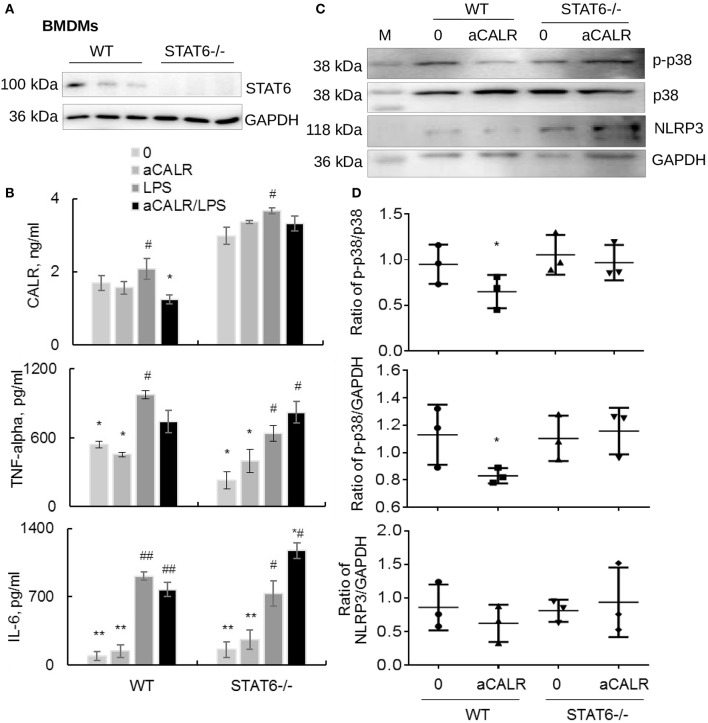
Calreticulin (CALR) has anti-tumor effects by increasing dendritic cell maturation and tumor antigen presentation. However, whether CALR affects macrophages and modulates progression of acute respiratory distress syndrome/acute lung injury (ARDS/ALI) remains unknown. In this study, we discovered that CALR protein was highly expressed in the mice with LPS-induced ALI and CALR expression level was positively correlated to the severity of ALI. Commercial anti-CALR antibody (aCALR) can neutralize recombinant CALR (rCALR) and suppress the expression of TNF-alpha and IL-6 in the rCALR-treated macrophages. Blocking CALR activity by intraperitoneal (i.p.) administration of aCALR significantly suppressed ALI, accompanied with lower total cell counts, neutrophil and T cell infiltration in bronchoalveolar lavage (BAL) and lung tissues. The expression of CXCL15, IL-6, IL-1beta, TNF-alpha, and CALR were significantly reduced, in association with more polarization of Siglec F+CD206+M2 subtype macrophages in the aCALR-treated mice. Pre-depletion of circulating monocytes did not abolish the aCALR-mediated suppression of ALI. Further analysis in bone marrow-derived macrophages (BMDMs) showed that aCALR suppressed the expression of CD80, IL-6, IL-1beta, IL-18, NLRP3, and p-p38 MAPK; but enhanced the expression of CD206 and IL-10. In addition, we observed more expression and phosphorylation of STAT6 in the aCALR-treated BMDM. Lack of STAT6 resulted in comparable and slightly higher expression of CALR, TNF-alpha and IL-6 in the aCALR-treated STAT6-/- BMDMs than the untreated cells. Therefore, we conclude that CALR is a novel biomarker in the evaluation of ALI. Blocking CALR activity by aCALR effectively suppressed ALI independent of circulating monocytes. Siglec F+CD206+M2 subtype macrophages and p38 MAPK/STAT6 signaling pathway played important role in the immune regulation of aCALR. Blocking CALR activity is a promising therapeutic approach in the treatment of ARDS/ALI.
钙网织蛋白(CALR)通过增加树突状细胞成熟和肿瘤抗原呈递而具有抗肿瘤作用。然而,CALR 是否影响巨噬细胞并调节急性呼吸窘迫综合征/急性肺损伤(ARDS/ALI)的进展尚不清楚。在这项研究中,我们发现 LPS 诱导的 ALI 小鼠中 CALR 蛋白表达水平较高,CALR 表达水平与 ALI 的严重程度呈正相关。商业抗-CALR 抗体(aCALR)可以中和重组 CALR(rCALR),并抑制 rCALR 处理的巨噬细胞中 TNF-α和 IL-6 的表达。通过腹腔内(i.p.)给予 aCALR 阻断 CALR 活性可显著抑制 ALI,同时伴有支气管肺泡灌洗液(BAL)和肺组织中总细胞计数、中性粒细胞和 T 细胞浸润减少。aCALR 处理的小鼠中 CXCL15、IL-6、IL-1β、TNF-α和 CALR 的表达显著降低,Siglec F+CD206+M2 亚型巨噬细胞的极化程度更高。循环单核细胞的预先耗竭并不能消除 aCALR 介导的对 ALI 的抑制作用。在骨髓来源的巨噬细胞(BMDM)中的进一步分析表明,aCALR 抑制了 CD80、IL-6、IL-1β、IL-18、NLRP3 和 p-p38 MAPK 的表达;但增强了 CD206 和 IL-10 的表达。此外,我们观察到 aCALR 处理的 BMDM 中 STAT6 的表达和磷酸化增加。缺乏 STAT6 导致 aCALR 处理的 STAT6-/-BMDM 中 CALR、TNF-α和 IL-6 的表达与未经处理的细胞相当且略高。因此,我们得出结论,CALR 是评估 ALI 的新型生物标志物。通过 aCALR 阻断 CALR 活性可有效抑制不依赖于循环单核细胞的 ALI。Siglec F+CD206+M2 亚型巨噬细胞和 p38 MAPK/STAT6 信号通路在 aCALR 的免疫调节中发挥重要作用。阻断 CALR 活性是治疗 ARDS/ALI 的一种有前途的治疗方法。