Department of Anesthesiology and Operative Intensive Care Medicine, Charité Campus Mitte and Campus Virchow Klinikum, Charité-Universitaetsmedizin Berlin, Corporate Member of Freie Universität Berlin, Humboldt-Universität zu Berlin, and Berlin Institute of Health, Berlin, Germany.
Department of Nephrology and Medical Intensive Care, Charité-Universitaetsmedizin Berlin, Corporate Member of Freie Universität Berlin, Humboldt-Universität zu Berlin, and Berlin Institute of Health, Berlin, Germany.
PLoS One. 2020 Feb 21;15(2):e0229325. doi: 10.1371/journal.pone.0229325. eCollection 2020.
Postoperative anaemia is a frequent surgical complication and in contrast to preoperative anaemia has not been validated in relation to mortality, morbidity and its associated health economic effect. Postoperative anaemia can predispose postoperative delirium through impairment of cerebral oxygenation. The aim of this secondary analysis is to investigate the association of postoperative anaemia in accordance with the sex specific World Health Organization definition of anaemia to postoperative delirium and its impact on the duration of hospital stay.
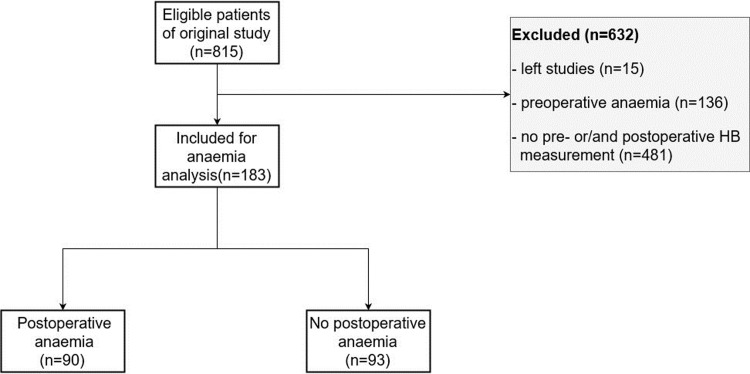
A secondary analysis of the prospective multicentric observational CESARO-study was conducted. 800 adult patients undergoing elective surgery were enrolled from various operative disciplines across seven hospitals ranging from university hospitals, district general hospitals to specialist clinics of minimally invasive surgery in Germany. Patients were classified as anaemic according to the World Health Organization parameters, setting the haemoglobin level cut off below 12g/dl for females and below 13g/dl for males. Focus of the investigation were patients with acute anaemia. Patients with present preoperative anaemia or missing haemoglobin measurement were excluded from the sample set. Delirium screening was established postoperatively for at least 24 hours and up to three days, applying the validated Nursing Delirium Screening Scale.
The initial sample set contained 800 patients of which 183 were suitable for analysis in the study. Ninety out of 183 (49.2%) suffered from postoperative anaemia. Ten out of 93 (10.9%) patients without postoperative anaemia developed a postoperative delirium. In the group with postoperative anaemia, 28 (38.4%) out of 90 patients suffered from postoperative delirium (odds ratio 3.949, 95% confidence interval, (1.358-11.480)) after adjustment for NYHA-stadium, severity of surgery, cutting/suture time, duration of anaesthesia, transfusion of packed red cells and sedation status with Richmond Agitation Scale after surgery. Additionally, patients who suffered from postoperative anaemia showed a significantly longer duration of hospitalisation (7.75 vs. 12.42 days, odds ratio = 1.186, 95% confidence interval, 1.083-1.299, after adjustments).
The study results reveal that postoperative anaemia is not only a frequent postsurgical complication with an incidence probability of almost 50%, but could also be associated with a postoperative delirium and a prolonged hospitalisation.
术后贫血是一种常见的手术并发症,与术前贫血不同,它与死亡率、发病率及其相关的健康经济影响尚未得到验证。术后贫血可通过损害脑氧合作用导致术后谵妄。本二次分析的目的是根据世界卫生组织(WHO)关于贫血的性别特异性定义,调查术后贫血与术后谵妄的关系及其对住院时间的影响。
对前瞻性多中心 CESARO 研究进行二次分析。该研究纳入了来自德国 7 家医院的不同手术科室的 800 名成年择期手术患者,这些医院包括大学医院、地区综合医院和微创外科专科诊所。根据世界卫生组织的参数,将患者分为贫血,女性血红蛋白水平设定为 12g/dl 以下,男性为 13g/dl 以下。研究的重点是急性贫血患者。从样本集中排除了有术前贫血或血红蛋白测量值缺失的患者。术后至少 24 小时至 3 天内进行了谵妄筛查,采用了经过验证的护理谵妄筛查量表。
最初的样本集包含 800 名患者,其中 183 名适合研究分析。183 名患者中有 183 名(49.2%)患有术后贫血。93 名无术后贫血的患者中有 10 名(10.9%)发生术后谵妄。在术后贫血组中,90 名患者中有 28 名(38.4%)发生术后谵妄(比值比 3.949,95%置信区间为 1.358-11.480),调整纽约心脏协会(NYHA)分期、手术严重程度、切割/缝合时间、麻醉持续时间、输注浓缩红细胞和术后 Richmond 激动量表镇静状态后。此外,患有术后贫血的患者住院时间明显延长(7.75 天比 12.42 天,比值比=1.186,95%置信区间为 1.083-1.299,调整后)。
研究结果表明,术后贫血不仅是一种常见的术后并发症,发生率近 50%,而且还可能与术后谵妄和住院时间延长有关。