Departamento de Química, Faculdade de Filosofia, Ciências e Letras de Ribeirão Preto da Universidade de São Paulo (FFCLRP-USP), Ribeirão Preto, São Paulo 14040-900, Brazil.
Nencki Institute of Experimental Biology, 3 Pasteur Street, 02-093 Warsaw, Poland.
Int J Mol Sci. 2020 Feb 18;21(4):1367. doi: 10.3390/ijms21041367.
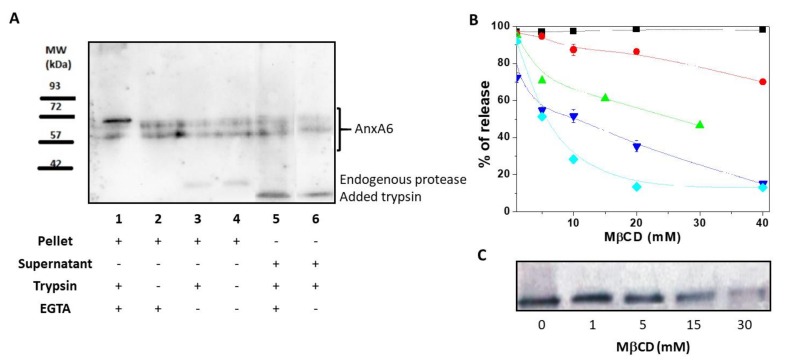
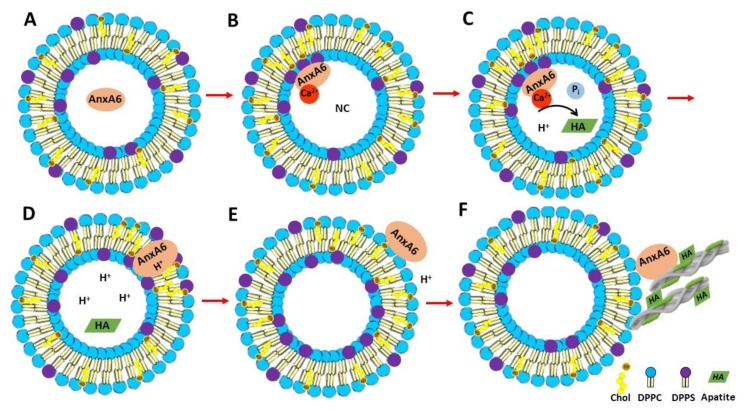
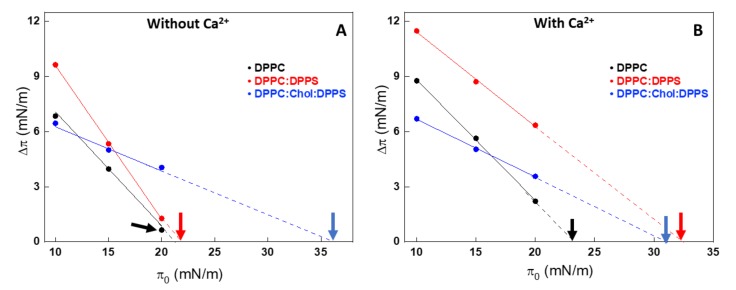
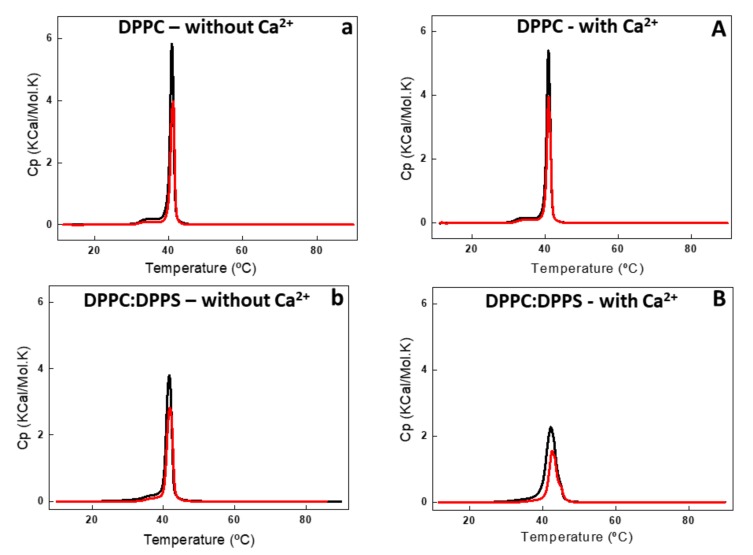
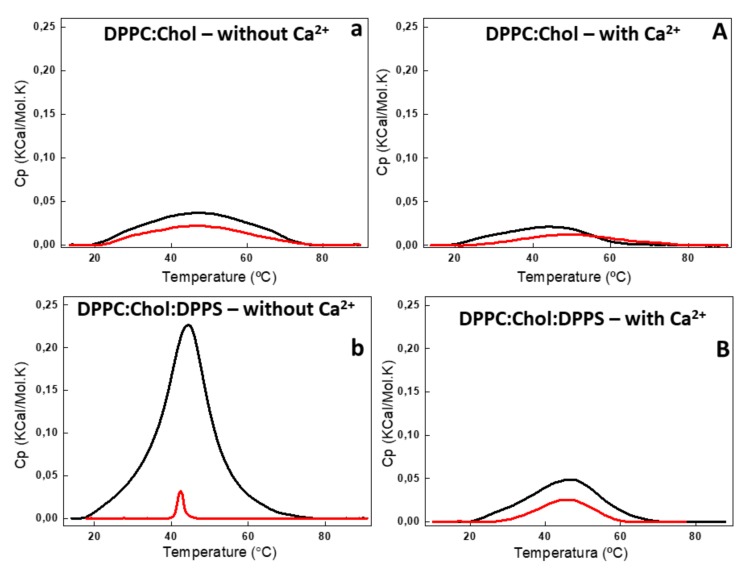
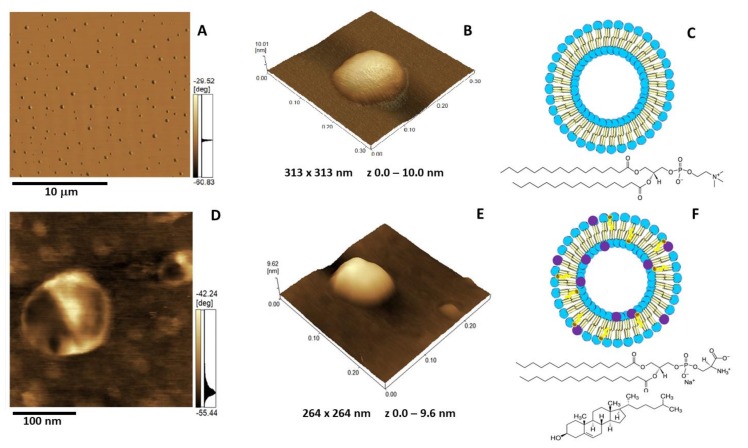
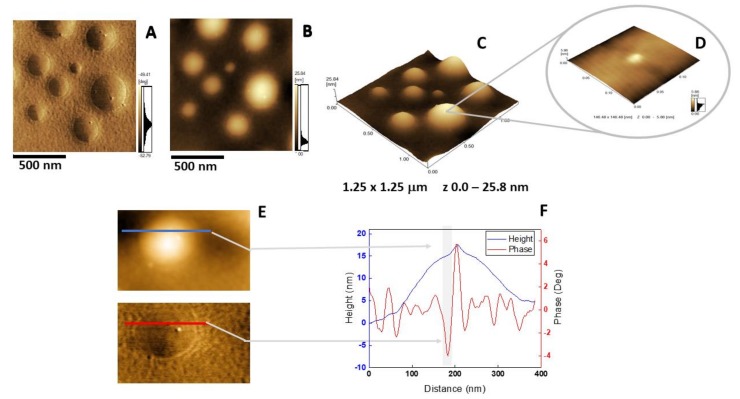
Annexin A6 (AnxA6) is the largest member of the annexin family of proteins present in matrix vesicles (MVs). MVs are a special class of extracellular vesicles that serve as a nucleation site during cartilage, bone, and mantle dentin mineralization. In this study, we assessed the localization of AnxA6 in the MV membrane bilayer using native MVs and MV biomimetics. Biochemical analyses revealed that AnxA6 in MVs can be divided into three distinct groups. The first group corresponds to Ca-bound AnxA6 interacting with the inner leaflet of the MV membrane. The second group corresponds to AnxA6 localized on the surface of the outer leaflet. The third group corresponds to AnxA6 inserted in the membrane's hydrophobic bilayer and co-localized with cholesterol (Chol). Using monolayers and proteoliposomes composed of either dipalmitoylphosphatidylcholine (DPPC) to mimic the outer leaflet of the MV membrane bilayer or a 9:1 DPPC:dipalmitoylphosphatidylserine (DPPS) mixture to mimic the inner leaflet, with and without Ca, we confirmed that, in agreement with the biochemical data, AnxA6 interacted differently with the MV membrane. Thermodynamic analyses based on the measurement of surface pressure exclusion (π), enthalpy (ΔH), and phase transition cooperativity (Δt) showed that AnxA6 interacted with DPPC and 9:1 DPPC:DPPS systems and that this interaction increased in the presence of Chol. The selective recruitment of AnxA6 by Chol was observed in MVs as probed by the addition of methyl-β-cyclodextrin (MβCD). AnxA6-lipid interaction was also Ca-dependent, as evidenced by the increase in π in negatively charged 9:1 DPPC:DPPS monolayers and the decrease in ΔH in 9:1 DPPC:DPPS proteoliposomes caused by the addition of AnxA6 in the presence of Ca compared to DPPC zwitterionic bilayers. The interaction of AnxA6 with DPPC and 9:1 DPPC:DPPS systems was distinct even in the absence of Ca as observed by the larger change in Δt in 9:1 DPPC:DPPS vesicles as compared to DPPC vesicles. Protrusions on the surface of DPPC proteoliposomes observed by atomic force microscopy suggested that oligomeric AnxA6 interacted with the vesicle membrane. Further work is needed to delineate possible functions of AnxA6 at its different localizations and ways of interaction with lipids.
膜粘连蛋白 A6(AnxA6)是膜粘连蛋白家族中最大的成员,存在于基质小泡(MVs)中。MVs 是一种特殊的细胞外囊泡,在软骨、骨和牙本质矿化过程中充当成核位点。在这项研究中,我们使用天然 MVs 和 MV 仿生物评估了 AnxA6 在 MV 膜双层中的定位。生化分析表明,MVs 中的 AnxA6 可分为三组。第一组对应于与 MV 膜内层相互作用的 Ca 结合的 AnxA6。第二组对应于定位于外叶表面的 AnxA6。第三组对应于插入膜疏水区双层并与胆固醇(Chol)共定位的 AnxA6。使用由二棕榈酰磷脂酰胆碱(DPPC)组成的单层和蛋白脂囊泡来模拟 MV 膜双层的外叶,或使用 9:1 DPPC:二棕榈酰磷脂酰丝氨酸(DPPS)混合物来模拟内层,有无 Ca,我们证实,与生化数据一致,AnxA6 与 MV 膜的相互作用不同。基于表面压力排除(π)、焓(ΔH)和相变协同性(Δt)的测量的热力学分析表明,AnxA6 与 DPPC 和 9:1 DPPC:DPPS 系统相互作用,并且这种相互作用在 Chol 存在下增加。正如通过添加甲基-β-环糊精(MβCD)探测 MV 中所观察到的那样,Chol 对 AnxA6 的选择性募集。如在带负电荷的 9:1 DPPC:DPPS 单层中π的增加以及在 DPPC 两性离子双层中存在 Ca 时添加 AnxA6 导致 9:1 DPPC:DPPS 蛋白脂囊泡中ΔH 的降低所证明的那样,AnxA6-脂质相互作用也是 Ca 依赖性的。即使在没有 Ca 的情况下,AnxA6 与 DPPC 和 9:1 DPPC:DPPS 系统的相互作用也很明显,如与 DPPC 囊泡相比,9:1 DPPC:DPPS 囊泡中Δt 的变化更大。原子力显微镜观察到 DPPC 蛋白脂囊泡表面的突起表明寡聚 AnxA6 与囊泡膜相互作用。需要进一步的工作来描绘 AnxA6 在不同定位的可能功能及其与脂质相互作用的方式。