CLLE, University of Toulouse, CNRS, Toulouse, France.
Université Toulouse Jean Jaurès, Maison de la Recherche, Laboratoire CLLE, 5, allée Antonio Machado, 31058, Toulouse Cedex 9, France.
Orphanet J Rare Dis. 2020 Feb 21;15(1):55. doi: 10.1186/s13023-020-1333-9.
People with Prader-Willi Syndrome (PWS) experience great difficulties in social adaptation that could be explained by disturbances in emotional competencies. However, current knowledge about the emotional functioning of people with PWS is incomplete. In particular, despite being the foundation of social adaptation, their emotional expression abilities have never been investigated. In addition, motor and cognitive difficulties - characteristic of PWS - could further impair these abilities.
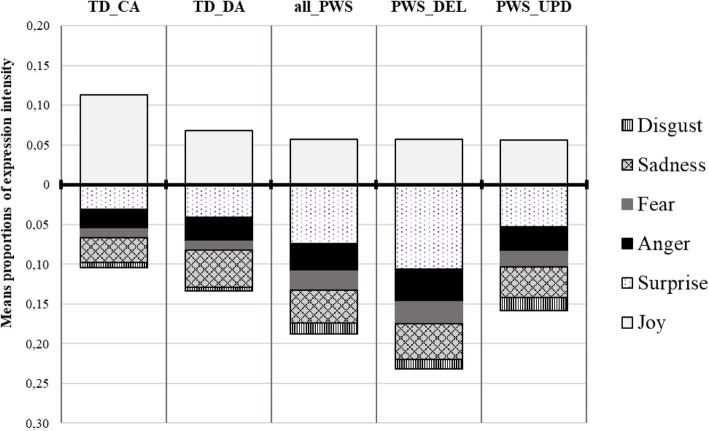
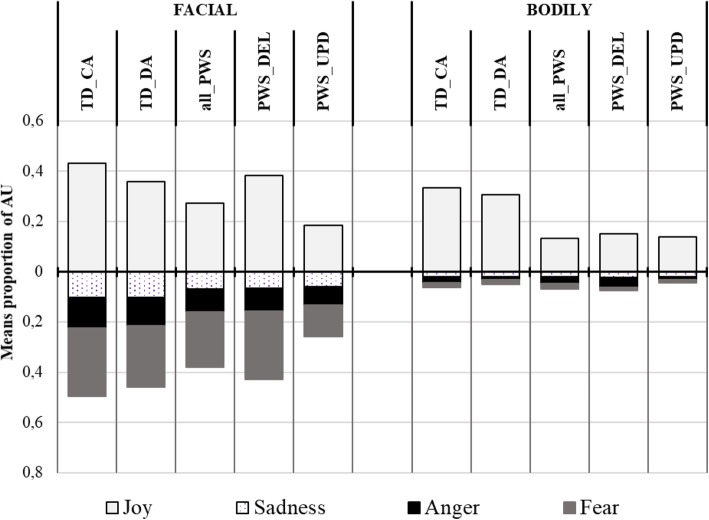
To explore the expression abilities of children with PWS, twenty-five children with PWS aged 5 to 10 years were assessed for 1) their emotional facial reactions to a funny video-clip and 2) their ability to produce on demand the facial and bodily expressions of joy, anger, fear and sadness. Their productions were compared to those of two groups of children with typical development, matched to PWS children by chronological age and by developmental age. The analyses focused on the proportion of expressive patterns relating to the target emotion and to untargeted emotions in the children's productions.
The results showed that the facial and bodily emotional expressions of children with PWS were particularly difficult to interpret, involving a pronounced mixture of different emotional patterns. In addition, it was observed that the emotions produced on demand by PWS children were particularly poor and equivocal.
As far as we know, this study is the first to highlight the existence of particularities in the expression of emotions in PWS children. These results shed new light on emotional dysfunction in PWS and consequently on the adaptive abilities of those affected in daily life.
普拉德-威利综合征(PWS)患者在社会适应方面存在很大困难,这可以用情绪能力障碍来解释。然而,目前关于 PWS 患者情绪功能的知识并不完整。特别是,尽管情绪表达能力是社会适应的基础,但从未对其进行过研究。此外,运动和认知方面的困难——这是 PWS 的特征——可能会进一步损害这些能力。
为了探索 PWS 儿童的表达能力,对 25 名 5 至 10 岁的 PWS 儿童进行了评估:1)他们对搞笑视频片段的情绪面部反应,以及 2)他们按需产生喜悦、愤怒、恐惧和悲伤的面部和身体表情的能力。将他们的表现与两组具有典型发育的儿童进行比较,这些儿童按年龄和发育年龄与 PWS 儿童相匹配。分析集中在儿童表现中与目标情绪相关的表达模式和与非目标情绪相关的表达模式的比例上。
结果表明,PWS 儿童的面部和身体情绪表达特别难以解读,涉及明显的不同情绪模式的混合。此外,还观察到 PWS 儿童按需产生的情绪特别差且模棱两可。
据我们所知,这项研究首次强调了 PWS 儿童在表达情绪方面存在特殊性。这些结果为 PWS 中的情绪功能障碍以及受影响者在日常生活中的适应能力提供了新的视角。