IEEE Trans Biomed Eng. 2020 Nov;67(11):3035-3047. doi: 10.1109/TBME.2020.2974826. Epub 2020 Feb 18.
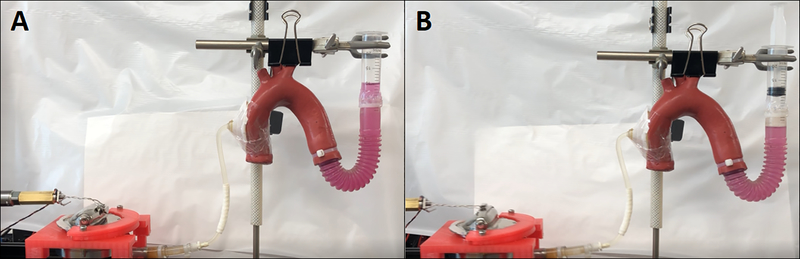
Conventional long-term ventricular assist devices continue to be extremely problematic due to infections caused by percutaneous drivelines and thrombotic events associated with the use of blood-contacting surfaces. Here we describe a muscle-powered cardiac assist device that avoids both these problems by using an internal muscle energy converter to drive a non-blood-contacting extra-aortic balloon pump. The technology was developed previously in this lab and operates by converting the contractile energy of the latissimus dorsi muscle into hydraulic power that can be used, in principle, to drive any blood pump amenable to pulsatile actuation. The two main advantages of this implantable power source are that it 1) significantly reduces infection risk by avoiding a constant skin wound, and 2) improves patient quality-of-life by eliminating all external hardware components. The counterpulsatile balloon pumps, which compress the external surface of the ascending aorta during the diastolic phase of the cardiac cycle, offer another critical advantage in the setting of long-term circulatory support in that they increase cardiac output and improve coronary perfusion without touching the blood. The goal of this work is to combine these two technologies into a single circulatory support system that eliminates driveline complications and avoids surface-mediated thromboembolic events, thereby providing a safe, tether-free means to support the failing heart over extended - or even indefinite - periods of time.
由于经皮驱动轴引起的感染和与血液接触表面相关的血栓事件,传统的长期心室辅助装置仍然存在极大的问题。在这里,我们描述了一种肌肉驱动的心脏辅助装置,它通过使用内部肌肉能量转换器来驱动非血液接触的主动脉外球囊泵,避免了这两个问题。这项技术是由本实验室之前开发的,它的工作原理是将背阔肌的收缩能量转化为液压能,原则上可以驱动任何可进行脉动驱动的血液泵。这种可植入电源有两个主要优点:1)通过避免持续的皮肤伤口,大大降低了感染风险;2)通过消除所有外部硬件组件,提高了患者的生活质量。反搏球囊泵在心脏周期的舒张期压缩升主动脉的外表面,在长期循环支持的情况下提供了另一个关键优势,因为它们在不接触血液的情况下增加心输出量和改善冠状动脉灌注。这项工作的目标是将这两种技术结合成一个单一的循环支持系统,消除驱动轴并发症,并避免表面介导的血栓栓塞事件,从而提供一种安全、无束缚的方法来在延长的甚至是无限期的时间内支持衰竭的心脏。