School of Life Science and Technology, The Key Laboratory of Developmental Genes and Human Disease, Southeast University, 210096 Nanjing, China;
Department of Molecular Genetics and Microbiology, Genetics Institute and the Center for NeuroGenetics, University of Florida, College of Medicine, Gainesville, FL 32610.
Proc Natl Acad Sci U S A. 2020 Mar 10;117(10):5472-5477. doi: 10.1073/pnas.1907297117. Epub 2020 Feb 21.
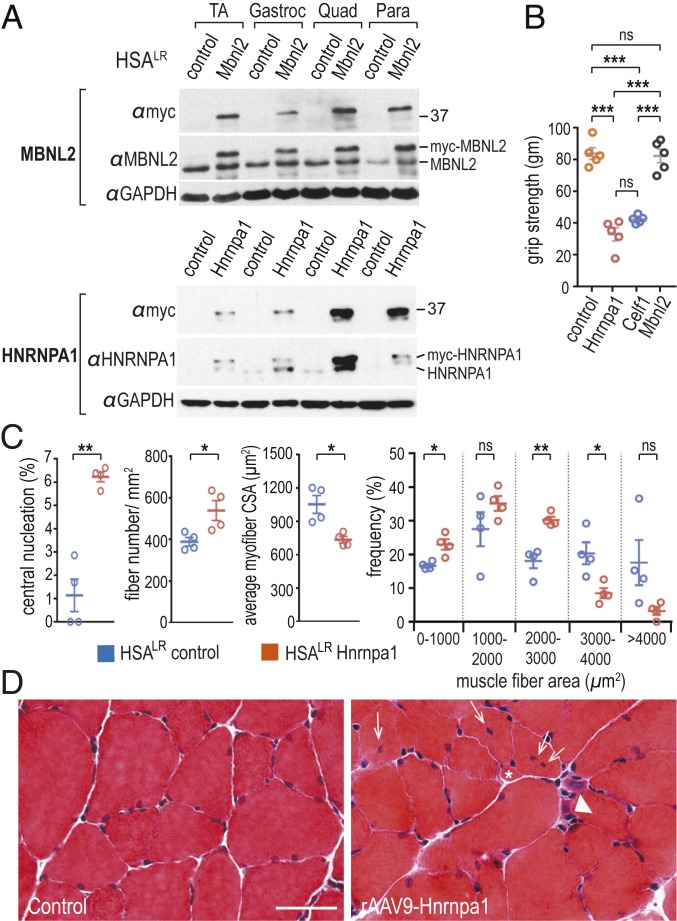
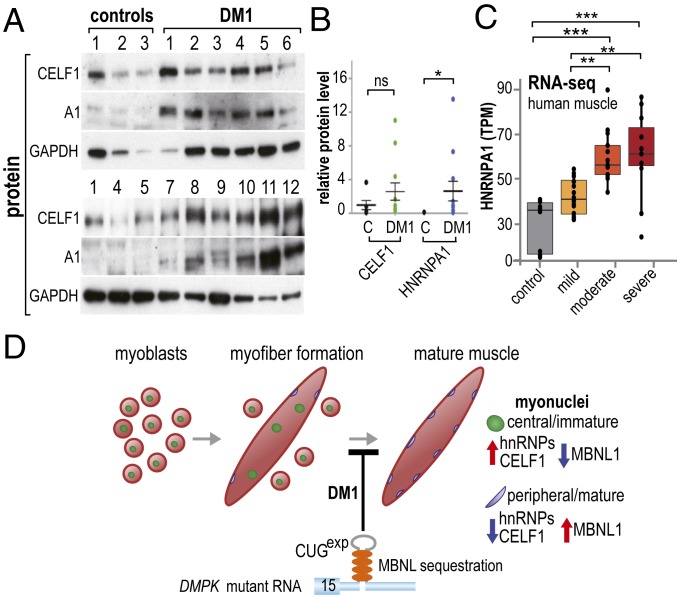
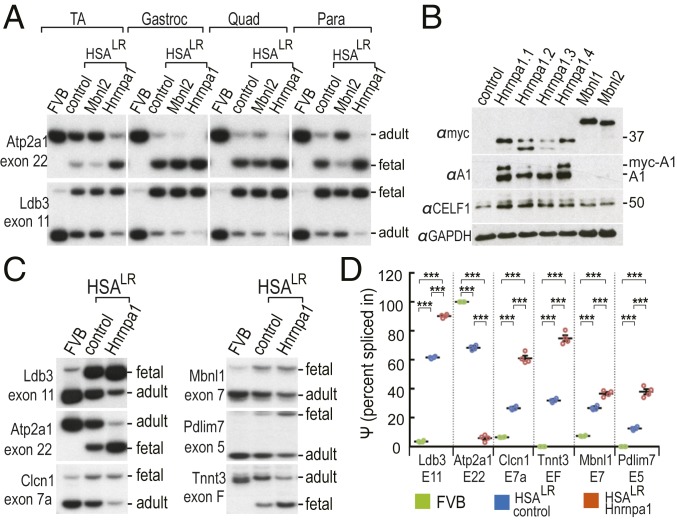
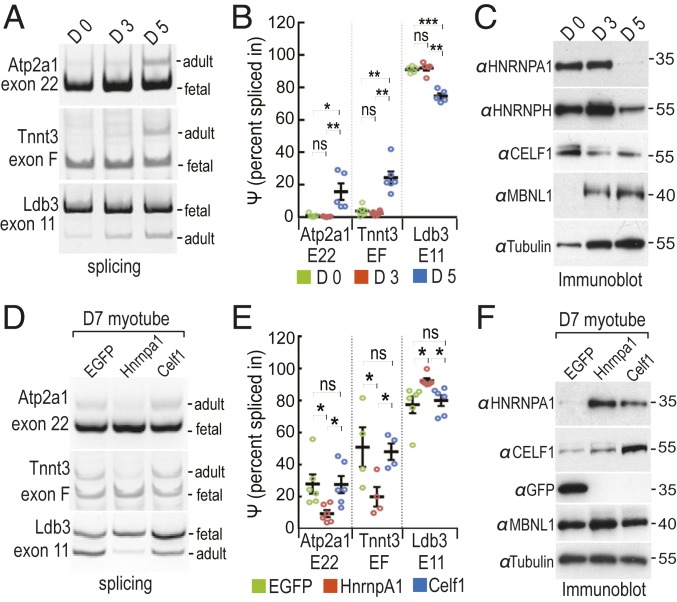
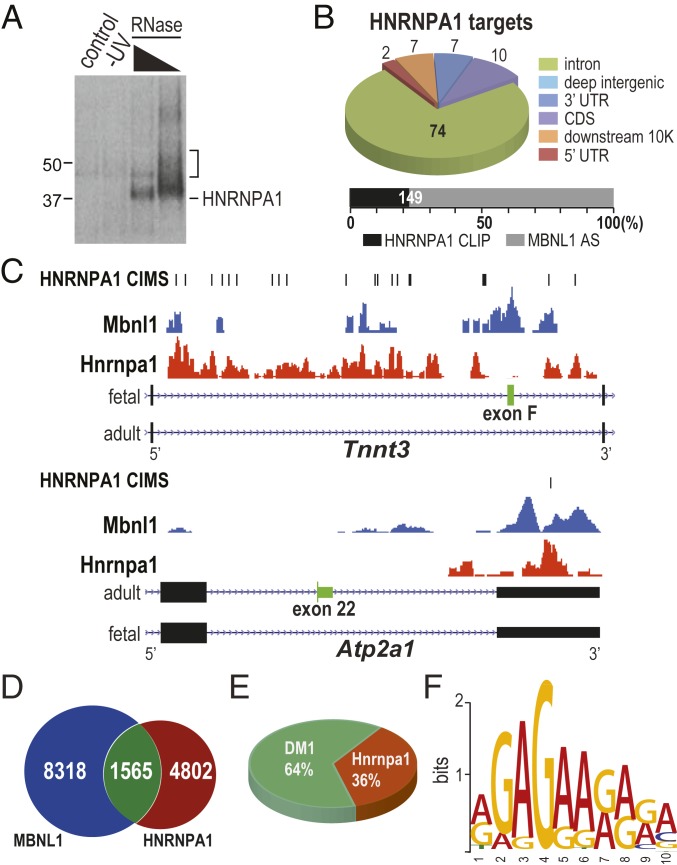
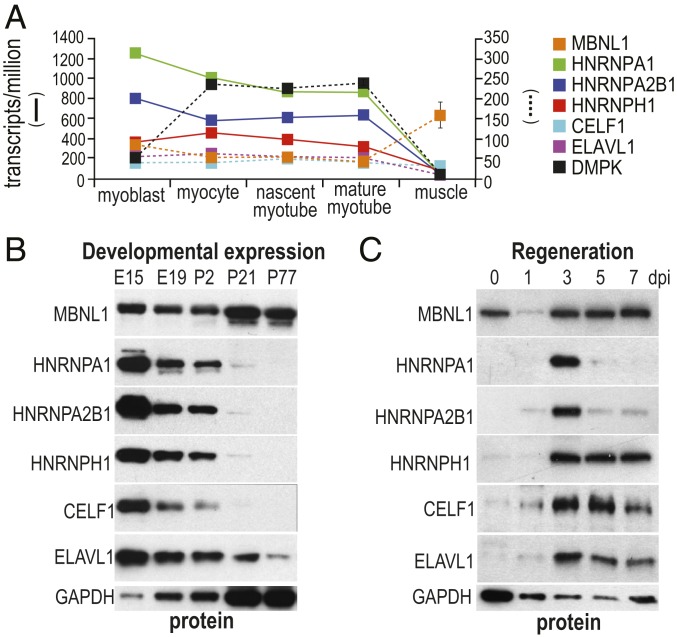
Studies on myotonic dystrophy type 1 (DM1) have led to the RNA-mediated disease model for hereditary disorders caused by noncoding microsatellite expansions. This model proposes that DM1 disease manifestations are caused by a reversion to fetal RNA processing patterns in adult tissues due to the expression of toxic CUG RNA expansions (CUG) leading to decreased muscleblind-like, but increased CUGBP1/ETR3-like factor 1 (CELF1), alternative splicing activities. Here, we test this model in vivo, using the mouse poly(CUG) model for DM1 and recombinant adeno-associated virus (rAAV)-mediated transduction of specific splicing factors. Surprisingly, systemic overexpression of HNRNPA1, not previously linked to DM1, also shifted DM1-relevant splicing targets to fetal isoforms, resulting in more severe muscle weakness/myopathy as early as 4 to 6 wk posttransduction, whereas rAAV controls were unaffected. Overexpression of HNRNPA1 promotes fetal exon inclusion of representative DM1-relevant splicing targets in differentiated myoblasts, and HITS-CLIP of rAAV-mycHnrnpa1-injected muscle revealed direct interactions of HNRNPA1 with these targets in vivo. Similar to CELF1, HNRNPA1 protein levels decrease during postnatal development, but are elevated in both regenerating mouse muscle and DM1 skeletal muscle. Our studies suggest that CUG RNA triggers abnormal expression of multiple nuclear RNA binding proteins, including CELF1 and HNRNPA1, that antagonize MBNL activity to promote fetal splicing patterns.
肌强直性营养不良 1 型(DM1)的研究导致了非编码微卫星扩展引起的遗传性疾病的 RNA 介导疾病模型。该模型提出,DM1 疾病表现是由于在成年组织中表达有毒的 CUG RNA 扩展(CUG)导致肌肉盲样蛋白减少,但增加 CUGBP1/ETR3 样因子 1(CELF1),替代剪接活性,从而导致胎儿 RNA 加工模式的恢复。在这里,我们使用 DM1 的小鼠多(CUG)模型和重组腺相关病毒(rAAV)介导的特定剪接因子转导在体内测试该模型。令人惊讶的是,HNRNPA1 的全身过表达,以前与 DM1 无关,也将 DM1 相关的剪接靶标转移到胎儿异构体,导致转导后 4 至 6 周肌肉无力/肌病更加严重,而 rAAV 对照不受影响。HNRNPA1 的过表达促进了分化的成肌细胞中代表性 DM1 相关剪接靶标的胎儿外显子包含,并且 rAAV-mycHnrnpa1 注射肌肉的 HITS-CLIP 揭示了 HNRNPA1 在体内与这些靶标的直接相互作用。与 CELF1 相似,HNRNPA1 蛋白水平在出生后发育过程中下降,但在再生的小鼠肌肉和 DM1 骨骼肌中均升高。我们的研究表明,CUG RNA 触发多种核 RNA 结合蛋白的异常表达,包括 CELF1 和 HNRNPA1,它们拮抗 MBNL 活性以促进胎儿剪接模式。