Hicks Sawyer M, Frias Jesus A, Mishra Subodh K, Scotti Marina, Muscato Derek R, Valero M Carmen, Adams Leanne M, Cleary John D, Nakamori Masayuki, Wang Eric, Berglund J Andrew
Department of Biological Sciences, College of Arts and Sciences, University at Albany, SUNY, Albany, NY 12222, USA.
The RNA Institute, College of Arts and Sciences, University at Albany, SUNY, Albany, NY 12222, USA.
Mol Ther Nucleic Acids. 2024 Sep 13;35(4):102338. doi: 10.1016/j.omtn.2024.102338. eCollection 2024 Dec 10.
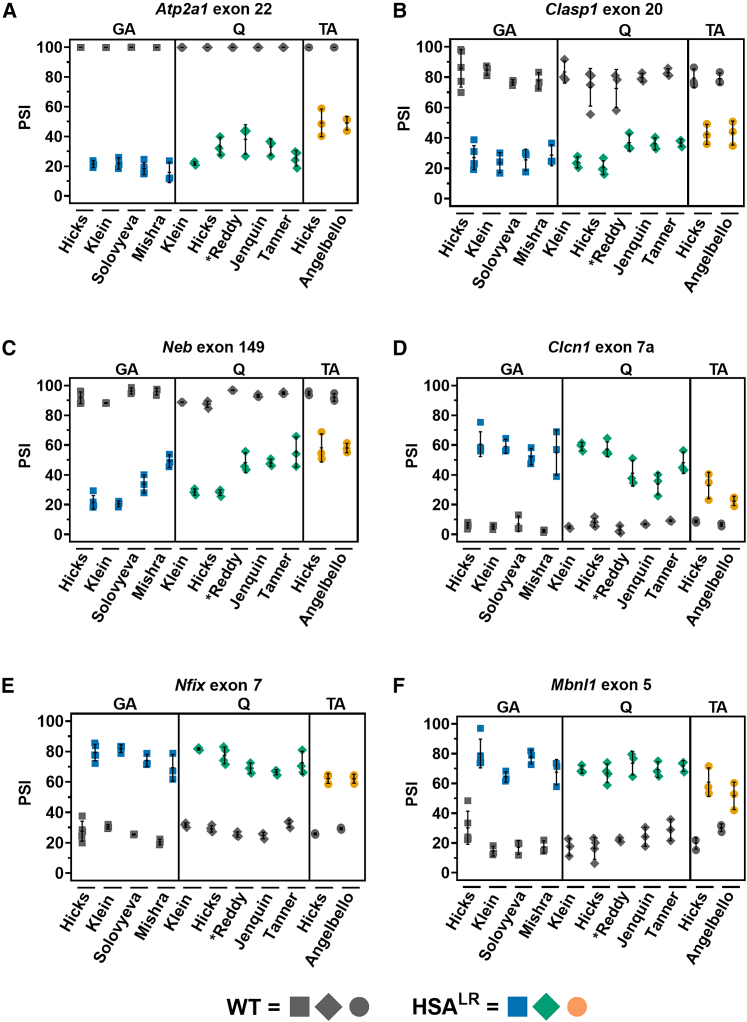
Myotonic dystrophy type 1 (DM1), the leading cause of adult-onset muscular dystrophy, is caused by a CTG repeat expansion. Expression of the repeat causes widespread alternative splicing (AS) defects and downstream pathogenesis, including significant skeletal muscle impacts. The mouse model plays a significant role in therapeutic development. This mouse model features a transgene composed of approximately 220 interrupted CTG repeats, which results in skeletal muscle pathology that mirrors DM1. To better understand this model and the growing number of therapeutic approaches developed with it, we performed a meta-analysis of publicly available RNA sequencing data for AS changes across three widely examined skeletal muscles: quadriceps, gastrocnemius, and tibialis anterior. Our analysis demonstrated that transgene expression correlated with the extent of splicing dysregulation across these muscles from gastrocnemius (highest), quadriceps (medium), to tibialis anterior (lowest). We identified 95 splicing events consistently dysregulated across all examined datasets. Comparison of splicing rescue across seven therapeutic approaches showed a range of rescue across the 95 splicing events from the three muscle groups. This analysis contributes to our understanding of the model and the growing number of therapeutic approaches currently in preclinical development for DM1.
1型强直性肌营养不良(DM1)是成人发病的肌营养不良的主要原因,由CTG重复序列扩增引起。该重复序列的表达会导致广泛的可变剪接(AS)缺陷和下游发病机制,包括对骨骼肌产生重大影响。小鼠模型在治疗开发中发挥着重要作用。这个小鼠模型的特征是一个由大约220个中断的CTG重复序列组成的转基因,它会导致类似于DM1的骨骼肌病理变化。为了更好地理解这个模型以及由此开发出的越来越多的治疗方法,我们对公开可用的RNA测序数据进行了荟萃分析,以研究在三个广泛研究的骨骼肌(股四头肌、腓肠肌和胫前肌)中AS的变化。我们的分析表明,转基因表达与这些肌肉中剪接失调的程度相关,从腓肠肌(最高)、股四头肌(中等)到胫前肌(最低)。我们确定了在所有检测数据集中均持续失调的95个剪接事件。对七种治疗方法的剪接挽救情况进行比较,结果显示在这95个剪接事件中,三个肌肉组的挽救程度各不相同。该分析有助于我们理解这个模型以及目前正在进行临床前开发的针对DM1的越来越多的治疗方法。