Department of Psychiatry and Psychotherapy, Central Institute of Mental Health, Medical Faculty Mannheim / University of Heidelberg, Mannheim, Germany.
Department of Child and Adolescent Psychiatry and Psychotherapy, Central Institute of Mental Health, Medical Faculty Mannheim / University of Heidelberg, Mannheim, Germany.
Mol Autism. 2020 Feb 22;11(1):17. doi: 10.1186/s13229-020-0317-x.
Autism spectrum disorder (ASD) is a neurodevelopmental condition with key deficits in social functioning. It is widely assumed that the biological underpinnings of social impairment are neurofunctional alterations in the "social brain," a neural circuitry involved in inferring the mental state of a social partner. However, previous evidence comes from small-scale studies and findings have been mixed. We therefore carried out the to-date largest study on neural correlates of mentalizing in ASD.
As part of the Longitudinal European Autism Project, we performed functional magnetic resonance imaging at six European sites in a large, well-powered, and deeply phenotyped sample of individuals with ASD (N = 205) and typically developing (TD) individuals (N = 189) aged 6 to 30 years. We presented an animated shapes task to assess and comprehensively characterize social brain activation during mentalizing. We tested for effects of age, diagnosis, and their association with symptom measures, including a continuous measure of autistic traits.
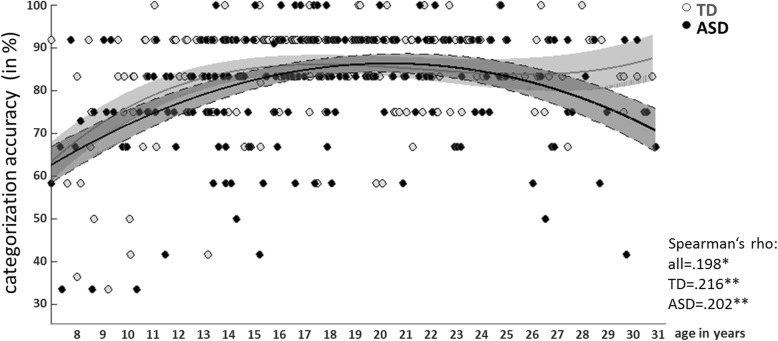
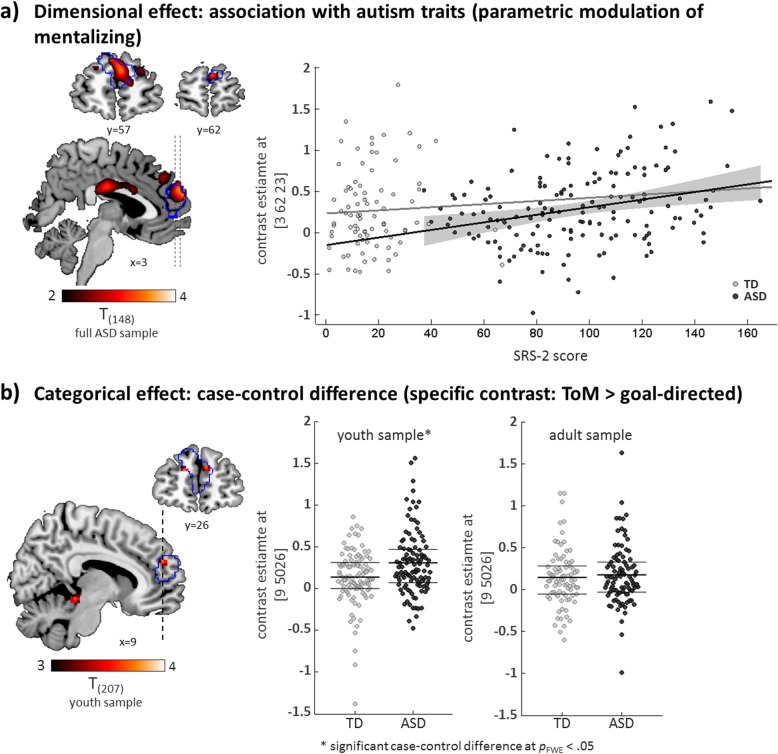
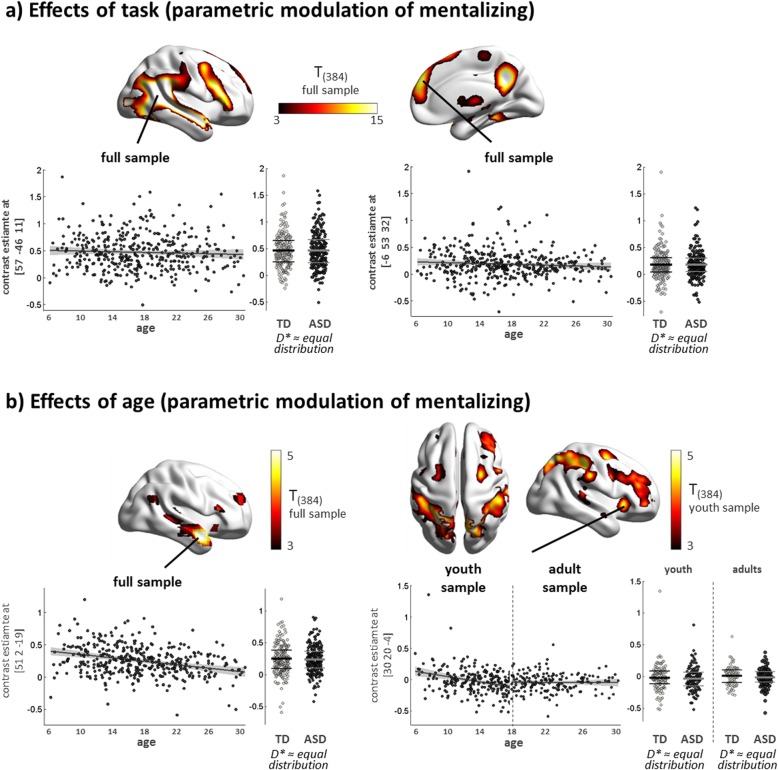
We observed robust effects of task. Within the ASD sample, autistic traits were moderately associated with functional activation in one of the key regions of the social brain, the dorsomedial prefrontal cortex. However, there were no significant effects of diagnosis on task performance and no effects of age and diagnosis on social brain responses. Besides a lack of mean group differences, our data provide no evidence for meaningful differences in the distribution of brain response measures. Extensive control analyses suggest that the lack of case-control differences was not due to a variety of potential confounders.
Contrary to prior reports, this large-scale study does not support the assumption that altered social brain activation during mentalizing forms a common neural marker of ASD, at least with the paradigm we employed. Yet, autistic individuals show socio-behavioral deficits. Our work therefore highlights the need to interrogate social brain function with other brain measures, such as connectivity and network-based approaches, using other paradigms, or applying complementary analysis approaches to assess individual differences in this heterogeneous condition.
自闭症谱系障碍(ASD)是一种神经发育障碍,其主要缺陷在于社交功能。人们普遍认为,社交障碍的生物学基础是“社交大脑”的神经功能改变,这是一种涉及推断社交伙伴心理状态的神经回路。然而,之前的证据来自于小规模研究,研究结果参差不齐。因此,我们进行了迄今为止最大规模的 ASD 心理理论神经相关性研究。
作为欧洲自闭症纵向项目的一部分,我们在六个欧洲地点对一个大型、功能强大且深入表型的 ASD 个体(N=205)和典型发育(TD)个体(N=189)的样本进行了功能磁共振成像。年龄在 6 至 30 岁之间。我们使用动画形状任务来评估和全面描述心理理论过程中的社交大脑激活。我们测试了年龄、诊断以及它们与症状测量值(包括自闭症特质的连续测量值)的关联的影响。
我们观察到任务的稳健影响。在 ASD 样本中,自闭症特质与社交大脑关键区域之一的背内侧前额叶皮层的功能激活中度相关。然而,诊断对任务表现没有显著影响,年龄和诊断对社交大脑反应也没有影响。除了缺乏平均组差异外,我们的数据没有提供大脑反应测量值分布有意义差异的证据。广泛的对照分析表明,缺乏病例对照差异不是由于各种潜在的混杂因素造成的。
与之前的报告相反,这项大规模研究不支持在心理理论过程中改变的社交大脑激活形成 ASD 的共同神经标志物的假设,至少我们使用的范式是这样。然而,自闭症个体表现出社交行为缺陷。因此,我们的工作强调需要使用其他脑测量方法,如连接和基于网络的方法,使用其他范式,或应用互补的分析方法来检查这种异质条件下的个体差异,以探究社交大脑功能。