Center for Neuroscience of Embodied Cognition (CeNEC), Brain and Creativity Institute, Dornsife College of Letters, Arts and Sciences, University of Southern California, Los Angeles, CA, USA; USC Mrs. T.H. Chan Division of Occupational Science and Occupational Therapy, University of Southern California, Los Angeles, CA, USA.
Center for Neuroscience of Embodied Cognition (CeNEC), Brain and Creativity Institute, Dornsife College of Letters, Arts and Sciences, University of Southern California, Los Angeles, CA, USA; USC Mark and Mary Stevens Neuroimaging and Informatics Institute, University of Southern California, Los Angeles, CA, USA.
Cortex. 2023 Oct;167:115-131. doi: 10.1016/j.cortex.2023.06.014. Epub 2023 Jul 14.
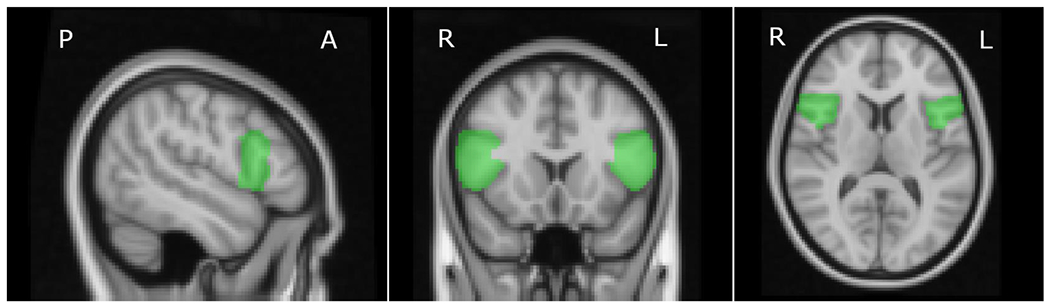
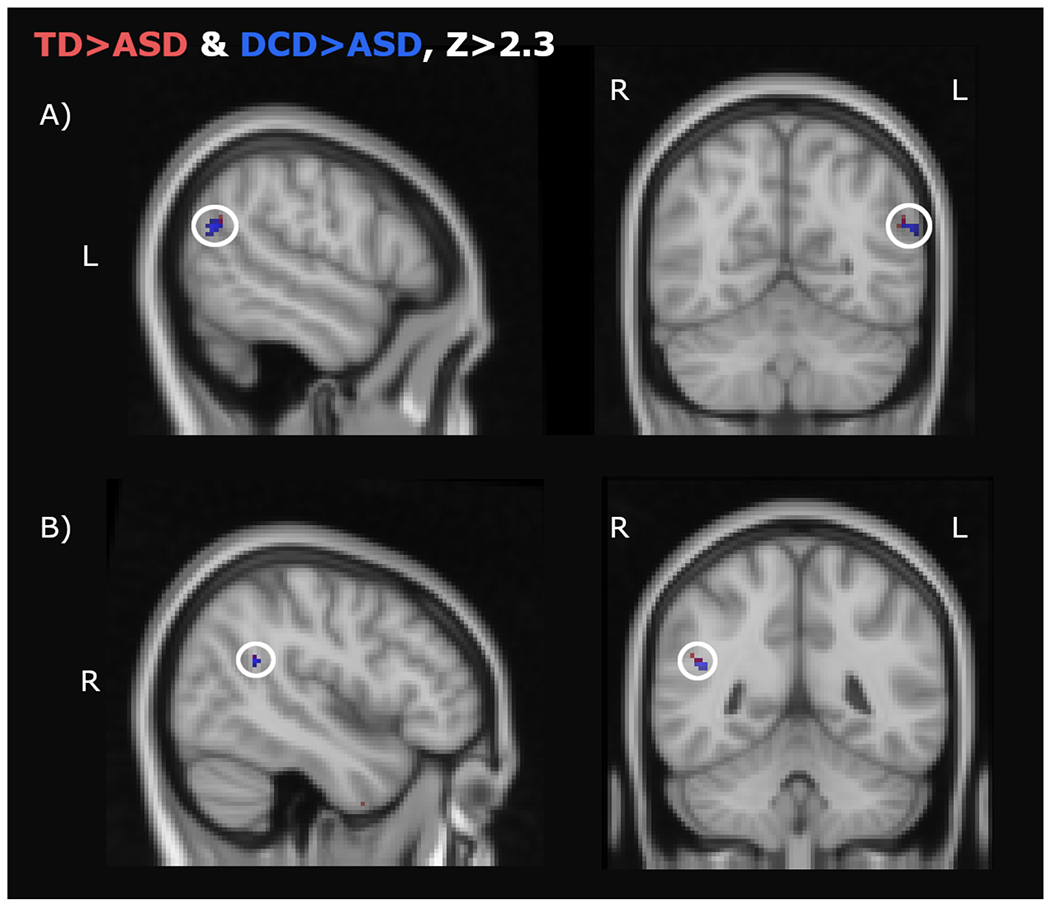
Prior studies have compared neural connectivity during mentalizing tasks in autism (ASD) to non-autistic individuals and found reduced connectivity between the inferior frontal gyrus (IFG) and mentalizing regions. However, given that the IFG is involved in motor processing, and about 80% of autistic individuals have motor-related difficulties, it is necessary to explore if these differences are specific to ASD or instead similar across other developmental motor disorders, such as developmental coordination disorder (DCD). Participants (29 ASD, 20 DCD, 31 typically developing [TD]; ages 8-17) completed a mentalizing task in the fMRI scanner, where they were asked to think about why someone was performing an action. Results indicated that the ASD group, as compared to both TD and DCD groups, showed significant functional connectivity differences when mentalizing about other's actions. The left IFG seed revealed ASD connectivity differences with the: bilateral temporoparietal junction (TPJ), left insular cortex, and bilateral dorsolateral prefrontal cortex (DLPFC). Connectivity differences using the right IFG seed revealed ASD differences in the: left insula, and right DLPFC. These results indicate that connectivity differences between the IFG, mentalizing regions, emotion and motor processing regions are specific to ASD and not a result of potentially co-occurring motor differences.
先前的研究比较了自闭症(ASD)患者在进行心理化任务时的神经连接,发现下额前回(IFG)与心理化区域之间的连接减少。然而,由于 IFG 参与运动处理,大约 80%的自闭症患者存在与运动相关的困难,因此有必要探索这些差异是特定于 ASD 的,还是在其他发育性运动障碍(如发育性协调障碍 [DCD])中也类似。参与者(29 名 ASD、20 名 DCD、31 名正常发育[TD];年龄 8-17 岁)在 fMRI 扫描仪中完成了一项心理化任务,在该任务中,他们被要求思考某人为什么要执行某个动作。结果表明,与 TD 和 DCD 组相比,ASD 组在心理化他人行为时表现出显著的功能连接差异。左 IFG 种子显示与双侧颞顶联合(TPJ)、左侧岛叶和双侧背外侧前额叶皮质(DLPFC)的 ASD 连接差异。使用右 IFG 种子的连接差异显示 ASD 在左侧岛叶和右侧 DLPFC 中的差异。这些结果表明,IFG、心理化区域、情感和运动处理区域之间的连接差异是 ASD 的特异性,而不是潜在的共患运动差异的结果。