Institute of Physiology and Pathophysiology, Friedrich-Alexander-University Erlangen-Nürnberg, Universitätsstr. 17, 91054, Erlangen, Germany.
Neuroscience Graduate Program, University of Iowa, Iowa City, IA, 52242, USA.
J Neural Transm (Vienna). 2020 Apr;127(4):431-444. doi: 10.1007/s00702-020-02161-7. Epub 2020 Feb 22.
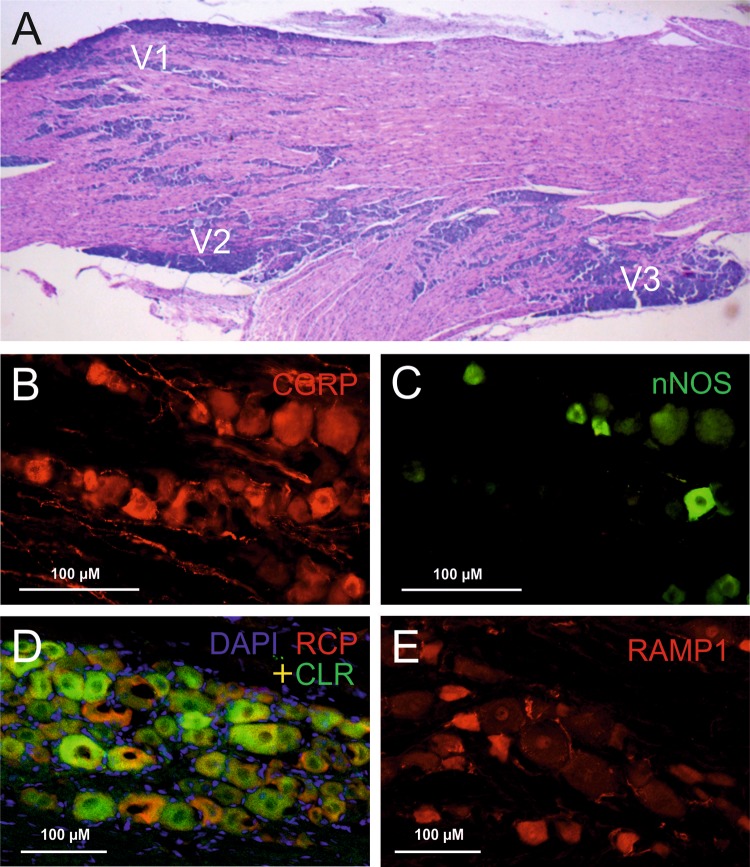
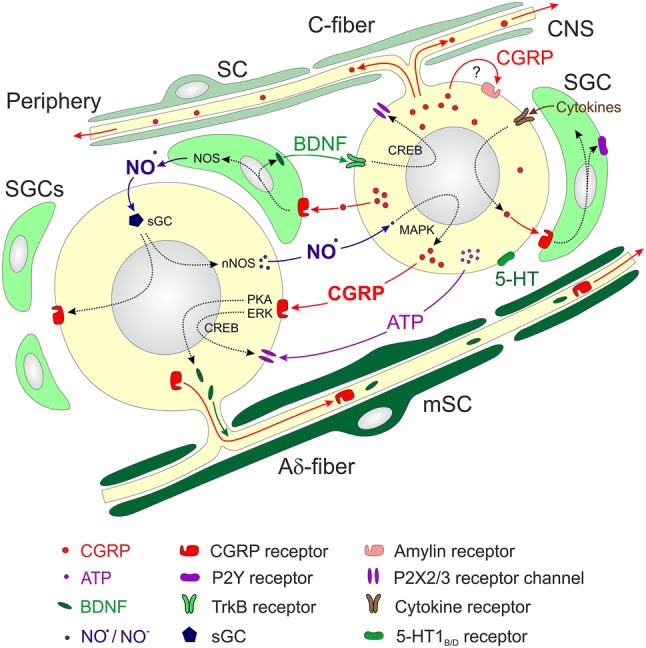
The trigeminal ganglion with its three trigeminal nerve tracts consists mainly of clusters of sensory neurons with their peripheral and central processes. Most neurons are surrounded by satellite glial cells and the axons are wrapped by myelinating and non-myelinating Schwann cells. Trigeminal neurons express various neuropeptides, most notably, calcitonin gene-related peptide (CGRP), substance P, and pituitary adenylate cyclase-activating polypeptide (PACAP). Two types of CGRP receptors are expressed in neurons and satellite glia. A variety of other signal molecules like ATP, nitric oxide, cytokines, and neurotrophic factors are released from trigeminal ganglion neurons and signal to neighboring neurons or satellite glial cells, which can signal back to neurons with same or other mediators. This potential cross-talk of signals involves intracellular mechanisms, including gene expression, that can modulate mediators of sensory information, such as neuropeptides, receptors, and neurotrophic factors. From the ganglia cell bodies, which are outside the blood-brain barrier, the mediators are further distributed to peripheral sites and/or to the spinal trigeminal nucleus in the brainstem, where they can affect neural transmission. A major question is how the sensory neurons in the trigeminal ganglion differ from those in the dorsal root ganglion. Despite their functional overlap, there are distinct differences in their ontogeny, gene expression, signaling pathways, and responses to anti-migraine drugs. Consequently, drugs that modulate cross-talk in the trigeminal ganglion can modulate both peripheral and central sensitization, which may potentially be distinct from sensitization mediated in the dorsal root ganglion.
三叉神经节及其三个三叉神经束主要由感觉神经元簇及其外周和中枢过程组成。大多数神经元被卫星胶质细胞包围,轴突被髓鞘形成和非髓鞘形成的施万细胞包裹。三叉神经神经元表达各种神经肽,最显著的是降钙素基因相关肽(CGRP)、P 物质和垂体腺苷酸环化酶激活肽(PACAP)。两种类型的 CGRP 受体在神经元和卫星胶质细胞中表达。多种其他信号分子,如 ATP、一氧化氮、细胞因子和神经营养因子,从三叉神经节神经元释放,并向相邻神经元或卫星胶质细胞发出信号,卫星胶质细胞可以用相同或其他介质向神经元发出信号。这种潜在的信号交叉对话涉及细胞内机制,包括基因表达,可以调节感觉信息的介质,如神经肽、受体和神经营养因子。从中枢神经系统的脑干三叉神经核,从位于血脑屏障外的神经节细胞体,这些介质进一步分布到外周部位,或分布到三叉神经核,在那里它们可以影响神经传递。一个主要的问题是三叉神经节中的感觉神经元如何与背根神经节中的感觉神经元不同。尽管它们的功能重叠,但它们在胚胎发生、基因表达、信号通路和对抗偏头痛药物的反应方面存在明显差异。因此,调节三叉神经节中串扰的药物可以调节外周和中枢敏化,这可能与背根神经节中介导的敏化不同。