Brunker Kirstyn, Jaswant Gurdeep, Thumbi S M, Lushasi Kennedy, Lugelo Ahmed, Czupryna Anna M, Ade Fred, Wambura Gati, Chuchu Veronicah, Steenson Rachel, Ngeleja Chanasa, Bautista Criselda, Manalo Daria L, Gomez Ma Ricci R, Chu Maria Yna Joyce V, Miranda Mary Elizabeth, Kamat Maya, Rysava Kristyna, Espineda Jason, Silo Eva Angelica V, Aringo Ariane Mae, Bernales Rona P, Adonay Florencio F, Tildesley Michael J, Marston Denise A, Jennings Daisy L, Fooks Anthony R, Zhu Wenlong, Meredith Luke W, Hill Sarah C, Poplawski Radoslaw, Gifford Robert J, Singer Joshua B, Maturi Mathew, Mwatondo Athman, Biek Roman, Hampson Katie
Institute of Biodiversity, Animal Health and Comparative Medicine, University of Glasgow, Glasgow, G12 8QQ, UK.
The Boyd Orr Centre for Population and Ecosystem Health, University of Glasgow, Glasgow, G12 8QQ, UK.
Wellcome Open Res. 2020 May 19;5:3. doi: 10.12688/wellcomeopenres.15518.2. eCollection 2020.
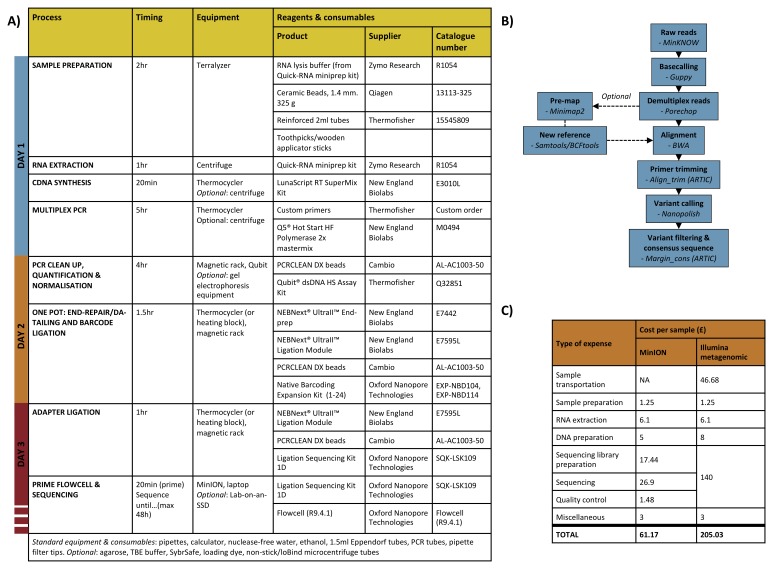
Genomic surveillance is an important aspect of contemporary disease management but has yet to be used routinely to monitor endemic disease transmission and control in low- and middle-income countries. Rabies is an almost invariably fatal viral disease that causes a large public health and economic burden in Asia and Africa, despite being entirely vaccine preventable. With policy efforts now directed towards achieving a global goal of zero dog-mediated human rabies deaths by 2030, establishing effective surveillance tools is critical. Genomic data can provide important and unique insights into rabies spread and persistence that can direct control efforts. However, capacity for genomic research in low- and middle-income countries is held back by limited laboratory infrastructure, cost, supply chains and other logistical challenges. Here we present and validate an end-to-end workflow to facilitate affordable whole genome sequencing for rabies surveillance utilising nanopore technology. We used this workflow in Kenya, Tanzania and the Philippines to generate rabies virus genomes in two to three days, reducing costs to approximately £60 per genome. This is over half the cost of metagenomic sequencing previously conducted for Tanzanian samples, which involved exporting samples to the UK and a three- to six-month lag time. Ongoing optimization of workflows are likely to reduce these costs further. We also present tools to support routine whole genome sequencing and interpretation for genomic surveillance. Moreover, combined with training workshops to empower scientists in-country, we show that local sequencing capacity can be readily established and sustainable, negating the common misperception that cutting-edge genomic research can only be conducted in high resource laboratories. More generally, we argue that the capacity to harness genomic data is a game-changer for endemic disease surveillance and should precipitate a new wave of researchers from low- and middle-income countries.
基因组监测是当代疾病管理的一个重要方面,但在低收入和中等收入国家尚未被常规用于监测地方病的传播和控制。狂犬病是一种几乎总是致命的病毒性疾病,尽管完全可以通过疫苗预防,但在亚洲和非洲仍造成巨大的公共卫生和经济负担。随着政策努力现在致力于实现到2030年全球犬传人狂犬病死亡零病例的目标,建立有效的监测工具至关重要。基因组数据可以为狂犬病的传播和持续存在提供重要且独特的见解,从而指导防控工作。然而,低收入和中等收入国家的基因组研究能力受到实验室基础设施有限、成本、供应链及其他后勤挑战的制约。在此,我们展示并验证了一种端到端的工作流程,以利用纳米孔技术促进用于狂犬病监测的经济实惠的全基因组测序。我们在肯尼亚、坦桑尼亚和菲律宾使用了这种工作流程,在两到三天内生成狂犬病病毒基因组,将成本降低到每个基因组约60英镑。这比之前对坦桑尼亚样本进行宏基因组测序的成本降低了一半以上,之前的测序需要将样本出口到英国,且有三到六个月的延迟。对工作流程的持续优化可能会进一步降低这些成本。我们还展示了支持基因组监测的常规全基因组测序和解读的工具。此外,结合培训研讨会以增强国内科学家的能力,我们表明可以轻松建立并维持本地测序能力,消除了那种认为前沿基因组研究只能在高资源实验室进行的普遍误解。更广泛地说,我们认为利用基因组数据的能力是地方病监测的一个变革因素,应该促使来自低收入和中等收入国家的新一代研究人员涌现。