Department of Restorative Dentistry, University of Washington School of Dentistry, Seattle, WA 98195, USA.
Sensors (Basel). 2020 Feb 20;20(4):1157. doi: 10.3390/s20041157.
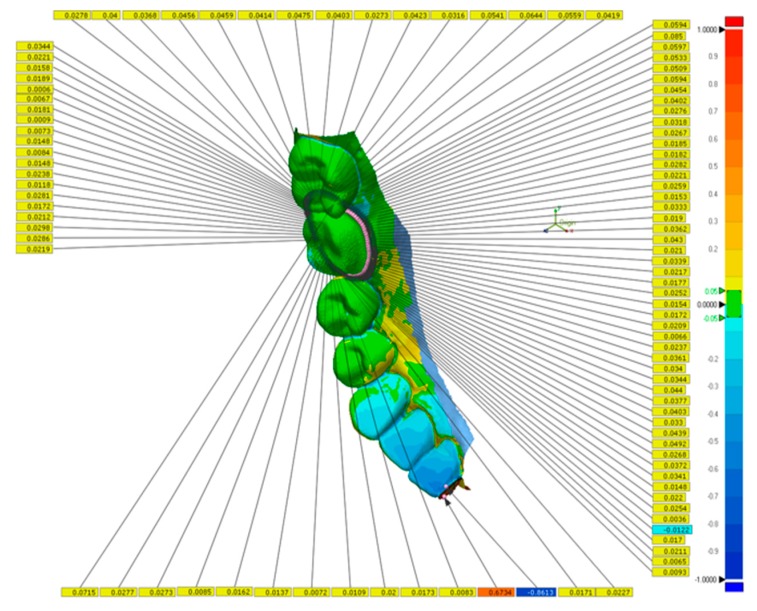
The advancement of intraoral scanners has allowed for more efficient workflow in the dental clinical setting. However, limited data exist regarding the accuracy of the digital impressions produced with various scanner settings and scanning approaches. The purpose of this in vitro study was to compare the accuracy of digital impressions at the crown preparation margin using different scanning resolutions of a specific intraoral scanner system. An all-ceramic crown preparation of a mandibular first molar was constructed in a typodont, and a scan (n = 3) was created with an industrial-grade laboratory scanner (3Shape D2000) as the control. Digital impressions were obtained with an intraoral scanner (3Shape TRIOS 3) under three settings-high resolution (HR), standard resolution (SR), and combined resolution (SHR). Comparative 3D analysis of scans was performed with Geomagic Control X software to measure the discrepancy between intraoral scans and the control scan along the preparation finish line. The scan time and number of images captured per scan were recorded. Statistical analysis was performed by one-way ANOVA, two-way repeated measures ANOVA, Pearson's correlation, and Dunnett's T3 test (α = 0.05). Significant differences were observed for scan time and for number of images captured among scan resolution settings (α < 0.05). The scan time for the SR group was, on average, 34.2 s less than the SHR group and 46.5 s less than the HR group. For discrepancy on the finish line, no significant differences were observed among scanning resolutions (HR: 31.5 ± 5.5 μm, SHR: 33.2 ± 3.7 μm, SR: 33.6 ± 3.1 μm). Significant differences in discrepancy were observed among tooth surfaces, with the distal surface showing the highest discrepancies. In conclusion, the resolution of the intra-oral scanner is primarily defined by the system hardware and optimized for default scans. A software high-resolution mode that obtains more data over a longer time may not necessarily benefit the scan accuracy, while the tooth preparation and surface parameters do affect the accuracy.
口腔内扫描仪的进步使得牙科临床环境中的工作流程更加高效。然而,关于各种扫描仪设置和扫描方法所产生的数字印模的准确性,相关数据有限。本体外研究的目的是比较特定口腔内扫描仪系统的不同扫描分辨率下,牙冠预备边缘的数字印模的准确性。在仿头模型上构建下颌第一磨牙的全瓷冠预备体,并使用工业级实验室扫描仪(3Shape D2000)作为对照进行扫描(n = 3)。使用口腔内扫描仪(3Shape TRIOS 3)在三种设置下(高分辨率(HR)、标准分辨率(SR)和组合分辨率(SHR))获得数字印模。使用 Geomagic Control X 软件对扫描进行比较性 3D 分析,以测量预备完成线处口腔内扫描与对照扫描之间的差异。记录扫描时间和每次扫描捕获的图像数量。通过单向方差分析、双向重复测量方差分析、皮尔逊相关和 Dunnett T3 检验(α = 0.05)进行统计分析。扫描分辨率设置之间的扫描时间和捕获的图像数量存在显著差异(α < 0.05)。SR 组的扫描时间平均比 SHR 组少 34.2 秒,比 HR 组少 46.5 秒。在完成线上的差异方面,扫描分辨率之间没有观察到显著差异(HR:31.5 ± 5.5 μm,SHR:33.2 ± 3.7 μm,SR:33.6 ± 3.1 μm)。牙面之间的差异存在显著差异,其中远中面显示出最高的差异。结论是,口腔内扫描仪的分辨率主要由系统硬件定义,并针对默认扫描进行了优化。虽然软件高分辨率模式可能会在更长的时间内获取更多的数据,但不一定会提高扫描准确性,而牙预备和表面参数确实会影响准确性。