Department of Ornithology, American Museum of Natural History, Central Park West at 79th Street, New York, NY, 10024, USA.
Department of Ecology, Evolution and Environmental Biology, Columbia University, New York, NY, 10027, USA.
BMC Evol Biol. 2020 Feb 24;20(1):32. doi: 10.1186/s12862-020-1577-y.
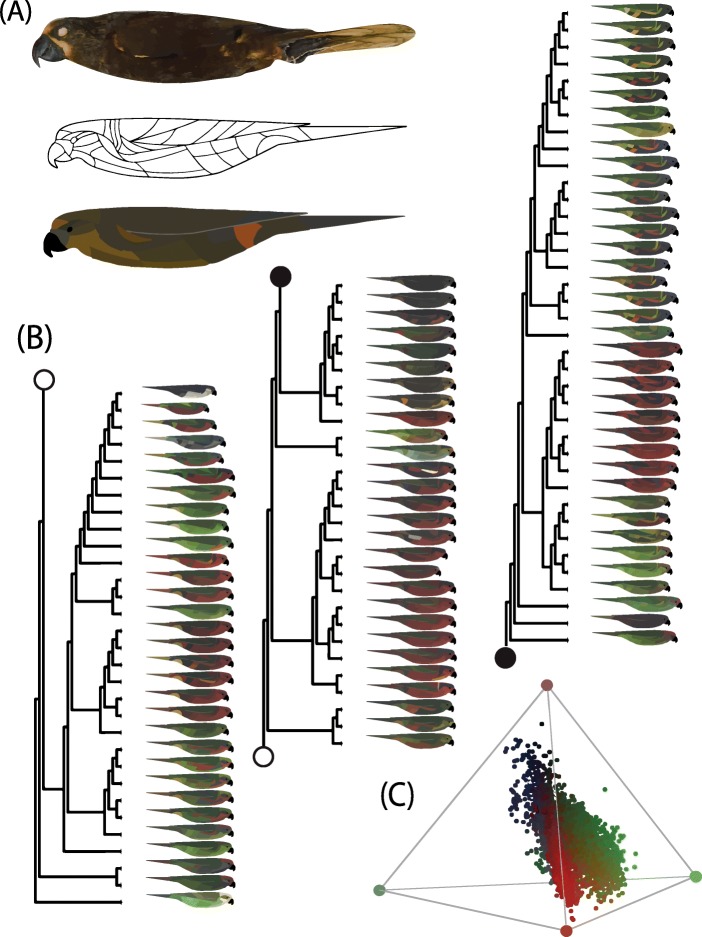
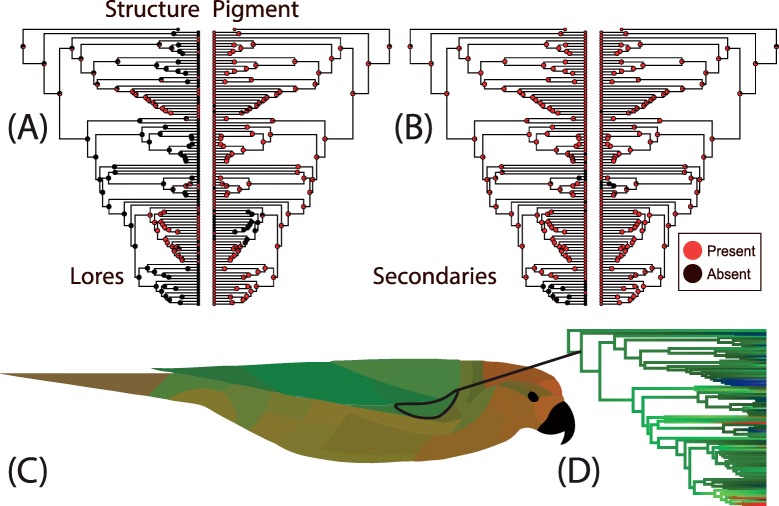
Bird plumage exhibits a diversity of colors that serve functional roles ranging from signaling to camouflage and thermoregulation. However, birds must maintain a balance between evolving colorful signals to attract mates, minimizing conspicuousness to predators, and optimizing adaptation to climate conditions. Examining plumage color macroevolution provides a framework for understanding this dynamic interplay over phylogenetic scales. Plumage evolution due to a single overarching process, such as selection, may generate the same macroevolutionary pattern of color variation across all body regions. In contrast, independent processes may partition plumage and produce region-specific patterns. To test these alternative scenarios, we collected color data from museum specimens of an ornate clade of birds, the Australasian lorikeets, using visible-light and UV-light photography, and comparative methods. We predicted that the diversification of homologous feather regions, i.e., patches, known to be involved in sexual signaling (e.g., face) would be less constrained than patches on the back and wings, where new color states may come at the cost of crypsis. Because environmental adaptation may drive evolution towards or away from color states, we tested whether climate more strongly covaried with plumage regions under greater or weaker macroevolutionary constraint.
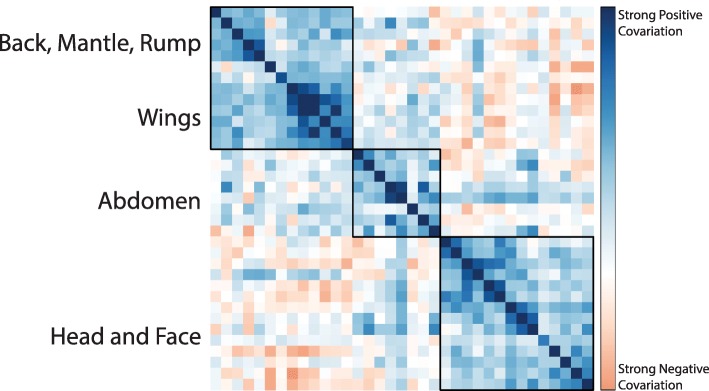
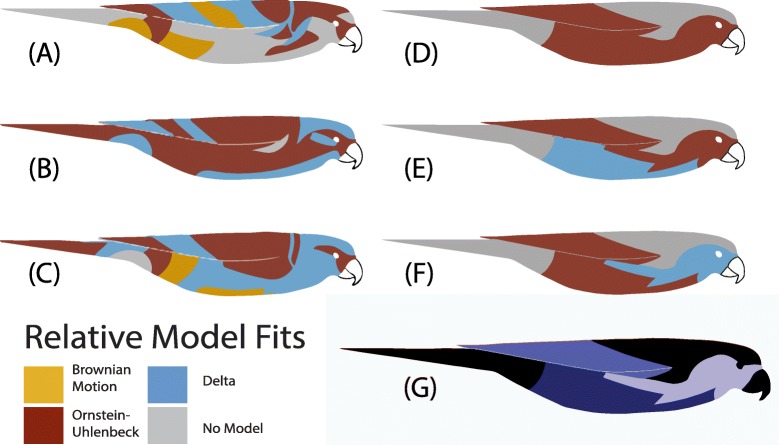
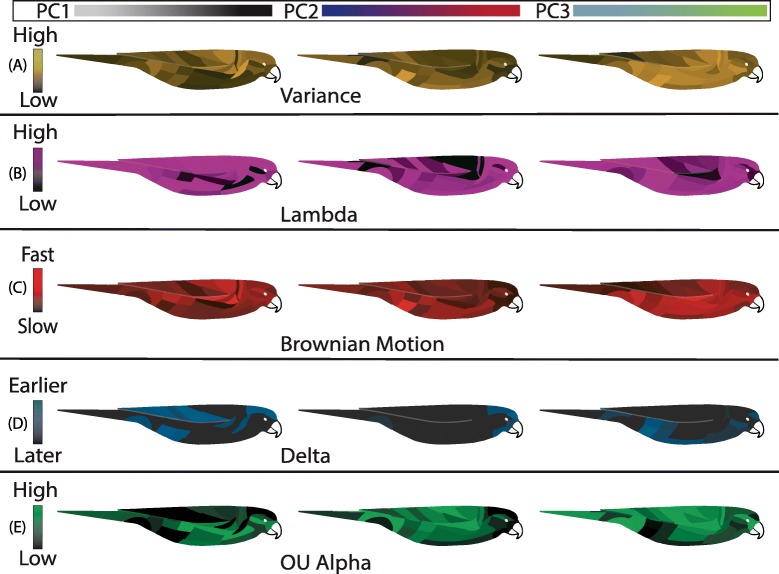
We found that alternative macroevolutionary models and varying rates best describe color evolution, a pattern consistent with our prediction that different plumage regions evolved in response to independent processes. Modeling plumage regions independently, in functional groups, and all together showed that patches with similar macroevolutionary models clustered together into distinct regions (e.g., head, wing, belly), which suggests that plumage does not evolve as a single trait in this group. Wing patches, which were conserved on a macroevolutionary scale, covaried with climate more strongly than plumage regions (e.g., head), which diversified in a burst.
Overall, our results support the hypothesis that the extraordinary color diversity in the lorikeets was generated by a mosaic of evolutionary processes acting on plumage region subsets. Partitioning of plumage regions in different parts of the body provides a mechanism that allows birds to evolve bright colors for signaling and remain hidden from predators or adapt to local climatic conditions.
鸟类的羽毛呈现出多种多样的颜色,这些颜色在信号传递、伪装和体温调节等方面发挥着功能作用。然而,鸟类必须在进化出有吸引力的信号以吸引配偶、最小化对捕食者的可见度以及优化对气候条件的适应之间保持平衡。研究羽毛颜色的宏观进化为理解这种在系统发育尺度上的动态相互作用提供了一个框架。由于单一的主导过程(如选择)而导致的羽毛进化可能会在所有身体区域产生相同的颜色变化的宏观进化模式。相比之下,独立的过程可能会划分羽毛并产生区域特异性的模式。为了检验这些替代方案,我们使用可见光和紫外线摄影以及比较方法,从博物馆标本中收集了华丽鸟类分支(即澳大拉西亚吸蜜鹦鹉)的颜色数据。我们预测,已知参与性信号传递的同源羽毛区域(例如面部)的多样化程度将比背部和翅膀上的羽毛区域受到的限制更小,因为在新的颜色状态可能会以伪装为代价。由于环境适应可能会导致进化朝着或远离颜色状态,因此我们测试了气候是否与受到更大或更小的宏观进化限制的羽毛区域更强烈地相关。
我们发现,替代的宏观进化模型和不同的进化速度最好地描述了颜色的进化,这一模式与我们的预测一致,即不同的羽毛区域是对独立的过程作出反应而进化的。将羽毛区域独立地、在功能组中以及全部一起进行建模表明,具有相似宏观进化模型的斑块聚集在一起形成不同的区域(例如头部、翅膀、腹部),这表明在这个群体中,羽毛不是作为一个单一的特征进行进化的。在宏观进化尺度上保守的翅膀斑块与气候的相关性比多样化爆发的羽毛区域(例如头部)更强。
总的来说,我们的结果支持了这样一种假设,即吸蜜鹦鹉非凡的颜色多样性是由作用于羽毛区域子集的一系列进化过程产生的。身体不同部位的羽毛区域的划分提供了一种机制,使鸟类能够进化出鲜艳的颜色用于信号传递,同时保持对捕食者的隐藏或适应当地的气候条件。