Medina Joshua J, Maley James M, Sannapareddy Siddharth, Medina Noah N, Gilman Cyril M, McCormack John E
Moore Laboratory of Zoology, Occidental College, Los Angeles, CA, United States of America.
PLoS One. 2020 Aug 13;15(8):e0236417. doi: 10.1371/journal.pone.0236417. eCollection 2020.
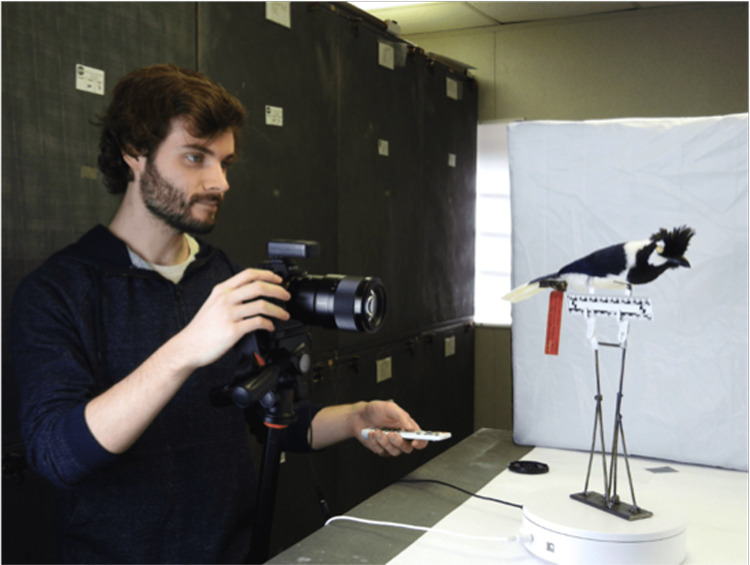
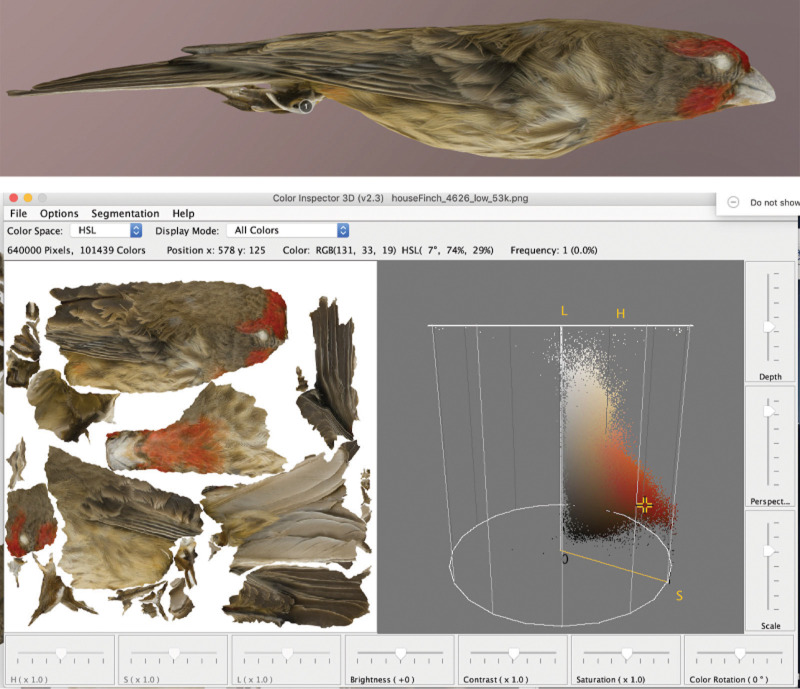
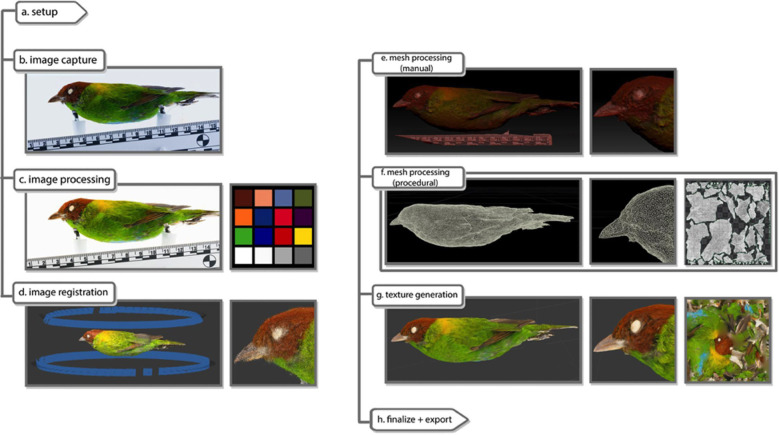
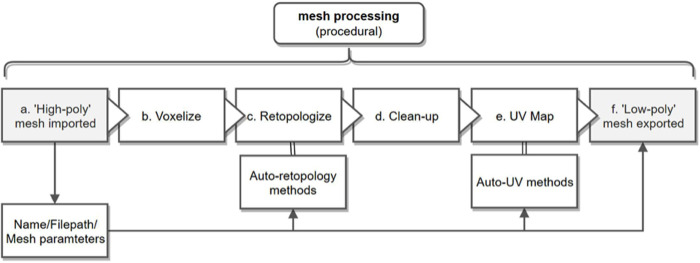
Natural history collections are yielding more information as digitization brings specimen data to researchers, connects specimens across museums, and as new technologies allow for more large-scale data collection. Therefore, a key goal in specimen digitization is developing methods that both increase access and allow for the highest yield of phenomic data. 3D digitization is increasingly popular because it has the potential to meet both aspects of that key goal. However, current methods overlook or do not prioritize some of the most sought-after phenotypic traits, those involving the external appearance of specimens, especially color. Here, we introduce an efficient and cost-effective pipeline for 3D photogrammetry to capture the external appearance of natural history specimens and other museum objects. 3D photogrammetry aligns and compares sets of dozens, hundreds, or even thousands of photos to create 3D models. The hardware set-up requires little physical space and around $3,000 in initial investment, while the software pipeline requires $1,400/year for proprietary software subscriptions (with open-source alternatives). The creation of each 3D model takes 1-2 hours/specimen and much of the software pipeline is automated with minimal supervision required, including the onerous step of mesh processing. We showcase the method by creating 3D models for most of the type specimens in the Moore Laboratory of Zoology bird collection and show that digital bill measurements are comparable to hand-taken measurements. Color data, while not included as part of this pipeline, is easily extractable from the models and one of the most promising areas of data collection. Future advances can adapt the method for ultraviolet reflectance capture and increased efficiency and model quality. Combined with genomic data, phenomic data from 3D models including photogrammetry will open new doors to understanding organismal evolution.
随着数字化将标本数据带给研究人员、连接各博物馆的标本,以及新技术允许进行更大规模的数据收集,自然历史标本收藏正在产生更多信息。因此,标本数字化的一个关键目标是开发既能增加获取途径又能实现最高表型数据产量的方法。三维数字化越来越受欢迎,因为它有潜力实现这一关键目标的两个方面。然而,目前的方法忽略或没有优先考虑一些最受关注的表型特征,即那些涉及标本外观的特征,尤其是颜色。在这里,我们介绍一种用于三维摄影测量的高效且经济高效的流程,以捕捉自然历史标本和其他博物馆藏品的外观。三维摄影测量对齐并比较数十张、数百张甚至数千张照片集,以创建三维模型。硬件设置所需的物理空间很小,初始投资约为3000美元,而软件流程每年需要1400美元用于购买专有软件订阅(有开源替代方案)。创建每个三维模型每个标本需要1 - 2小时,并且软件流程的大部分是自动化的,所需监督极少,包括繁琐的网格处理步骤。我们通过为动物学摩尔实验室鸟类收藏中的大多数模式标本创建三维模型来展示该方法,并表明数字喙部测量与手工测量相当。颜色数据虽然不包含在这个流程中,但很容易从模型中提取,并且是最有前景的数据收集领域之一。未来的进展可以使该方法适用于紫外线反射率捕捉,并提高效率和模型质量。与基因组数据相结合,来自包括摄影测量在内的三维模型的表型数据将为理解生物进化打开新的大门。