Sun Mei-Lan, Zhang Yong, Wang Bo, Ma Te-An, Jiang Hong, Hu Shou-Liang, Zhang Piao, Tuo Yan-Hong
Department of Blood Purification Center, The First Affiliated Hospital of Yangtze University, Jingzhou, Hubei, China.
Department of Nephrology, Jianli People's Hospital, Jingzhou, Hubei, China.
BMC Nephrol. 2020 Feb 24;21(1):60. doi: 10.1186/s12882-020-01724-w.
The application of laparoscopic catheterization technology in peritoneal dialysis (PD) patients has recently increased. However, the advantages and disadvantages of laparoscopic versus conventional open PD catheter placement are still controversial. The aim of this meta-analysis is to assess the complications of catheterization in PD patients and to provide a reference for choosing a PD-catheter placement technique in the clinic.
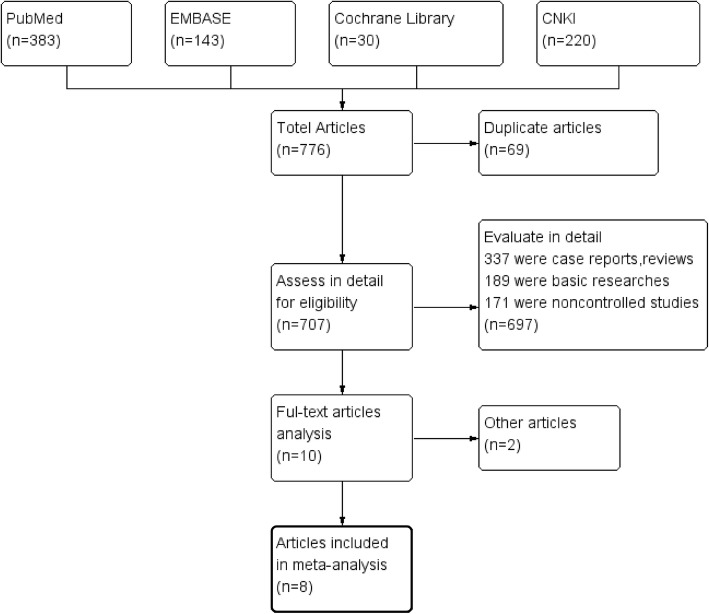
We searched numerous databases, including Embase, PubMed, CNKI and the Cochrane Library, for published randomized controlled trials (RCTs).
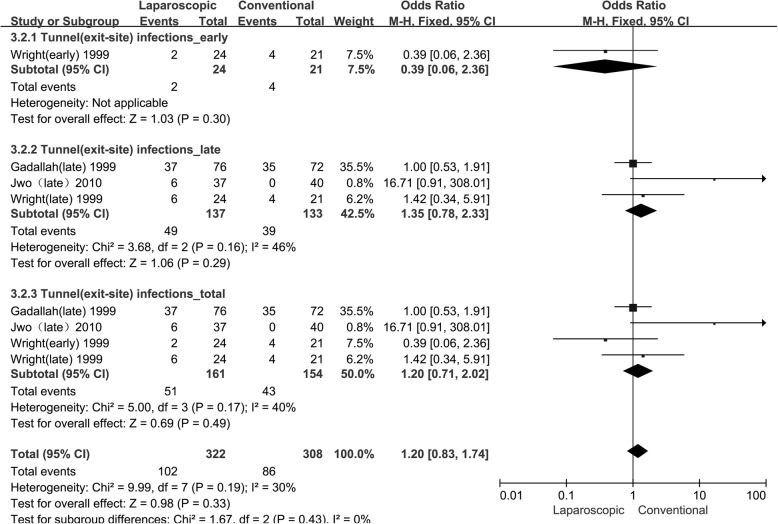
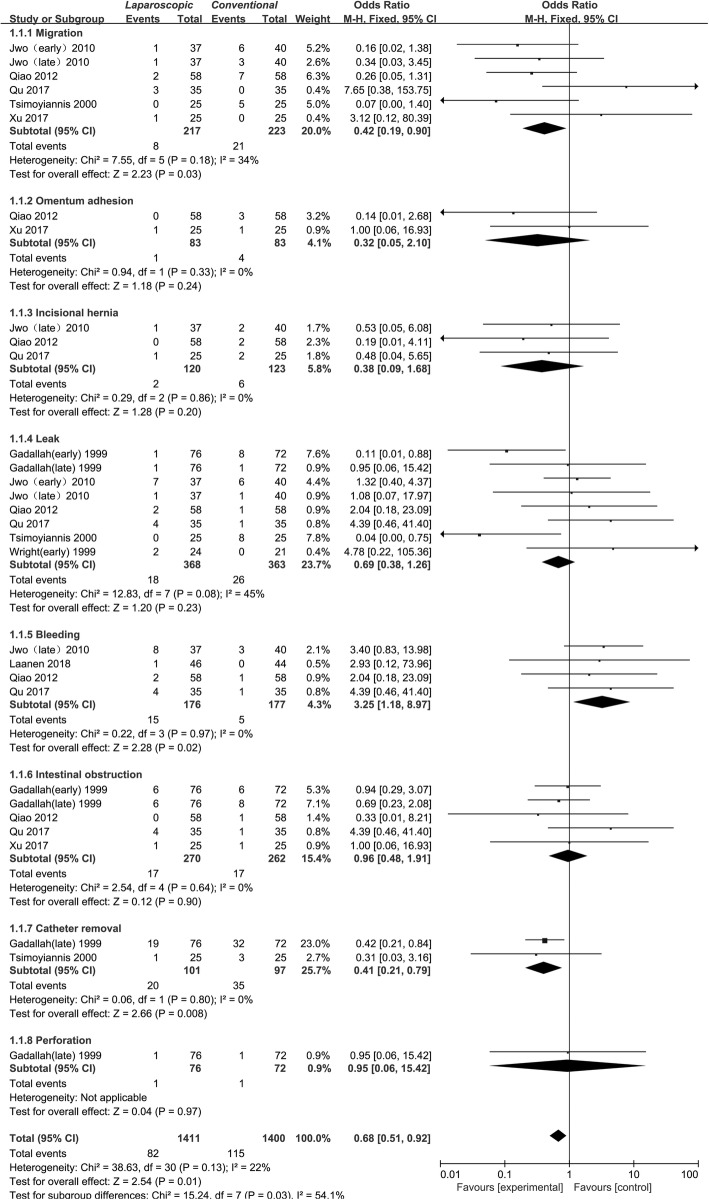
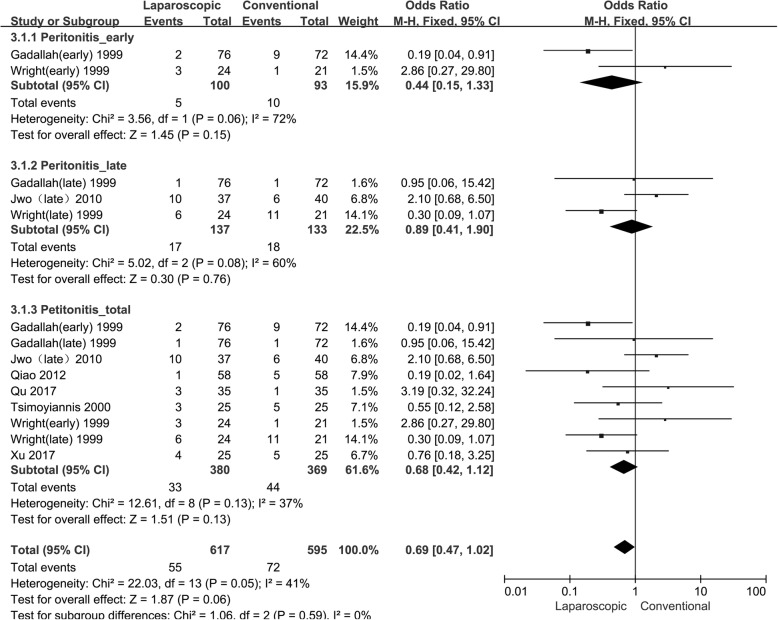
Eight relevant studies (n = 646) were included in the meta-analysis. The pooled results showed a lower incidence of catheter migration (OR: 0.42, 95% CI: 0.19 to 0.90, P: 0.03) and catheter removal (OR: 0.41, 95% CI: 0.21 to 0.79, P: 0.008) but a higher incidence of bleeding (OR: 3.25, 95% CI: 1.18 to 8.97, P: 0.02) with a laparoscopic approach than with a conventional approach. There was no significant difference in the incidence of omentum adhesion (OR: 0.32, 95% CI: 0.05 to 2.10, P: 0.24), hernia (OR: 0.38, 95% CI: 0.09 to 1.68, P: 0.20), leakage (OR: 0.69, 95% CI: 0.38 to 1.26, P: 0.23), intestinal obstruction (OR: 0.96, 95% CI: 0.48 to 1.91, P: 0.90) or perforation (OR: 0.95, 95% CI: 0.06 to 15.42, P: 0.97). The statistical analysis showed no significant difference in early (OR: 0.44, 95% CI: 0.15 to 1.33, P: 0.15), late (OR: 0.89, 95% CI: 0.41 to 1.90, P: 0.76) or total (OR: 0.68, 95% CI: 0.42 to 1.12, P: 0.13) peritonitis infections between the 2 groups, and there are no no significant difference in early (OR: 0.39, 95% CI: 0.06 to 2.36, P: 0.30), late (OR: 1.35, 95% CI: 0.78 to 2.33, P: 0.16) or total (OR: 1.20, 95% CI: 0.71 to 2.02, P: 0.17) tunnel or exit-site infections between the 2 groups.
Laparoscopic catheterization and conventional open catheter placement in PD patients have unique advantages, but laparoscopic PD catheterization may be superior to conventional open catheter placement. However, this conclusion needs to be confirmed with further large-sample-size, multi-centre, high-quality RCTs.
腹腔镜置管技术在腹膜透析(PD)患者中的应用近来有所增加。然而,腹腔镜与传统开放PD导管置入术的优缺点仍存在争议。本荟萃分析的目的是评估PD患者置管的并发症,并为临床选择PD导管置入技术提供参考。
我们检索了众多数据库,包括Embase、PubMed、中国知网和考克兰图书馆,以查找已发表的随机对照试验(RCT)。
荟萃分析纳入了8项相关研究(n = 646)。汇总结果显示,与传统方法相比,腹腔镜手术方法的导管移位发生率较低(比值比:0.42,95%置信区间:0.19至0.90,P值:0.03)和导管拔除率较低(比值比:0.41,95%置信区间:0.21至0.79,P值:0.008),但出血发生率较高(比值比:3.25,95%置信区间:1.18至8.97,P值:0.02)。大网膜粘连发生率(比值比:0.32,95%置信区间:0.05至2.10,P值:0.24)、疝发生率(比值比:0.38,95%置信区间:0.09至1.68,P值:0.20)、渗漏发生率(比值比:0.69,95%置信区间:0.38至1.26,P值:0.23)、肠梗阻发生率(比值比:0.96,95%置信区间:0.48至1.91,P值:0.90)或穿孔发生率(比值比:0.95,95%置信区间:0.06至15.42,P值:0.97)无显著差异。统计分析显示,两组之间早期(比值比:0.44,95%置信区间:0.15至1.33,P值:0.15)、晚期(比值比:0.89,95%置信区间:0.41至1.90,P值:0.76)或总体(比值比:0.68,95%置信区间:0.42至1.12,P值:0.13)腹膜炎感染发生率无显著差异,两组之间早期(比值比:0.39,95%置信区间:0.06至2.36,P值:0.30)、晚期(比值比:1.35,95%置信区间:0.78至2.33,P值:0.16)或总体(比值比:1.20,95%置信区间:0.71至2.02,P值:0.17)隧道或出口部位感染发生率无显著差异。
PD患者的腹腔镜置管和传统开放导管置入术各有独特优势,但腹腔镜PD置管术可能优于传统开放导管置入术。然而,这一结论需要通过进一步的大样本、多中心、高质量RCT来证实。