School of Public Health, the University of Queensland, Brisbane, Australia.
Institute of Tropical Medicine, Antwerp, Belgium.
Global Health. 2020 Feb 24;16(1):17. doi: 10.1186/s12992-020-00549-4.
The third Sustainable Development Goal (SDG - 3) aims to ensure healthy lives and promote well-being for all at all ages. SDG-3 has a specific target on universal health coverage (UHC), which emphasizes the importance of all people and communities having access to quality health services without risking financial hardship. The objective of this study is to review progress towards UHC using antiretroviral treatment (ART) as a case study.
We used a mixed-methods design including qualitative and quantitative approaches. We reviewed and synthesised the evidence on the evolution of the WHO HIV treatment guidelines between 2002 and 2019. We calculated ART coverage over time by gender, age group, and location. We also estimated ART coverage differences and ratios.
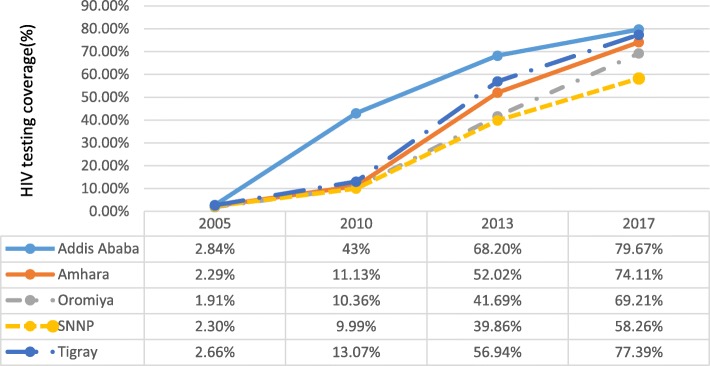
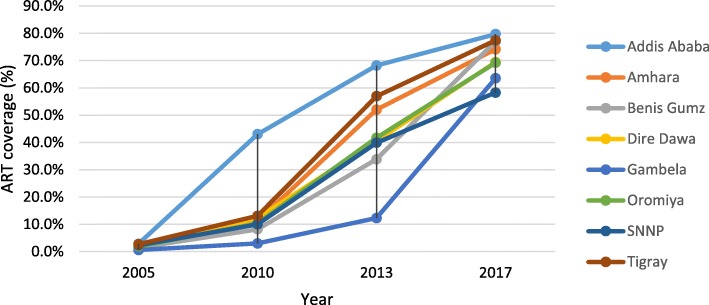
ART guidelines have evolved from "treating the sickest" to "treating all". ART coverage increased globally from under 7% in 2005 to 62% in 2018. There have been successes in increasing ART coverage in all populations and locations. However, progress varies by population and location in many regions. There is inequity in ART coverage: women (68%) versus men (55%), and adults (62%) versus children (54%). This inequity has widened over time, and with expanded ART eligibility criteria. On the other hand, data from at least one high-burden country (Ethiopia) shows that inequity among regions has narrowed over time due to the improvements in the primary health care systems and implementation of the public health approach in the country.
ART coverage has increased at global, regional and national levels to all population groups. However, the gains have not been equitable among locations and populations. Policies towards universality may widen the inequity in resource-limited settings unless countries take precautions and "put the last first". We argue that primary health care and public health approaches, with multi-sectoral actions and community engagement, are vital to minimize inequity, achieve UHC and leave no one behind.
第三个可持续发展目标(SDG-3)旨在确保所有人在所有年龄段都能享有健康的生活并促进福祉。SDG-3 有一个关于全民健康覆盖(UHC)的具体目标,强调所有人和社区都能获得高质量的卫生服务,而不会陷入经济困境。本研究的目的是通过抗逆转录病毒治疗(ART)作为案例研究来审查 UHC 的进展情况。
我们使用了一种混合方法设计,包括定性和定量方法。我们审查并综合了 2002 年至 2019 年期间世卫组织艾滋病毒治疗指南演变的证据。我们按性别、年龄组和地点计算了随时间推移的 ART 覆盖率。我们还估计了 ART 覆盖率的差异和比例。
ART 指南已经从“治疗最严重的病人”发展到“治疗所有人”。全球的 ART 覆盖率从 2005 年的不足 7%上升到 2018 年的 62%。在所有人群和地点都取得了增加 ART 覆盖率的成功。然而,在许多地区,进展因人群和地点而异。在 ART 覆盖率方面存在不平等现象:女性(68%)与男性(55%),成年人(62%)与儿童(54%)。这种不平等现象随着时间的推移而扩大,并且随着 ART 资格标准的扩大而扩大。另一方面,来自至少一个高负担国家(埃塞俄比亚)的数据表明,由于该国初级卫生保健系统的改善和公共卫生方法的实施,区域间的不平等现象随着时间的推移而缩小。
全球、区域和国家各级的 ART 覆盖率都有所增加,覆盖了所有人群。然而,在地点和人群之间,收益并不平等。在资源有限的环境中,普及政策可能会扩大资源不平等,除非各国采取预防措施并“将最后一个放在首位”。我们认为,初级卫生保健和公共卫生方法,以及多部门行动和社区参与,对于最大限度地减少不平等、实现全民健康覆盖和不落下任何人至关重要。