College of Tobacco Science, Flavors and Fragrance Engineering & Technology Research Center of Henan Province, Henan Agricultural University, Zhengzhou, 450002, P.R. China.
Sci Rep. 2020 Feb 24;10(1):3285. doi: 10.1038/s41598-020-60160-w.
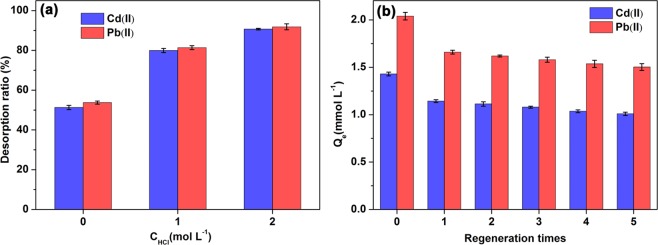
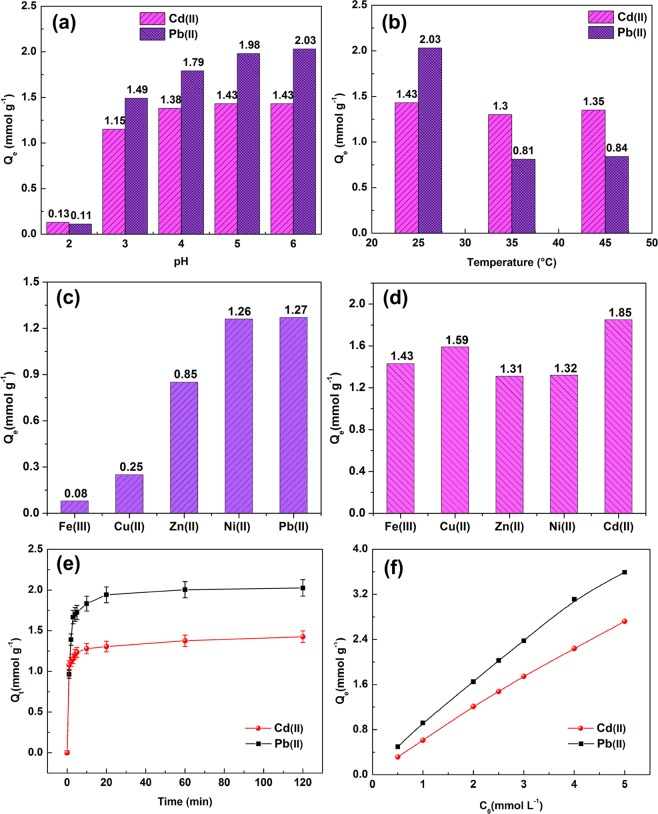
A waste biomass based hydrogel soybean residue-poly(acrylic acid) (SR-PAA) was prepared through a fast one-step reaction by UV radiation technology. SR-PAA was used to remove Cd(II) and Pb(II) ions from aqueous solutions. Effect of pH value, temperature, initial concentration, contact time, competitive ions in the solutions on metal ions adsorption and desorption/regeneration capacity of SR-PAA was discussed in detailed. It was found that the adsorption equilibrium was achieved within 20 min, and maximum adsorption for Cd(II) and Pb(II) ions were 1.43 and 2.04 mmol g, respectively. Besides, adsorption thermodynamic analysis indicates that the process of Cd(II) and Pb(II) ions adsorption was spontaneous, feasible and exothermic in nature. And experimental data fitted the pseudo-second-order and Freundlich isotherm model well. Moreover, XPS spectra analysis proves that the metal ions were adsorbed on SR-PAA due to the interaction of carboxyl, hydroxyl and amine with these ions as ionic bond, coordination bond and electrostatic interaction.
采用 UV 辐射技术,通过快速一步反应制备了基于废生物质的水凝胶-大豆残渣-聚丙烯酸(SR-PAA)。SR-PAA 用于从水溶液中去除 Cd(II)和 Pb(II)离子。详细讨论了 pH 值、温度、初始浓度、接触时间、溶液中竞争离子对金属离子吸附和解吸/再生能力的影响。结果表明,吸附平衡在 20 min 内达到,对 Cd(II)和 Pb(II)离子的最大吸附量分别为 1.43 和 2.04 mmol·g-1。此外,吸附热力学分析表明,Cd(II)和 Pb(II)离子吸附过程是自发的、可行的,本质上是放热的。实验数据很好地拟合了准二级和 Freundlich 等温线模型。此外,XPS 谱图分析证明,金属离子通过与羧基、羟基和胺的相互作用,以离子键、配位键和静电相互作用吸附在 SR-PAA 上。