Department of Neurology, Graduate School of Medicine, Kyoto University, 54 Shogoin-Kawahara-cho, Sakyo-ku, Kyoto, Japan.
Transl Neurodegener. 2020 Feb 17;9:7. doi: 10.1186/s40035-020-0185-5. eCollection 2020.
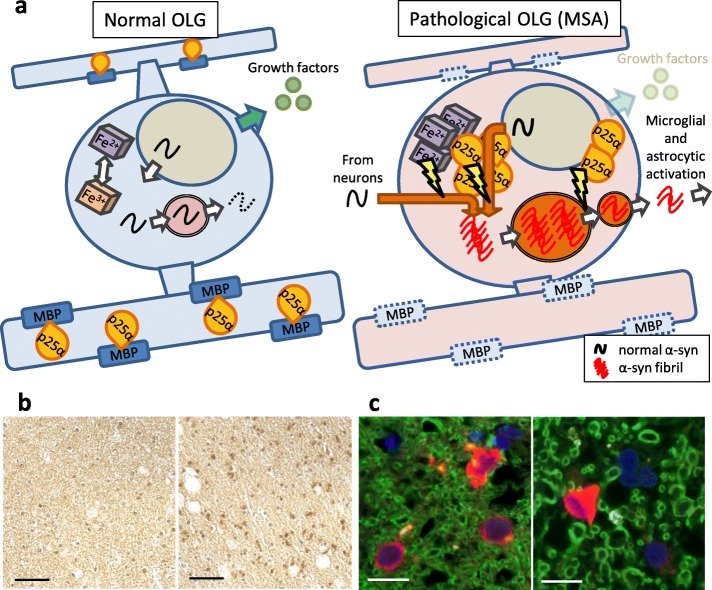
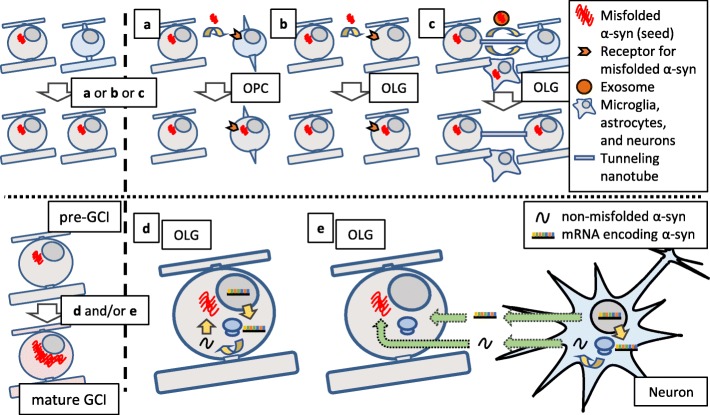
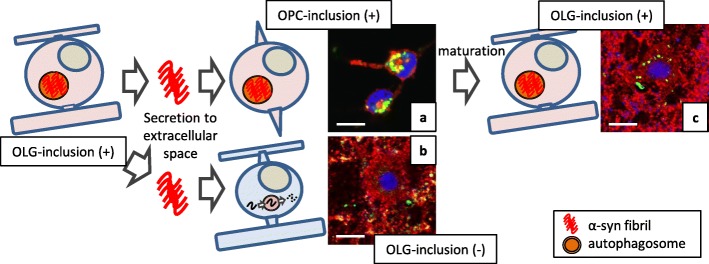
Multiple system atrophy (MSA) is a debilitating and fatal neurodegenerative disorder. The disease severity warrants urgent development of disease-modifying therapy, but the disease pathogenesis is still enigmatic. Neurodegeneration in MSA brains is preceded by the emergence of glial cytoplasmic inclusions (GCIs), which are insoluble α-synuclein accumulations within oligodendrocytes (OLGs). Thus, preventive strategies against GCI formation may suppress disease progression. However, although numerous studies have tried to elucidate the molecular pathogenesis of GCI formation, difficulty remains in understanding the pathological interaction between the two pivotal aspects of GCIs; α-synuclein and OLGs. The difficulty originates from several enigmas: 1) what triggers the initial generation and possible propagation of pathogenic α-synuclein species? 2) what contributes to OLG-specific accumulation of α-synuclein, which is abundantly expressed in neurons but not in OLGs? and 3) how are OLGs and other glial cells affected and contribute to neurodegeneration? The primary pathogenesis of GCIs may involve myelin dysfunction and dyshomeostasis of the oligodendroglial cellular environment such as autophagy and iron metabolism. We have previously reported that oligodendrocyte precursor cells are more prone to develop intracellular inclusions in the presence of extracellular fibrillary α-synuclein. This finding implies a possibility that the propagation of GCI pathology in MSA brains is mediated through the internalization of pathological α-synuclein into oligodendrocyte precursor cells. In this review, in order to discuss the pathogenesis of GCIs, we will focus on the composition of neuronal and oligodendroglial inclusions in synucleinopathies. Furthermore, we will introduce some hypotheses on how α-synuclein pathology spreads among OLGs in MSA brains, in the light of our data from the experiments with primary oligodendrocyte lineage cell culture. While various reports have focused on the mysterious source of α-synuclein in GCIs, insights into the mechanism which regulates the uptake of pathological α-synuclein into oligodendroglial cells may yield the development of the disease-modifying therapy for MSA. The interaction between glial cells and α-synuclein is also highlighted with previous studies of post-mortem human brains, cultured cells, and animal models, which provide comprehensive insight into GCIs and the MSA pathomechanisms.
多系统萎缩(MSA)是一种使人虚弱和致命的神经退行性疾病。疾病的严重程度需要紧急开发疾病修饰疗法,但疾病的发病机制仍然是个谜。MSA 大脑中的神经退行性变是由神经胶质细胞质包涵体(GCIs)的出现引起的,这些包涵体是在少突胶质细胞(OLGs)内的不溶性α-突触核蛋白积聚。因此,预防 GCI 形成的策略可能会抑制疾病的进展。然而,尽管有许多研究试图阐明 GCI 形成的分子发病机制,但仍然难以理解 GCI 形成的两个关键方面之间的病理相互作用;α-突触核蛋白和 OLGs。这种困难源于几个谜团:1)是什么引发了致病性α-突触核蛋白的初始产生和可能的传播?2)是什么导致α-突触核蛋白在神经元中大量表达但不在 OLGs 中特异性积累?3)OLGs 和其他神经胶质细胞是如何受到影响并导致神经退行性变的?GCIs 的主要发病机制可能涉及髓鞘功能障碍和少突胶质细胞细胞环境的动态平衡,如自噬和铁代谢。我们之前报道说,在存在细胞外纤维状α-突触核蛋白的情况下,少突胶质前体细胞更容易形成细胞内包涵体。这一发现暗示了一种可能性,即 MSA 大脑中 GCI 病理学的传播是通过将病理α-突触核蛋白内化到少突胶质前体细胞中来介导的。在这篇综述中,为了讨论 GCIs 的发病机制,我们将重点讨论突触核蛋白病中神经元和少突胶质细胞包涵体的组成。此外,我们将根据我们在原代少突胶质细胞系培养实验中的数据,介绍一些关于 MSA 大脑中α-突触核蛋白病理学如何在 OLGs 中传播的假说。虽然有各种报告集中在 GCIs 中α-突触核蛋白的神秘来源上,但对调节病理α-突触核蛋白进入少突胶质细胞摄取的机制的了解可能会为 MSA 的疾病修饰疗法的发展提供依据。以前对死后人类大脑、培养细胞和动物模型的研究也强调了胶质细胞与α-突触核蛋白之间的相互作用,为 GCI 和 MSA 发病机制提供了全面的认识。