Li Bofei, Hu Xuechen
Department of Surgery, The University of Hong Kong, Queen Mary Hospital, Hong Kong, SAR, People's Republic of China.
School of Nursing, Xi'an Medical University, Xi'an, People's Republic of China.
Cancer Manag Res. 2019 Dec 31;11:10949-10955. doi: 10.2147/CMAR.S234738. eCollection 2019.
Although prior studies have shown that marital status affects the prognosis of patients with gastric cancer, its time-varying effects are not well understood. We aimed to investigate the changes in marital status' impact over a 10-year follow-up time among patients with gastric cancer (GC) in the United States.
All patients with gastric cancer diagnosed between 2004 and 2008 in the Surveillance, Epidemiology, and End Results (SEER) database were retrieved. Married patients and unmarried patients (single, separated, divorced or widowed) with complete survival time were selected for comparisons. A total of 14,545 patients who had clinical data and follow-up information available were enrolled. We used Kaplan-Meier analyses and time-dependent flexible parametric models to estimate time-varying hazard ratios (HRs).
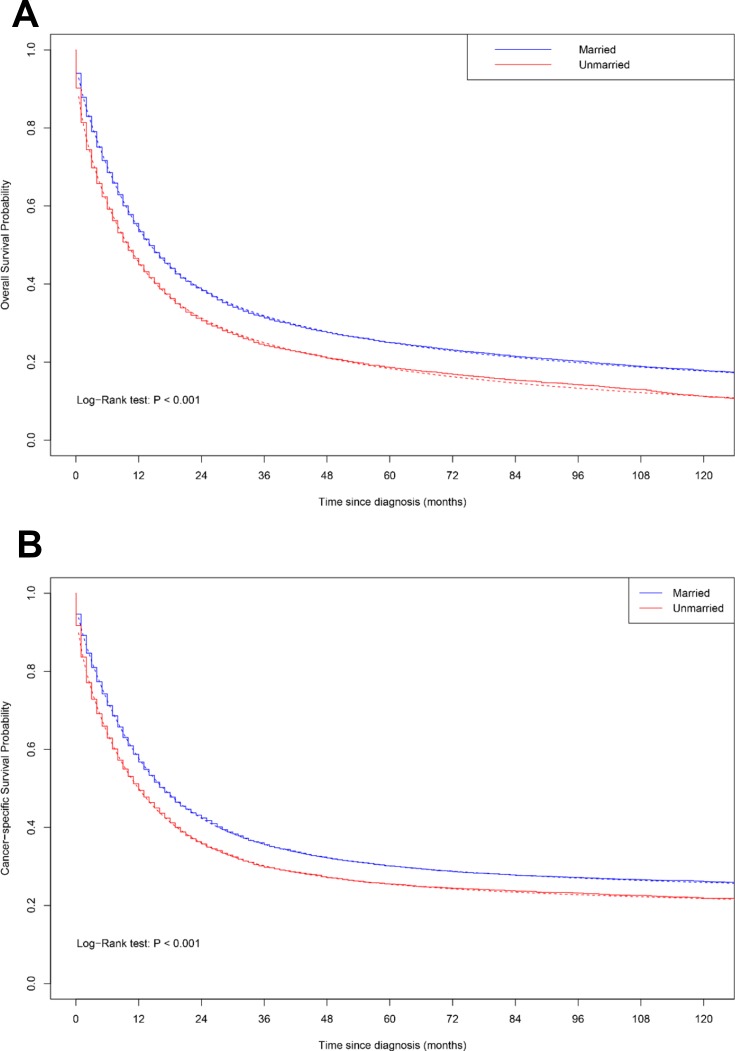
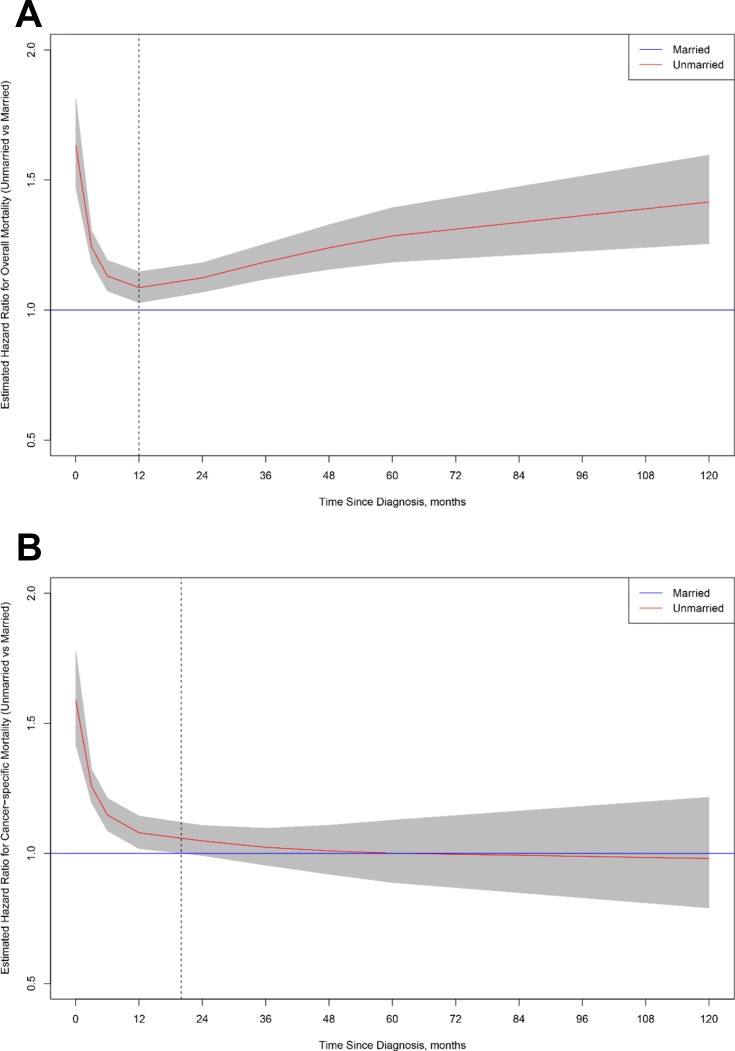
Unmarried GC patients had worse overall and cancer-specific survival compared with married patients (log-rank test: P < 0.001 and P < 0.001, respectively). The time-varying analysis found that unmarried patients had a significantly higher risk of overall mortality during the 10-year follow-up time, with the lowest adjusted hazard ratio (HR) at 12 months after diagnosis (HR at 12 months, 1.08; 95% CI, 1.03-1.15). For cancer-specific mortality, the time-varying adjusted HR of unmarried patients was significantly higher initially (HR at 12 months, 1.08; 95% CI, 1.02-1.14) but decreased to null after 20 months (HR at 24 months = 1.04; 95% CI = 0.99-1.11).
Unmarried patients had a higher risk of cancer-specific mortality during the 20 months after gastric cancer diagnosis, which may be an appropriate time frame for intervention.
尽管先前的研究表明婚姻状况会影响胃癌患者的预后,但其随时间变化的影响尚未得到充分理解。我们旨在调查美国胃癌(GC)患者在10年随访期间婚姻状况影响的变化。
检索了监测、流行病学和最终结果(SEER)数据库中2004年至2008年期间诊断出的所有胃癌患者。选择有完整生存时间的已婚患者和未婚患者(单身、分居、离婚或丧偶)进行比较。共纳入了14545例有临床数据和随访信息的患者。我们使用Kaplan-Meier分析和时间依赖的灵活参数模型来估计随时间变化的风险比(HRs)。
与已婚患者相比,未婚GC患者的总生存率和癌症特异性生存率更差(对数秩检验:P < 0.001和P < 0.001,分别)。随时间变化的分析发现,未婚患者在10年随访期间总体死亡风险显著更高,诊断后12个月时调整后的风险比(HR)最低(12个月时HR为1.08;95%CI,1.03 - 1.15)。对于癌症特异性死亡,未婚患者随时间变化的调整后HR最初显著更高(12个月时HR为1.08;95%CI,1.02 - 1.14),但在20个月后降至无差异(24个月时HR = 1.04;95%CI = 0.99 - 1.11)。
未婚患者在胃癌诊断后的20个月内癌症特异性死亡风险更高,这可能是一个合适的干预时间框架。