Adégbidi Hugues, Akpadjan Fabrice, Houngbo Odile, Vigan Jacques, Dégboé Bérénice, Agbessi Nadège, Koudoukpo Christiane, Atadokpèdé Félix
Department of Dermatology and Venereology of the National Teaching Hospital, Hubert Koutoukou Maga (NTH-HKM) of Cotonou, Cotonou, Benin.
Faculty of Health Sciences, University of Abomey-Calavi, Cotonou, Benin.
Dermatol Res Pract. 2020 Feb 13;2020:9186309. doi: 10.1155/2020/9186309. eCollection 2020.
. Dermatological damage in chronic hemodialysis patients is not uncommon. In Benin, to date, no study on the dermatological manifestations of chronic hemodialysis patients has been carried out. However, the presence of cutaneous signs is evident in these patients, and the need for dermatological care is not negligible. The objective of this study was to identify the epidemiological and clinical profile of the main dermatological manifestations presented by chronic hemodialysis patients at the NTH-HKM of Cotonou (Benin).
This was a descriptive cross-sectional study conducted in chronic hemodialysis patients from May 15th to September 15th, 2018. Included were all patients seen during the study period who had been on hemodialysis for at least three months, had at least one dermatological manifestation, and gave verbal or written consent. Chronic hemodialysis patients who did not wish to participate in the survey were excluded.
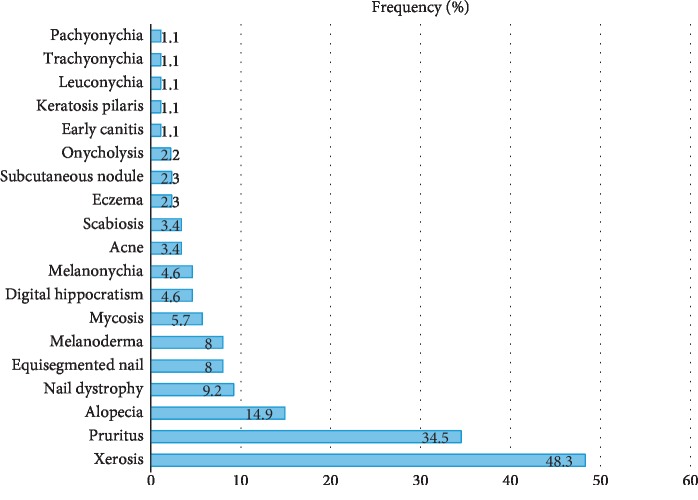
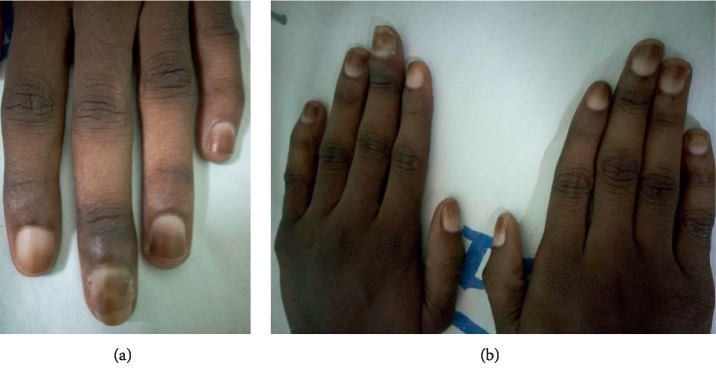
87 patients were included in the study for a hospital frequency of 33.8%. The sex ratio (male to female) was 2. The median age was 49 years (IQ [40.75-59]). Median age in hemodialysis was 36 months with two weekly sessions. The main dermatological manifestations were xerosis (48.3%), pruritus (34.5%), alopecia (14%), nail dystrophy (9.2%), equisegmented nails (8%), and melanoderma (8%). Pruritus was associated with a longer duration of hemodialysis sessions (=0.01), while xerosis, alopecia, and melanoderma were associated with seniority in hemodialysis.
Cutaneous manifestations in hemodialysis patients were frequent and dominated by xerosis, pruritus, and alopecia. Factors associated with some of these dermatologic manifestations were seniority in hemodialysis, long duration of the hemodialysis session, and female gender.
慢性血液透析患者的皮肤损伤并不罕见。在贝宁,迄今为止,尚未开展关于慢性血液透析患者皮肤表现的研究。然而,这些患者中皮肤体征明显,皮肤护理需求不可忽视。本研究的目的是确定科托努(贝宁)NTH - HKM慢性血液透析患者出现的主要皮肤表现的流行病学和临床特征。
这是一项描述性横断面研究,于2018年5月15日至9月15日在慢性血液透析患者中进行。纳入研究的对象为在研究期间接受血液透析至少三个月、至少有一处皮肤表现且给予口头或书面同意的所有患者。不希望参与调查的慢性血液透析患者被排除。
87名患者纳入研究,住院发生率为33.8%。男女比例为2。中位年龄为49岁(四分位间距[40.75 - 59])。血液透析中位时长为36个月,每周进行两次透析。主要皮肤表现为皮肤干燥(48.3%)、瘙痒(34.5%)、脱发(14%)、甲营养不良(9.2%)、均等甲(8%)和黑皮病(8%)。瘙痒与血液透析疗程较长相关(=0.01),而皮肤干燥、脱发和黑皮病与血液透析年限相关。
血液透析患者的皮肤表现常见,以皮肤干燥、瘙痒和脱发为主。其中一些皮肤表现相关因素为血液透析年限、血液透析疗程长和女性性别。