Betjes Michiel G H, Sablik Kasia S, Otten Henny G, Roelen Dave L, Claas Frans H, de Weerd Annelies
Department of Nephrology & Transplantation, Erasmus Medical Center, Rotterdam, Netherlands.
Laboratory of Translational Immunology, University Medical Center Utrecht, Utrecht, Netherlands.
J Transplant. 2020 Jan 29;2020:5694670. doi: 10.1155/2020/5694670. eCollection 2020.
The presence of donor-specific antibodies (DSAs) against HLA before kidney transplantation has been variably associated with decreased long-term graft survival. Data on the relation of pretransplant DSA with rejection and cause of graft failure in recipients of donor kidneys are scarce.
Patients transplanted between 1995 and 2005 were included and followed until 2016. Donor-specific antibodies before transplantation were determined retrospectively. For cause, renal transplant biopsies were reviewed.
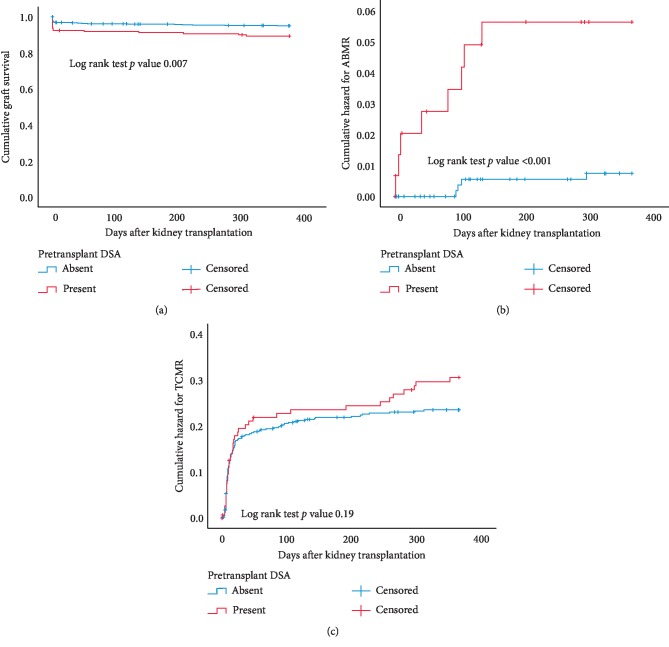
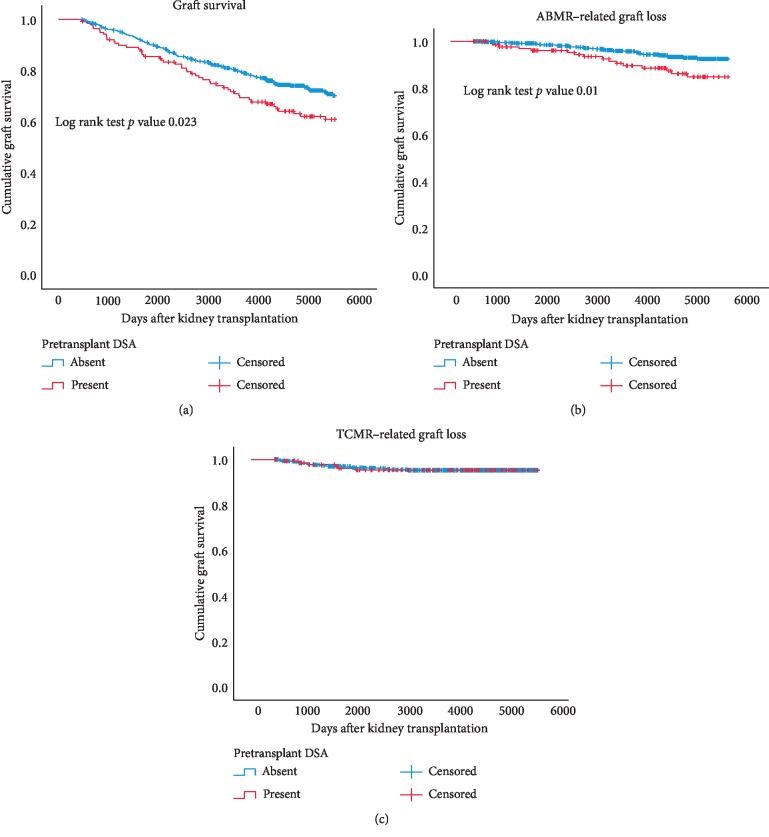
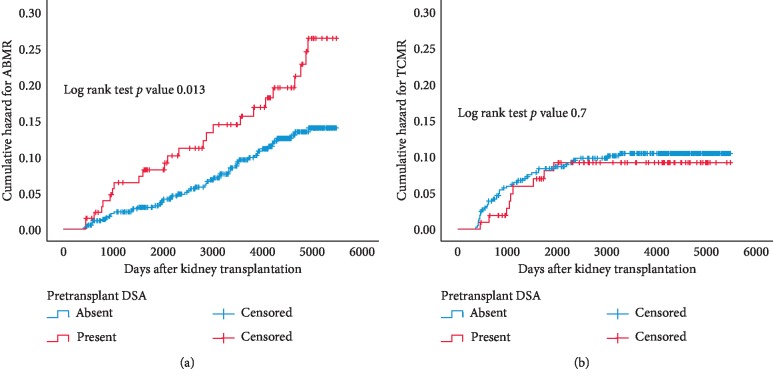
Pretransplant DSAs were found in 160 cases on a total of 734 transplantations (21.8%). In 80.5% of graft failures, a diagnostic renal biopsy was performed. The presence of pretransplant DSA (DSApos) increased the risk of graft failure within the first 3 months after transplantation (5.2% vs. 9.4%) because of rejection with intragraft thrombosis ( < 0.01). One year after transplantation, DSApos recipients had an increased hazard for antibody-mediated rejection at 10 years (9% DSAneg vs. 15% DSApos, < 0.01). One year after transplantation, DSApos recipients had an increased hazard for antibody-mediated rejection at 10 years (9% DSAneg vs. 15% DSApos, < 0.01). One year after transplantation, DSApos recipients had an increased hazard for antibody-mediated rejection at 10 years (9% DSAneg vs. 15% DSApos.
Pretransplant DSAs are a risk factor for early graft loss and increase the incidence for humoral rejection and graft loss but do not affect the risk for T cell-mediated rejection.
肾移植前针对人类白细胞抗原(HLA)的供者特异性抗体(DSA)的存在与长期移植物存活降低的相关性存在差异。关于肾移植受者移植前DSA与排斥反应及移植物失败原因之间关系的数据较少。
纳入1995年至2005年间接受移植的患者并随访至2016年。回顾性确定移植前的供者特异性抗体。对于病因,对肾移植活检进行评估。
在总共734例移植中,160例(21.8%)发现移植前DSA。在80.5%的移植物失败病例中,进行了诊断性肾活检。移植前DSA(DSA阳性)的存在增加了移植后前3个月内由于伴有移植物内血栓形成的排斥反应导致的移植物失败风险(5.2%对9.4%,P<0.01)。移植后1年,DSA阳性受者在10年时发生抗体介导排斥反应的风险增加(DSA阴性者为9%,DSA阳性者为15%,P<0.01)。移植后1年,DSA阳性受者在10年时发生抗体介导排斥反应的风险增加(DSA阴性者为9%,DSA阳性者为15%,P<0.01)。移植后1年,DSA阳性受者在10年时发生抗体介导排斥反应的风险增加(DSA阴性者为9%,DSA阳性者为15%)。
移植前DSA是早期移植物丢失的危险因素,增加了体液性排斥反应和移植物丢失的发生率,但不影响T细胞介导排斥反应的风险。