Yu Hee Tae, Yang Pil Sung, Hwang Jinseub, Ryu Soorack, Jang Eunsun, Kim Tae Hoon, Uhm Jae Sun, Kim Jong Youn, Pak Hui Nam, Lee Moon Hyoung, Lip Gregory Y H, Joung Boyoung
Division of Cardiology, Department of Internal Medicine, Yonsei University College of Medicine, Seoul, Korea.
Department of Cardiology, CHA Bundang Medical Center, CHA University, Seongnam, Korea.
Korean Circ J. 2020 Mar;50(3):267-277. doi: 10.4070/kcj.2019.0207.
Nationwide social inequalities of oral anticoagulation (OAC) usage after the introduction of non-vitamin K antagonist oral anticoagulants (NOACs) have not been well identified in patients with atrial fibrillation (AF). This study assessed overall rate and social inequalities of OAC usage after the introduction of NOAC in Korea.
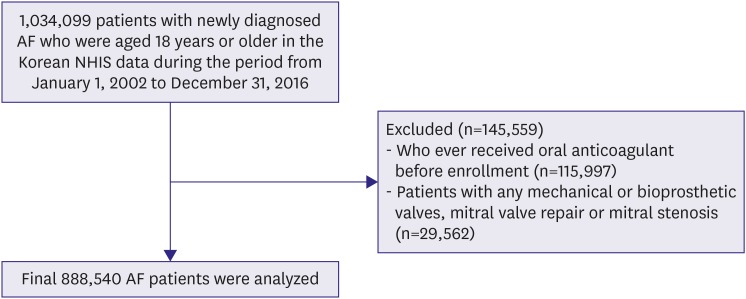
Between January 2002 and December 2016, we identified 888,540 patients with AF in the Korea National Health Insurance system database. The change of OAC rate in different medical systems after the introduction of NOAC were evaluated.
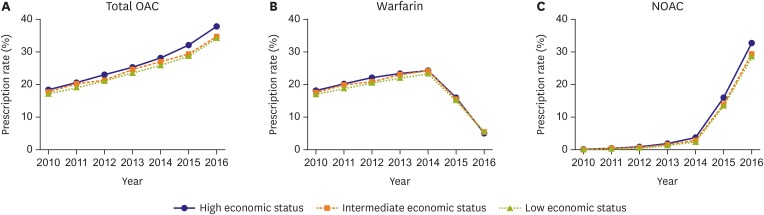
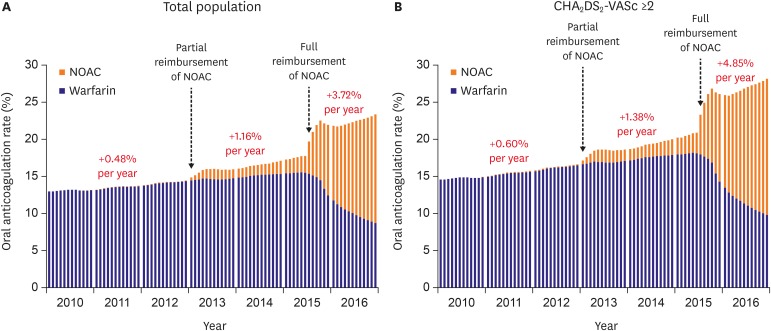
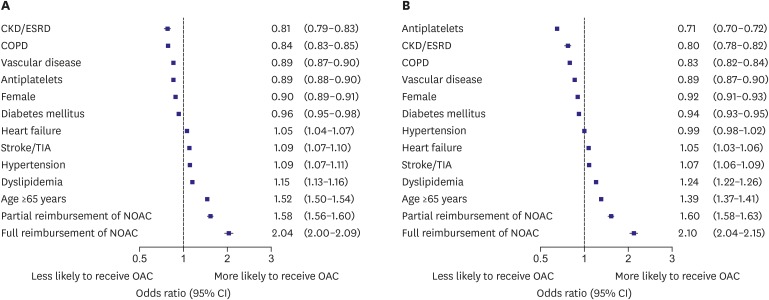
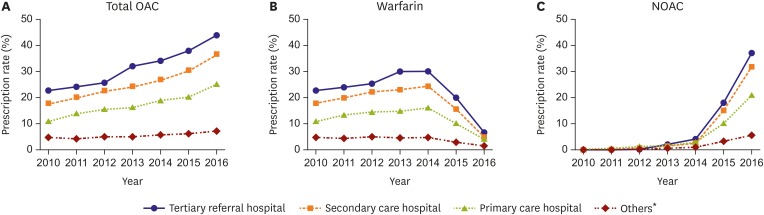
In all population, overall OAC use increased from 13.2% to 23.4% (p for trend <0.001), and NOAC use increased from 0% to 14.6% (p for trend <0.001). Compared with pre-reimbursement (0.48%), the annual increase of OAC use was significantly higher after partial (1.16%, p<0.001), and full reimbursement of OAC (3.72%, p<0.001). Full reimbursement of NOAC (adjusted odds ratio, 2.10; 95% confidence interval, 2.04-2.15) was independently associated with higher OAC use. However, the difference of overall OAC usage between tertiary referral hospitals and nursing or public health centers increased from 17.9% in 2010 to 36.8% in 2016. Moreover, usage rate of NOAC was significantly different among different medical systems from 37.2% at the tertiary referral hospital and 5.5% at nursing or public health centers.
Introduction of NOACs in routine practice for stroke prevention in AF was associated with improved rates of overall OAC use. However, significant practice-level variations in OAC and NOAC use remain producing social inequalities of OAC despite full reimbursement.
在非维生素K拮抗剂口服抗凝药(NOACs)引入后,韩国房颤(AF)患者口服抗凝治疗(OAC)的全国性社会不平等现象尚未得到充分认识。本研究评估了韩国引入NOAC后OAC使用的总体率和社会不平等情况。
2002年1月至2016年12月期间,我们在韩国国民健康保险系统数据库中识别出888,540例房颤患者。评估了引入NOAC后不同医疗系统中OAC率的变化。
在所有人群中,总体OAC使用率从13.2%增至23.4%(趋势p<0.001),NOAC使用率从0%增至14.6%(趋势p<0.001)。与未报销前(0.48%)相比,OAC部分报销后(1.16%,p<0.001)和完全报销后(3.72%,p<0.001),OAC使用的年增长率显著更高。NOAC完全报销(调整优势比,2.10;95%置信区间,2.04 - 2.15)与更高的OAC使用独立相关。然而,三级转诊医院与护理或公共卫生中心之间总体OAC使用的差异从2010年的17.9%增至2016年的36.8%。此外,不同医疗系统中NOAC的使用率差异显著,三级转诊医院为37.2%,护理或公共卫生中心为5.5%。
在房颤卒中预防的常规实践中引入NOAC与总体OAC使用率的提高相关。然而,尽管完全报销,OAC和NOAC使用在实践层面仍存在显著差异,导致OAC的社会不平等现象。