Brandl Fabian, Bergwinkl Sebastian, Allacher Carina, Dick Bernhard
Institut für Physikalische und Theoretische Chemie, Universität Regensburg, Universitätsstraße 31, 93053, Regensburg, Germany.
Chemistry. 2020 Jun 23;26(35):7946-7954. doi: 10.1002/chem.201905167. Epub 2020 May 26.
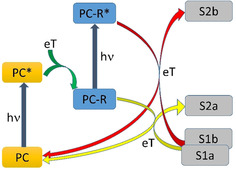
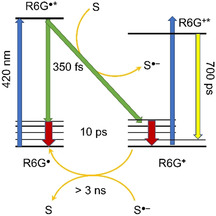
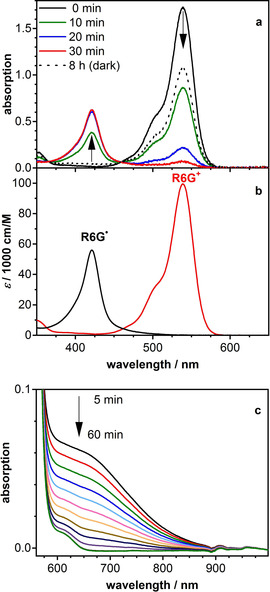
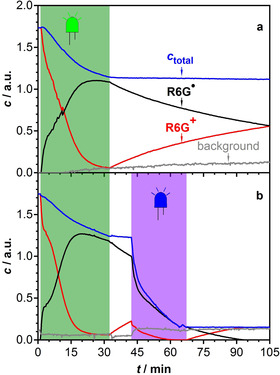
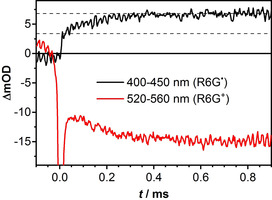
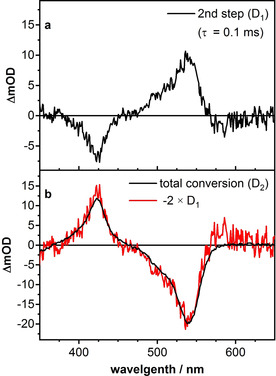
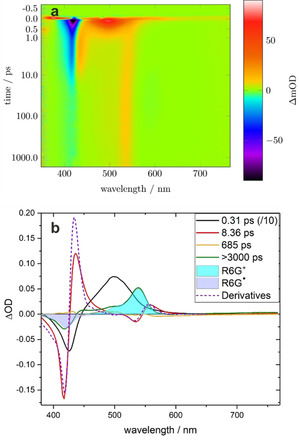
The dye rhodamine 6G can act as a photocatalyst through photoinduced electron transfer. After electronic excitation with green light, rhodamine 6G takes an electron from an electron donor, such as N,N-diisopropylethylamine, and forms the rhodamine 6G radical. This radical has a reduction potential of around -0.90 V and can split phenyl iodide into iodine anions and phenyl radicals. Recently, it has been reported that photoexcitation of the radical at 420 nm splits aryl bromides into bromide anions and aryl radicals. This requires an increase in reduction potential, hence the electronically excited rhodamine 6G radical was proposed as the reducing agent. Here, we present a study of the mechanism of the formation and photoreactions of the rhodamine 6G radical by transient absorption spectroscopy in the time range from femtoseconds to minutes in combination with quantum chemical calculations. We conclude that one photon of 540 nm light produces two rhodamine 6G radicals. The lifetime of the photoexcited radicals of around 350 fs is too short to allow diffusion-controlled interaction with a substrate. A fraction of the excited radicals ionize spontaneously, presumably producing solvated electrons. This decay produces hot rhodamine 6G and hot rhodamine 6G radicals, which cool with a time constant of around 10 ps. In the absence of a substrate, the ejected electrons recombine with rhodamine 6G and recover the radical on a timescale of nanoseconds. Photocatalytic reactions occur only upon excitation of the rhodamine 6G radical, and due to its short excited-state lifetime, the electron transfer to the substrate probably takes place through the generation of solvated electrons as an additional step in the proposed photochemical mechanism.
罗丹明6G染料可通过光致电子转移充当光催化剂。用绿光进行电子激发后,罗丹明6G从电子供体(如N,N - 二异丙基乙胺)获取一个电子,形成罗丹明6G自由基。该自由基的还原电位约为 - 0.90 V,可将碘化苯分解为碘阴离子和苯基自由基。最近有报道称,在420 nm波长下对该自由基进行光激发可将芳基溴化物分解为溴阴离子和芳基自由基。这需要提高还原电位,因此提出电子激发态的罗丹明6G自由基作为还原剂。在此,我们通过飞秒到分钟时间范围内的瞬态吸收光谱结合量子化学计算,对罗丹明6G自由基的形成和光反应机制进行了研究。我们得出结论,540 nm光的一个光子可产生两个罗丹明6G自由基。光激发自由基的寿命约为350 fs,太短以至于无法与底物进行扩散控制的相互作用。一部分激发态自由基会自发电离,大概会产生溶剂化电子。这种衰变产生热罗丹明6G和热罗丹明6G自由基,它们以约10 ps的时间常数冷却。在没有底物的情况下,射出的电子与罗丹明6G重新结合,并在纳秒时间尺度上恢复自由基。光催化反应仅在罗丹明6G自由基被激发时发生,并且由于其激发态寿命较短,电子向底物的转移可能通过产生溶剂化电子作为所提出的光化学机制中的一个额外步骤来进行。