Faculty of Medicine, University of British Columbia, Vancouver, British Columbia, Canada.
College of Pharmacy, Mercer University, Atlanta, Georgia, USA.
Clin Transl Sci. 2020 Sep;13(5):861-870. doi: 10.1111/cts.12771. Epub 2020 Apr 13.
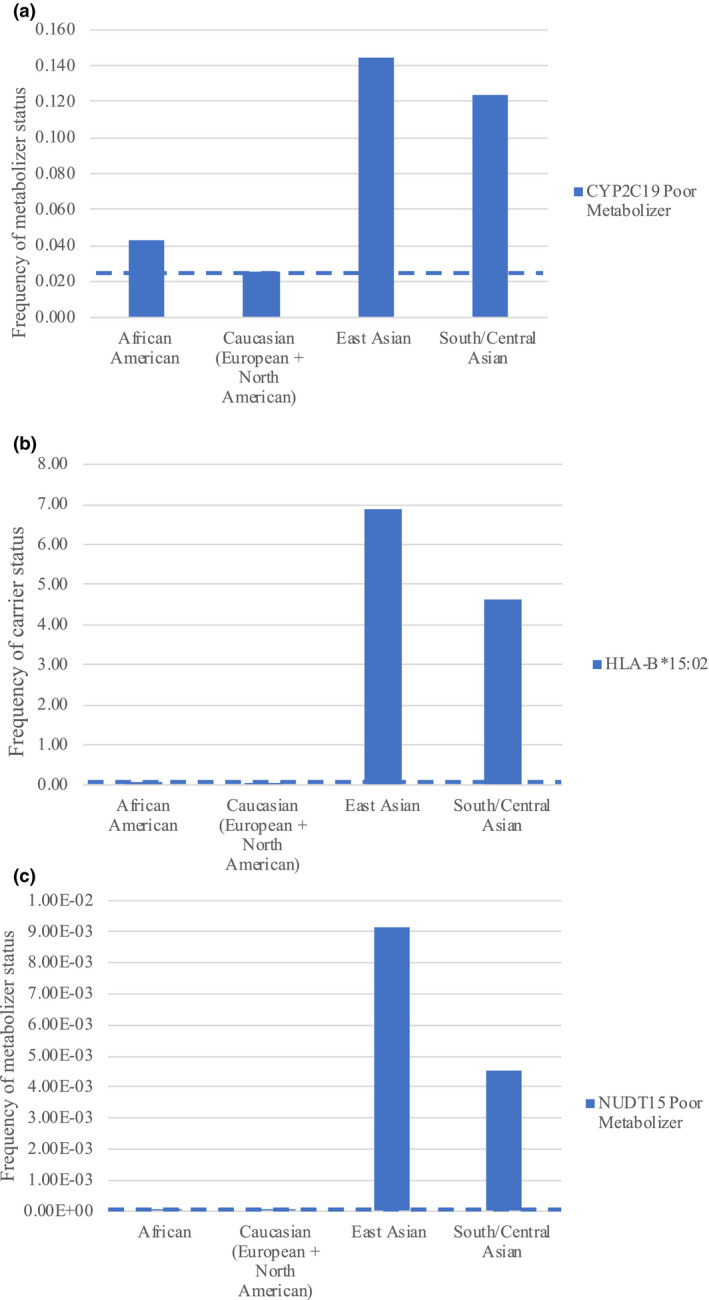
Asians as a group comprise > 60% the world's population. There is an incredible amount of diversity in Asian and admixed populations that has not been addressed in a pharmacogenetic context. The known pharmacogenetic differences in Asian subgroups generally represent previously known variants that are present at much lower or higher frequencies in Asians compared with other populations. In this review we summarize the main drugs and known genes that appear to have differences in their pharmacogenetic properties in certain Asian populations. Evidence-based guidelines and summary statistics from the US Food and Drug Administration and the Clinical Pharmacogenetics Implementation Consortium were analyzed for ethnic differences in outcomes. Implicated drugs included commonly prescribed drugs such as warfarin, clopidogrel, carbamazepine, and allopurinol. The majority of these associations are due to Asians more commonly being poor metabolizers of cytochrome P450 (CYP) 2C19 and carriers of the human leukocyte antigen (HLA)-B15:02 allele. The relative risk increase was shown to vary between genes and drugs, but could be > 100-fold higher in Asians. Specifically, there was a 172-fold increased risk of Stevens-Johnson syndrome and toxic epidermal necrolysis with carbamazepine use among HLA-B15:02 carriers. The effects ranged from relatively benign reactions such as reduced drug efficacy to severe cutaneous skin reactions. These reactions are severe and prevalent enough to warrant pharmacogenetic testing and appropriate changes in dose and medication choice for at-risk populations. Further studies should be done on Asian cohorts to more fully understand pharmacogenetic variants in these populations and to clarify how such differences may influence drug response.
亚洲人群占世界人口的 60%以上。亚洲和混合人群存在着令人难以置信的多样性,而这些多样性在药物遗传学方面尚未得到解决。亚洲亚群中已知的药物遗传学差异通常代表以前已知的变异,这些变异在亚洲人群中的出现频率比其他人群低得多或高得多。在这篇综述中,我们总结了主要的药物和已知的基因,这些药物和基因在某些亚洲人群中的药物遗传学特性上似乎存在差异。对美国食品和药物管理局和临床药物遗传学实施联盟的循证指南和汇总统计数据进行了分析,以了解不同种族在结局方面的差异。涉及的药物包括华法林、氯吡格雷、卡马西平和别嘌醇等常用处方药。这些关联大多是由于亚洲人 CYP2C19 的代谢不良和 HLA-B15:02 等位基因的携带者较多。研究表明,基因和药物之间的相对风险增加各不相同,但在亚洲人群中可能高达 100 倍以上。具体来说,在 HLA-B15:02 携带者中,卡马西平的使用与史蒂文斯-约翰逊综合征和中毒性表皮坏死松解症的风险增加了 172 倍。这些反应的范围从相对良性的反应(如药物疗效降低)到严重的皮肤反应。这些反应严重且普遍,足以证明需要进行药物遗传学检测,并对高危人群进行适当的剂量和药物选择改变。应该对亚洲队列进行进一步的研究,以更全面地了解这些人群中的药物遗传学变异,并阐明这些差异如何影响药物反应。