Department of Pharmacological and Biomolecular Sciences, University of Milan, Via Balzaretti 9, 20133 Milan, Italy.
Int J Mol Sci. 2020 Feb 24;21(4):1538. doi: 10.3390/ijms21041538.
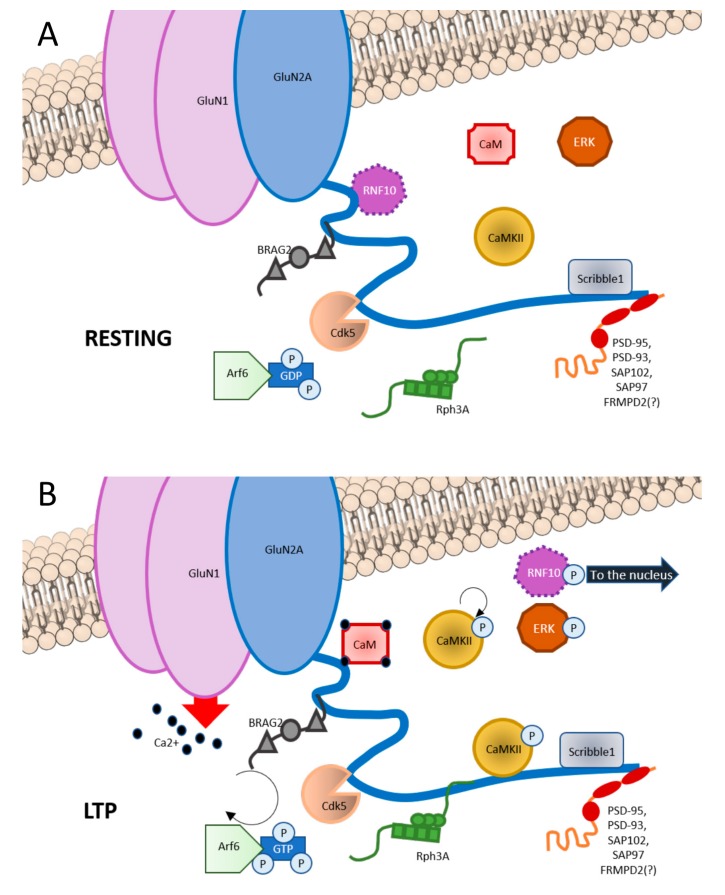
N-Methyl-d-Aspartate Receptors (NMDARs) are ionotropic glutamate-gated receptors. NMDARs are tetramers composed by several homologous subunits of GluN1-, GluN2-, or GluN3-type, leading to the existence in the central nervous system of a high variety of receptor subtypes with different pharmacological and signaling properties. NMDAR subunit composition is strictly regulated during development and by activity-dependent synaptic plasticity. Given the differences between GluN2 regulatory subunits of NMDAR in several functions, here we will focus on the synaptic pool of NMDARs containing the GluN2A subunit, addressing its role in both physiology and pathological synaptic plasticity as well as the contribution in these events of different types of GluN2A-interacting proteins.
N-甲基-D-天冬氨酸受体(NMDARs)是离子型谷氨酸门控受体。NMDAR 由 GluN1、GluN2 或 GluN3 型的几个同源亚基组成,导致中枢神经系统中存在具有不同药理学和信号转导特性的多种受体亚型。NMDAR 亚基组成在发育过程中和通过活性依赖性突触可塑性受到严格调节。鉴于 NMDAR 的 GluN2 调节亚基在多种功能中的差异,我们将在这里重点介绍含有 GluN2A 亚基的突触池 NMDAR,讨论其在生理和病理性突触可塑性中的作用,以及不同类型的 GluN2A 相互作用蛋白在这些事件中的贡献。