Department of Kinesiology, University of New Brunswick Fredericton, Fredericton, New Brunswick, Canada
Division of Psychology, University of Stirling, Stirling, UK.
BMJ Open. 2020 Feb 25;10(2):e032653. doi: 10.1136/bmjopen-2019-032653.
To examine the acceptability and feasibility of narrative text messages with or without financial incentives to support weight loss for men.
Individually randomised three-arm feasibility trial with 12 months' follow-up.
Two sites in Scotland with high levels of disadvantage according to Scottish Index for Multiple Deprivation (SIMD).
Men with obesity (n=105) recruited through community outreach and general practitioner registers.
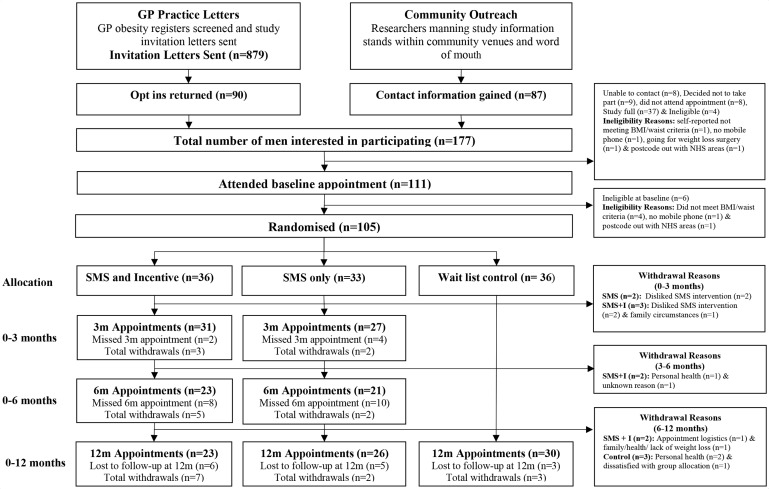
Participants randomised to: (A) narrative text messages plus financial incentive for 12 months (short message service (SMS)+I), (B) narrative text messages for 12 months (SMS only), or (C) waiting list control.
Acceptability and feasibility of recruitment, retention, intervention components and trial procedures assessed by analysing quantitative and qualitative data at 3, 6 and 12 months.
105 men were recruited, 60% from more disadvantaged areas (SIMD quintiles 1 or 2). Retention at 12 months was 74%. Fewer SMS+I participants (64%) completed 12-month assessments compared with SMS only (79%) and control (83%). Narrative texts were acceptable to many men, but some reported negative reactions. No evidence emerged that level of disadvantage was related to acceptability of narrative texts. Eleven SMS+I participants (31%) successfully met or partially met weight loss targets. The cost of the incentive per participant was £81.94 (95% CI £34.59 to £129.30). Incentives were acceptable, but improving health was reported as the key motivator for weight loss. All groups lost weight (SMS+I: -2.51 kg (SD=4.94); SMS only: -1.29 kg (SD=5.03); control: -0.86 kg (SD=5.64) at 12 months).
This three-arm weight management feasibility trial recruited and retained men from across the socioeconomic spectrum, with the majority from areas of disadvantage, was broadly acceptable to most participants and feasible to deliver.
NCT03040518.
探讨有无经济激励的叙事短信在支持男性减肥方面的可接受性和可行性。
12 个月随访的个体随机三臂可行性试验。
苏格兰两个根据苏格兰多维贫困指数(SIMD)处于高度劣势的地点。
通过社区外展和全科医生登记招募的肥胖男性(n=105)。
参与者随机分为:(A)12 个月的叙事短信加经济激励(短信服务(SMS)+I),(B)12 个月的叙事短信(仅 SMS),或(C)等候名单对照。
通过在 3、6 和 12 个月时分析定量和定性数据,评估了招募、保留、干预成分和试验程序的可接受性和可行性。
共招募了 105 名男性,其中 60%来自更弱势地区(SIMD 五分位数 1 或 2)。12 个月时的保留率为 74%。与仅 SMS(79%)和对照(83%)相比,SMS+I 组(64%)完成 12 个月评估的参与者较少。许多男性对叙事文本表示接受,但也有一些人表示反感。没有证据表明劣势程度与叙事文本的可接受性有关。11 名 SMS+I 参与者(31%)成功达到或部分达到减肥目标。每名参与者的激励费用为 81.94 英镑(95%置信区间 34.59 至 129.30 英镑)。激励措施是可以接受的,但报告称改善健康是减肥的关键动机。所有组在 12 个月时体重均减轻(SMS+I:-2.51 公斤(SD=4.94);SMS 仅:-1.29 公斤(SD=5.03);对照组:-0.86 公斤(SD=5.64))。
这项三臂体重管理可行性试验招募并保留了来自社会经济谱各个层面的男性,其中大多数来自弱势地区,大多数参与者普遍接受,且可行。
NCT03040518。