Amsterdam UMC, Vrije Universiteit Amsterdam, Medical Oncology, Cancer Center; Amsterdam, De Boelelaan 1117, Amsterdam, Netherlands; Amsterdam UMC, Vrije Universiteit Amsterdam, OncoProteomics Laboratory, Cancer Center Amsterdam, De Boelelaan 1117, Amsterdam, Netherlands; Amsterdam UMC, Vrije Universiteit Amsterdam Department of Hematology, De Boelelaan 1117, Amsterdam, Netherlands.
Amsterdam UMC, Vrije Universiteit Amsterdam Department of Hematology, De Boelelaan 1117, Amsterdam, Netherlands; Amsterdam UMC, Vrije Universiteit Amsterdam, Department of Pediatric Oncology, De Boelelaan 1117, Amsterdam, Netherlands.
Mol Cell Proteomics. 2020 May;19(5):884-899. doi: 10.1074/mcp.RA119.001504. Epub 2020 Feb 26.
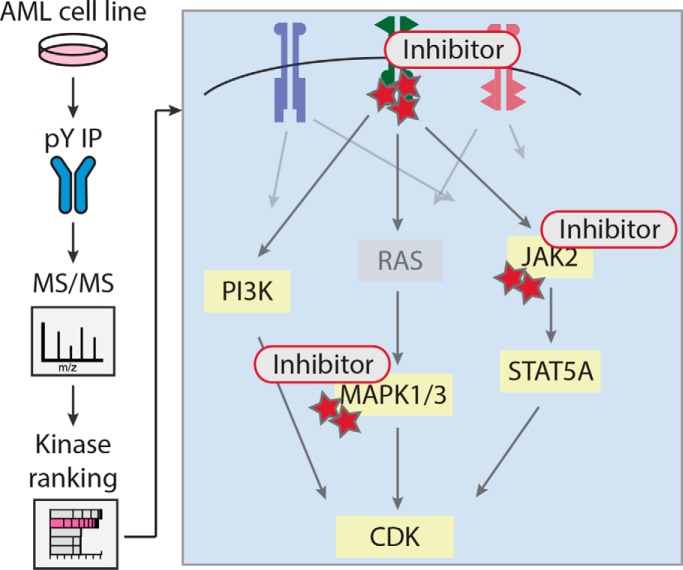
Acute myeloid leukemia (AML) is a clonal disorder arising from hematopoietic myeloid progenitors. Aberrantly activated tyrosine kinases (TK) are involved in leukemogenesis and are associated with poor treatment outcome. Kinase inhibitor (KI) treatment has shown promise in improving patient outcome in AML. However, inhibitor selection for patients is suboptimal.In a preclinical effort to address KI selection, we analyzed a panel of 16 AML cell lines using phosphotyrosine (pY) enrichment-based, label-free phosphoproteomics. The Integrative Inferred Kinase Activity (INKA) algorithm was used to identify hyperphosphorylated, active kinases as candidates for KI treatment, and efficacy of selected KIs was tested.Heterogeneous signaling was observed with between 241 and 2764 phosphopeptides detected per cell line. Of 4853 identified phosphopeptides with 4229 phosphosites, 4459 phosphopeptides (4430 pY) were linked to 3605 class I sites (3525 pY). INKA analysis in single cell lines successfully pinpointed driver kinases (PDGFRA, JAK2, KIT and FLT3) corresponding with activating mutations present in these cell lines. Furthermore, potential receptor tyrosine kinase (RTK) drivers, undetected by standard molecular analyses, were identified in four cell lines (FGFR1 in KG-1 and KG-1a, PDGFRA in Kasumi-3, and FLT3 in MM6). These cell lines proved highly sensitive to specific KIs. Six AML cell lines without a clear RTK driver showed evidence of MAPK1/3 activation, indicative of the presence of activating upstream RAS mutations. Importantly, FLT3 phosphorylation was demonstrated in two clinical AML samples with a internal tandem duplication (ITD) mutation.Our data show the potential of pY-phosphoproteomics and INKA analysis to provide insight in AML TK signaling and identify hyperactive kinases as potential targets for treatment in AML cell lines. These results warrant future investigation of clinical samples to further our understanding of TK phosphorylation in relation to clinical response in the individual patient.
急性髓系白血病(AML)是一种起源于造血髓系前体细胞的克隆性疾病。异常激活的酪氨酸激酶(TK)参与白血病的发生,并与治疗效果差有关。激酶抑制剂(KI)治疗已显示出改善 AML 患者预后的前景。然而,患者的抑制剂选择并不理想。在一项针对 KI 选择的临床前研究中,我们使用基于磷酸酪氨酸(pY)富集的无标记磷酸蛋白质组学分析了 16 个 AML 细胞系。整合推断激酶活性(INKA)算法用于鉴定过度磷酸化的、活跃的激酶作为 KI 治疗的候选物,并测试了选定 KI 的疗效。每个细胞系检测到 241 到 2764 个磷酸肽,观察到异质信号。在鉴定的 4853 个磷酸肽中有 4229 个磷酸化位点,其中 4459 个磷酸肽(4430 个 pY)与 3605 个 I 类位点(3525 个 pY)相关。在单个细胞系中的 INKA 分析成功地确定了与这些细胞系中存在的激活突变相对应的驱动激酶(PDGFRA、JAK2、KIT 和 FLT3)。此外,在四个细胞系(KG-1 和 KG-1a 中的 FGFR1、Kasumi-3 中的 PDGFRA 和 MM6 中的 FLT3)中鉴定到了标准分子分析未检测到的潜在受体酪氨酸激酶(RTK)驱动基因。这些细胞系对特定 KI 高度敏感。六个没有明确 RTK 驱动基因的 AML 细胞系显示 MAPK1/3 激活的证据,表明存在激活的上游 RAS 突变。重要的是,在两个具有内部串联重复(ITD)突变的临床 AML 样本中证实了 FLT3 磷酸化。我们的数据表明,pY 磷酸蛋白质组学和 INKA 分析具有提供 AML TK 信号见解和鉴定潜在治疗靶点的潜力,这些靶点在 AML 细胞系中过度活跃。这些结果证明了在临床样本中进一步研究的必要性,以进一步了解个体患者中与临床反应相关的 TK 磷酸化。