Department of Medical Oncology, Faculty of Medicine, University of Tsukuba, Tsukuba, Japan.
Department of General Thoracic Surgery, Osaka University Graduate School of Medicine, Suita, Japan.
Cancer Sci. 2020 May;111(5):1685-1691. doi: 10.1111/cas.14368. Epub 2020 Mar 25.
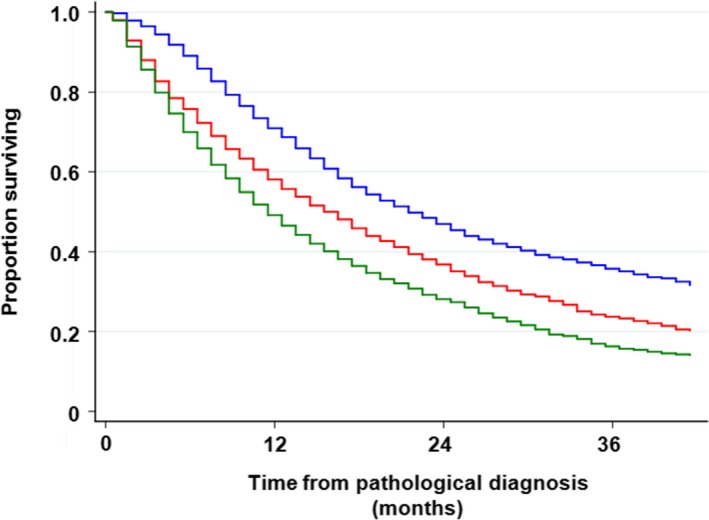
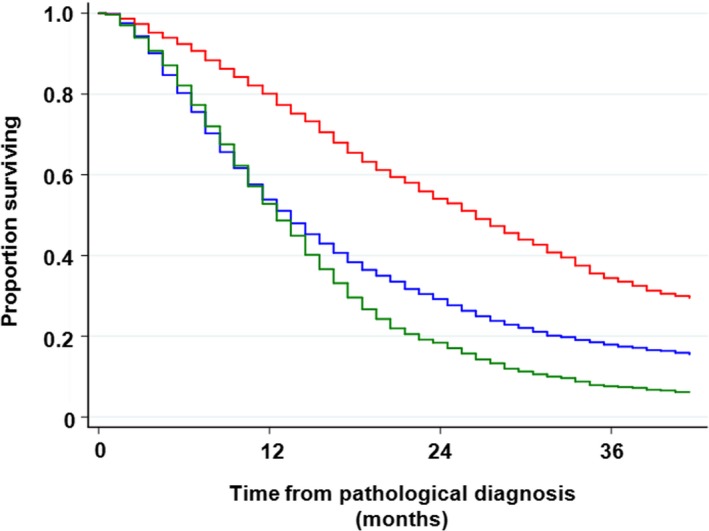
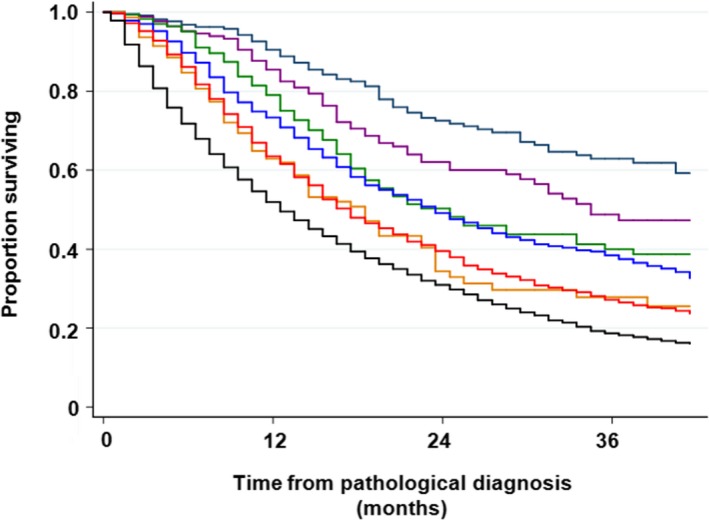
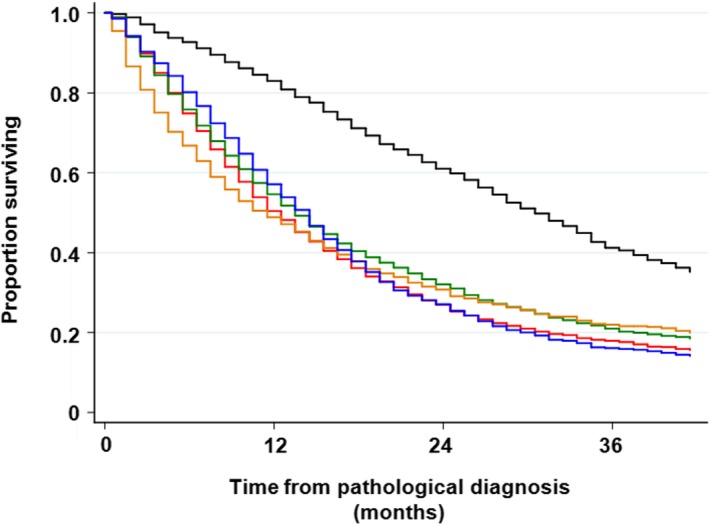
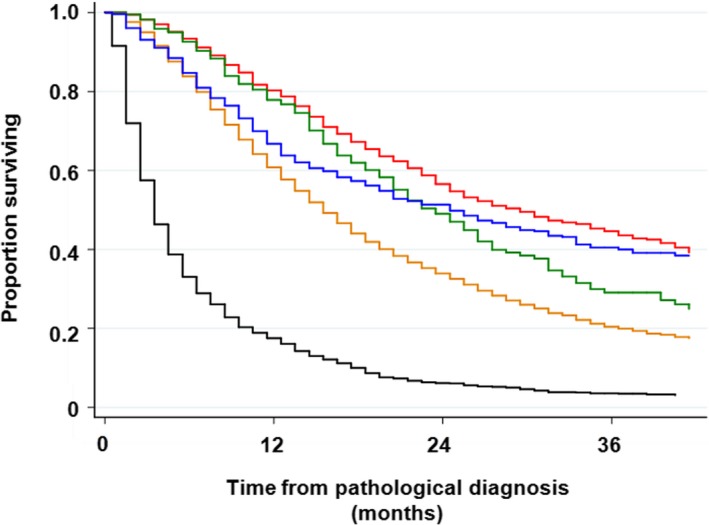
This study provides the benchmark statistics on medically treated patients with non-small cell lung cancer (NSCLC) and small cell lung cancer (SCLC) in Japan. Demographic background, treatment, and prognosis were obtained from patients with lung cancer pathologically diagnosed in 2012, who received nonsurgical treatment. Descriptive statistics and their associations with survival were analyzed. In total, 12 320 patients were registered from 314 institutions in Japan. The median age was 70 years, and 73% of the patients were male. The number (%) of stages I, II, III, and IV diseases were 468 (3.8%), 421 (3.4%), 3260 (26.5%), and 8171 (66.3%), respectively. NSCLC and SCLC accounted for 9872 (80.1%) and 2353 (19.1%) patients, respectively. Thoracic radiotherapy-based therapy, chemotherapy, and palliative care alone were administered to 2572 (20.9%), 7790 (63.2%), and 1952 (15.8%) patients, respectively. Clinical TNM stage was one of the strongest prognostic factors with the 3-year survival rates of 62.9%, 47.3%, 40.0%, 27.8%, 37.5%, 26.5%, and 18.2% for stages IA, IB, IIA, IIB, IIIA, IIIB, and IV, respectively. Among 6158 patients with NSCLC treated with chemotherapy, the 3-year survival rate was 33.4% in patients receiving epidermal growth factor receptor-tyrosine kinase inhibitors (EGFR-TKIs) at some point in their clinical course, whereas it was 17.4% in patients who did not. The 3-year survival rate of SCLC was only 15.9%. In conclusion, approximately two-thirds of the patients were diagnosed as stage IV at the initial diagnosis. Use of EGFR-TKIs significantly improved the survival of patients with NSCLC.
本研究提供了日本经医学治疗的非小细胞肺癌(NSCLC)和小细胞肺癌(SCLC)患者的基准统计数据。从 2012 年经病理诊断患有肺癌且未接受手术治疗的患者中获得了人口统计学背景、治疗和预后信息。对描述性统计数据及其与生存的相关性进行了分析。总共从日本的 314 家机构登记了 12320 名患者。中位年龄为 70 岁,73%的患者为男性。I、II、III 和 IV 期疾病的例数(%)分别为 468(3.8%)、421(3.4%)、3260(26.5%)和 8171(66.3%)。NSCLC 和 SCLC 分别占 9872(80.1%)和 2353(19.1%)名患者。2572 名(20.9%)、7790 名(63.2%)和 1952 名(15.8%)患者分别接受了基于胸部放疗的治疗、化疗和姑息治疗。临床 TNM 分期是最强的预后因素之一,IA、IB、IIA、IIB、IIIA、IIIB 和 IV 期患者的 3 年生存率分别为 62.9%、47.3%、40.0%、27.8%、37.5%、26.5%和 18.2%。在接受化疗治疗的 6158 名 NSCLC 患者中,在治疗过程中接受表皮生长因子受体酪氨酸激酶抑制剂(EGFR-TKIs)治疗的患者 3 年生存率为 33.4%,而未接受治疗的患者 3 年生存率为 17.4%。SCLC 的 3 年生存率仅为 15.9%。总之,约三分之二的患者在初始诊断时被诊断为 IV 期。EGFR-TKIs 的使用显著改善了 NSCLC 患者的生存。