University Medical Center Utrecht and Utrecht University, Utrecht, The Netherlands.
Ann & Robert H. Lurie Children's Hospital of Chicago, Northwestern University Feinberg School of Medicine, and the Cure JM Center of Excellence, Chicago, Illinois.
Arthritis Rheumatol. 2020 Jul;72(7):1214-1226. doi: 10.1002/art.41236. Epub 2020 May 29.
Juvenile dermatomyositis (DM) is a heterogeneous systemic immune-mediated vasculopathy. This study was undertaken to 1) identify inflammation/endothelial dysfunction-related biomarker profiles reflecting disease severity at diagnosis, and 2) establish whether such biomarker profiles could be used for predicting the response to treatment in patients with juvenile DM.
In total, 39 biomarkers related to activation of endothelial cells, endothelial dysfunction, and inflammation were measured using multiplex technology in serum samples from treatment-naive patients with juvenile DM from 2 independent cohorts (n = 30 and n = 29). Data were analyzed by unsupervised hierarchical clustering, nonparametric tests with correction for multiple comparisons, and Kaplan-Meier tests with Cox proportional hazards models for analysis of treatment duration. Myositis-specific antibodies (MSAs) were measured in the patients' serum using line blot assays.
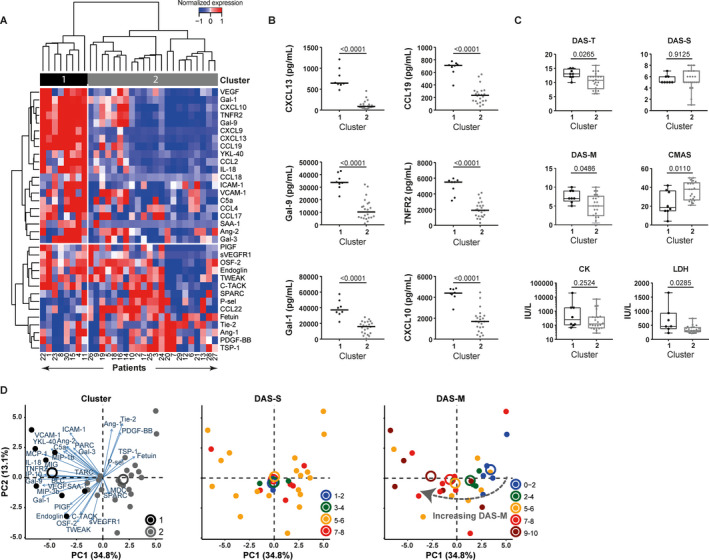
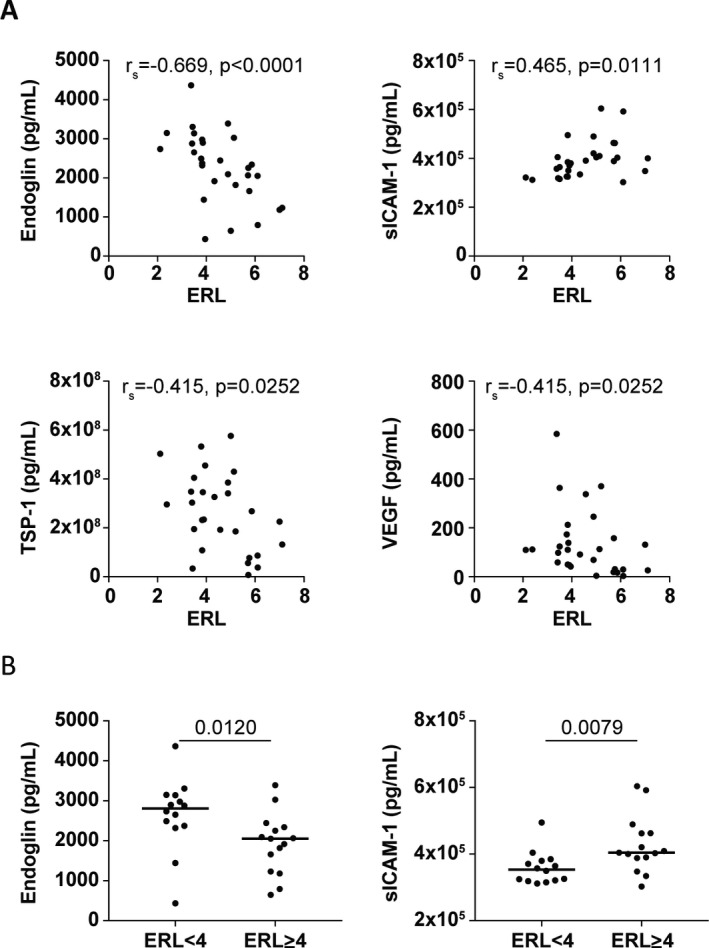
Severe vasculopathy in patients with juvenile DM was associated with low serum levels of intercellular adhesion molecule 1 (Spearman's rho [r ] = 0.465, P = 0.0111) and high serum levels of endoglin (r = -0.67, P < 0.0001). In the discovery cohort, unsupervised hierarchical clustering analysis of the biomarker profiles yielded 2 distinct patient clusters, of which the smaller cluster (cluster 1; n = 8) exhibited high serum levels of CXCL13, CCL19, galectin-9, CXCL10, tumor necrosis factor receptor type II (TNFRII), and galectin-1 (false discovery rate <0.0001), and this cluster had greater severity of muscle disease and global disease activity (each P < 0.05 versus cluster 2). In the validation cohort, correlations between the serum levels of galectin-9, CXCL10, TNFRII, and galectin-1 and the severity of global disease activity were confirmed (r = 0.40-0.52, P < 0.05). Stratification of patients according to the 4 confirmed biomarkers identified a cluster of patients with severe symptoms (comprising 64.7% of patients) who were considered at high risk of requiring more intensive treatment in the first 3 months after diagnosis (P = 0.0437 versus other cluster). Moreover, high serum levels of galectin-9, CXCL10, and TNFRII were predictive of a longer total treatment duration (P < 0.05). The biomarker-based clusters were not evidently correlated with patients' MSA serotypes.
Results of this study confirm the heterogeneity of new-onset juvenile DM based on serum biomarker profiles. Patients with high serum levels of galectin-9, CXCL10, TNFRII, and galectin-1 may respond suboptimally to conventional treatment, and may therefore benefit from more intensive monitoring and/or treatment.
幼年特发性皮肌炎(juvenile dermatomyositis,DM)是一种异质性的系统性免疫介导性血管病变。本研究旨在:1)鉴定反映诊断时疾病严重程度的炎症/内皮功能障碍相关生物标志物谱;2)建立这些生物标志物谱是否可用于预测幼年 DM 患者对治疗的反应。
采用无监督层次聚类、非参数检验(经多重比较校正)和 Kaplan-Meier 检验与 Cox 比例风险模型对来自 2 个独立队列(n=30 和 n=29)的未经治疗的幼年 DM 患者的血清样本中与内皮细胞激活、内皮功能障碍和炎症相关的 39 种生物标志物进行分析。采用线印迹分析测定患者血清中的肌炎特异性抗体(myositis-specific antibodies,MSAs)。
幼年 DM 患者严重的血管病变与血清中细胞间黏附分子 1(intercellular adhesion molecule 1,ICAM-1)水平较低(Spearman's rho [r] = 0.465,P = 0.0111)和血清内皮下调素(endoglin)水平较高相关(r = -0.67,P<0.0001)。在发现队列中,对生物标志物谱的无监督层次聚类分析产生了 2 个不同的患者聚类,其中较小的聚类(聚类 1;n=8)表现出高血清趋化因子(C-X-C 基元)配体 13(C-X-C motif ligand 13,CXCL13)、C 型凝集素 19(C-C motif ligand 19,CCL19)、半乳糖凝集素 9(galectin-9)、CXCL10、肿瘤坏死因子受体 2(tumor necrosis factor receptor type II,TNFRII)和半乳糖凝集素 1(galectin-1)水平升高(假发现率<0.0001),且该聚类肌肉疾病和总体疾病活动度的严重程度更大(均 P<0.05 与聚类 2 相比)。在验证队列中,半乳糖凝集素-9(galectin-9)、CXCL10、TNFRII 和 galectin-1 的血清水平与总体疾病活动度的严重程度之间的相关性得到了证实(r = 0.40-0.52,P<0.05)。根据 4 种经证实的生物标志物对患者进行分层,确定了一组症状严重的患者(占患者的 64.7%),这些患者在诊断后 3 个月内需要更强化的治疗的风险较高(P = 0.0437 与其他聚类相比)。此外,高血清水平的 galectin-9、CXCL10 和 TNFRII 与总治疗时间较长相关(P<0.05)。基于血清生物标志物谱的聚类与患者的肌炎特异性抗体(myositis-specific antibodies,MSAs)血清型之间无明显相关性。
本研究的结果证实了新发病幼年特发性皮肌炎(juvenile dermatomyositis,DM)基于血清生物标志物谱存在异质性。血清中 galectin-9、CXCL10、TNFRII 和 galectin-1 水平较高的患者对常规治疗的反应可能不理想,因此可能受益于更强化的监测和/或治疗。