Longhini Federico, Bruni Andrea, Garofalo Eugenio, De Sarro Rosalba, Memeo Riccardo, Navalesi Paolo, Navarra Giuseppe, Ranieri Girolamo, Currò Giuseppe, Ammendola Michele
Department of Medical and Surgical Sciences, Anesthesia and Intensive Care Unit, "Magna Graecia" University, Catanzaro, Italy.
Department of Clinical and Experimental Medicine, Section of Cardiology, G. Martino General Hospital, University of Messina, Messina, Italy.
Cancer Manag Res. 2020 Feb 10;12:931-940. doi: 10.2147/CMAR.S237224. eCollection 2020.
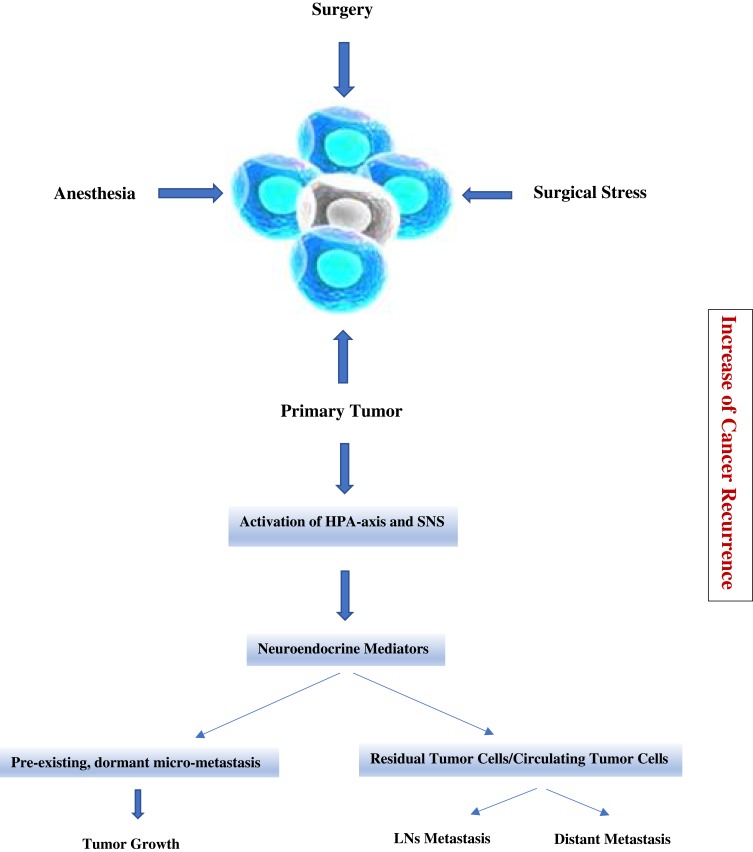
Tumor recurrences or metastases remain a major hurdle in improving overall cancer survival. In the perioperative period, the balance between the ability of the cancer to seed and grow at the metastatic site and the ability of the patient to fight against the tumor (i.e. the host antitumor immunity) may determine the development of clinically evident metastases and influence the patient outcome. Up to 80% of oncological patients receive anesthesia and/or analgesia for diagnostic, therapeutic or palliative interventions. Therefore, anesthesiologists are asked to administer drugs such as opiates and volatile or intravenous anesthetics, which may determine different effects on immunomodulation and cancer recurrence. For instance, some studies suggest that intravenous drugs, such as propofol, may inhibit the host immunity to a lower extent as compared to volatile anesthetics. Similarly, some studies suggest that analgesia assured by local anesthetics may provide a reduction of cancer recurrence rate; whilst on the opposite side, opioids may exert negative consequences in patients undergoing cancer surgery, by interacting with the immune system response via the modulation of the hypothalamic-pituitary-adrenal axis and autonomic nervous system, or directly through the opioid receptors on the surface of immune cells. In this review, we summarize the main findings on the effects induced by different drugs on immunomodulation and cancer recurrence.
肿瘤复发或转移仍然是提高癌症总体生存率的主要障碍。在围手术期,癌症在转移部位播种和生长的能力与患者对抗肿瘤的能力(即宿主抗肿瘤免疫力)之间的平衡,可能决定临床明显转移的发生,并影响患者的预后。高达80%的肿瘤患者因诊断、治疗或姑息性干预而接受麻醉和/或镇痛。因此,麻醉医生被要求使用如阿片类药物、挥发性或静脉麻醉剂等药物,这些药物可能对免疫调节和癌症复发产生不同的影响。例如,一些研究表明,与挥发性麻醉剂相比,静脉药物如丙泊酚对宿主免疫的抑制程度可能较低。同样,一些研究表明,局部麻醉剂确保的镇痛可能会降低癌症复发率;而另一方面,阿片类药物可能会对接受癌症手术的患者产生负面影响,通过调节下丘脑-垂体-肾上腺轴和自主神经系统与免疫系统反应相互作用,或直接通过免疫细胞表面的阿片受体。在这篇综述中,我们总结了不同药物对免疫调节和癌症复发影响的主要研究结果。