Santander Ballestín Sonia, Lanuza Bardaji Andrea, Marco Continente Cristina, Luesma Bartolomé María José
Department of Pharmacology, Physiology and Legal and Forensic Medicine, Faculty of Medicine, University of Zaragoza, Zaragoza, Spain.
Anesthesiology and Resuscitation, Clinic Hospital of Zaragoza, Zaragoza, Spain.
Front Med (Lausanne). 2022 Feb 18;9:799355. doi: 10.3389/fmed.2022.799355. eCollection 2022.
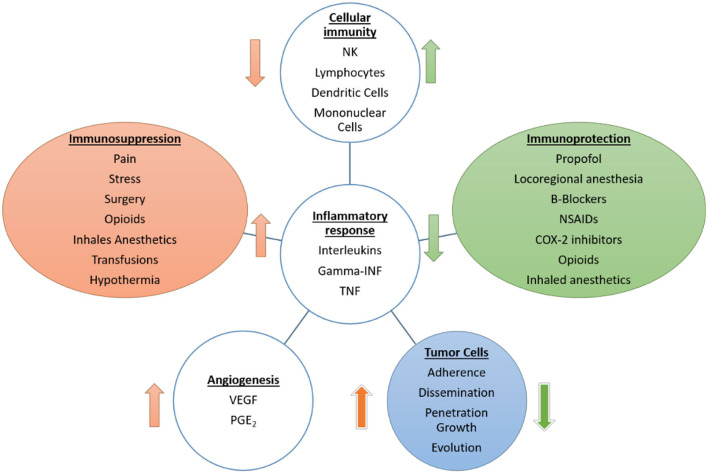
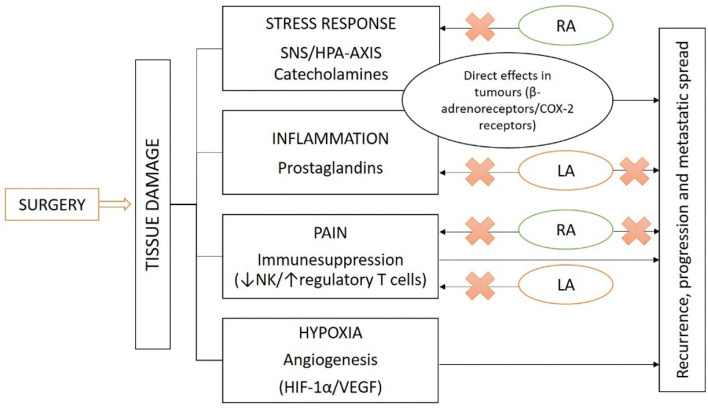
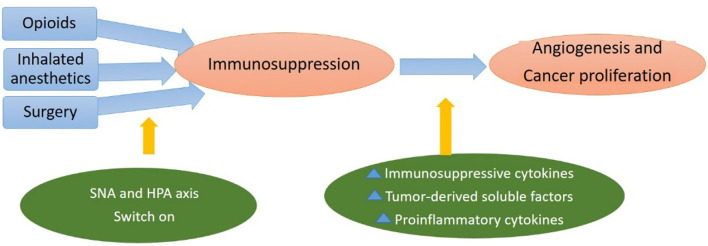
The stress response triggered by the surgical aggression and the transient immunosuppression produced by anesthetic agents stimulate the inadvertent dispersion of neoplastic cells and, paradoxically, tumor progression during the perioperative period. Anesthetic agents and techniques, in relation to metastatic development, are investigated for their impact on long-term survival. Scientific evidence indicates that inhaled anesthetics and opioids benefit immunosuppression, cell proliferation, and angiogenesis, providing the ideal microenvironment for tumor progression. The likely benefit of reducing their use, or even replacing them as much as possible with anesthetic techniques that protect patients from the metastatic process, is still being investigated. The possibility of using "immunoprotective" or "antitumor" anesthetic techniques would represent a turning point in clinical practice. Through understanding of pharmacological mechanisms of anesthetics and their effects on tumor cells, new perioperative approaches emerge with the aim of halting and controlling metastatic development. Epidural anesthesia and propofol have been shown to maintain immune activity and reduce catecholaminergic and inflammatory responses, considering the protective techniques against tumor spread. The current data generate hypotheses about the influence of anesthesia on metastatic development, although prospective trials that determinate causality are necessary to make changes in clinical practice.
手术侵袭引发的应激反应以及麻醉药物产生的短暂免疫抑制,会促使肿瘤细胞在围手术期意外扩散,而矛盾的是,这还会导致肿瘤进展。针对麻醉药物和技术对转移发展的影响,人们研究了它们对长期生存的作用。科学证据表明,吸入麻醉剂和阿片类药物有利于免疫抑制、细胞增殖和血管生成,为肿瘤进展提供了理想的微环境。减少其使用,甚至尽可能用能保护患者免受转移过程影响的麻醉技术来替代它们,其潜在益处仍在研究中。使用“免疫保护”或“抗肿瘤”麻醉技术的可能性将代表临床实践中的一个转折点。通过了解麻醉剂的药理机制及其对肿瘤细胞的影响,出现了旨在阻止和控制转移发展的新围手术期方法。考虑到针对肿瘤扩散的保护技术,硬膜外麻醉和丙泊酚已被证明能维持免疫活性并减少儿茶酚胺能和炎症反应。目前的数据产生了关于麻醉对转移发展影响的假设,不过要在临床实践中做出改变,确定因果关系的前瞻性试验是必要的。