Tran Thuy, Rades Thomas, Müllertz Anette
Department of Pharmacy, Faculty of Health and Medical Sciences, University of Copenhagen, Universitetsparken 2, 2100 Copenhagen, Denmark.
Bioneer: FARMA, Faculty of Health and Medical Sciences, University of Copenhagen, Universitetsparken 2, 2100 Copenhagen, Denmark.
Asian J Pharm Sci. 2018 Nov;13(6):536-545. doi: 10.1016/j.ajps.2017.09.006. Epub 2017 Oct 13.
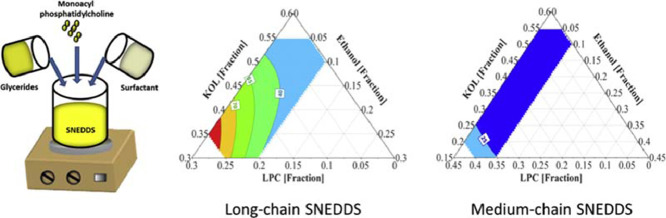
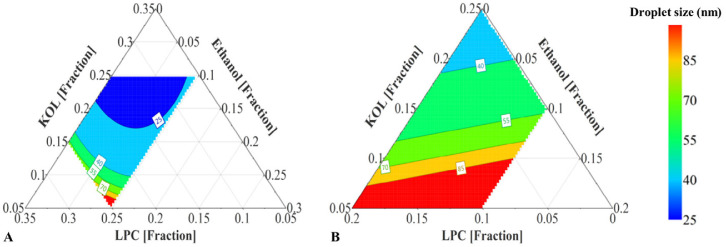
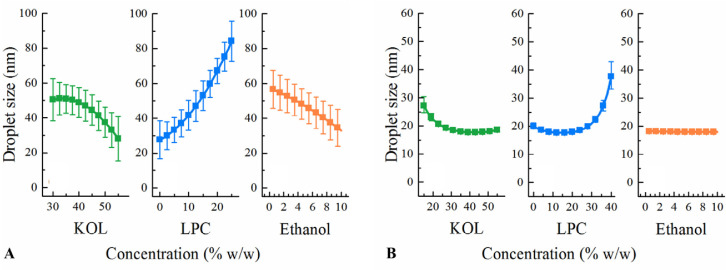
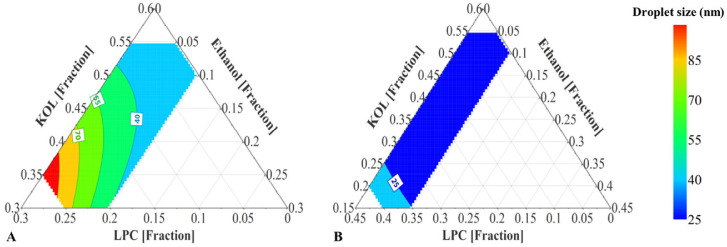
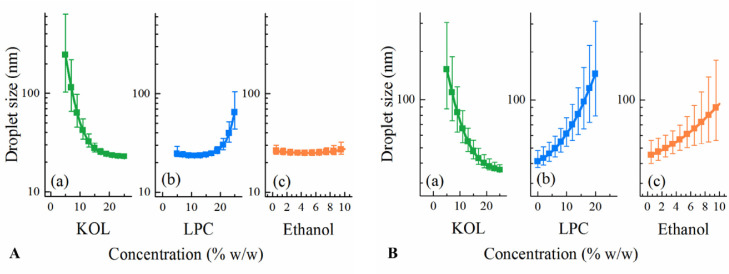
The development of self-nanoemulsifying drug delivery systems (SNEDDS) to enhance the oral bioavailability of lipophilic drugs is usually based on traditional one-factor-at-a-time approaches. These approaches may be inadequate to analyse the effect of each excipient and their potential interactions on the emulsion droplet size formed when dispersing the SNEDDS in an aqueous environment. The current study investigates the emulsion droplet sizes formed from SNEDDS containing different levels of the natural surfactant monoacyl phosphatidylcholine to reduce the concentration of the synthetic surfactant polyoxyl 40 hydrogenated castor oil (Kolliphor RH40). Monoacyl phosphatidylcholine was used in the form of Lipoid S LPC 80 (LPC, containing approximately 80% monoacyl phosphatidylcholine, 13% phosphatidylcholine and 4% concomitant components). The investigated SNEDDS comprised of long-chain or medium-chain glycerides (40% to 75%), Kolliphor RH40 (5% to 55%), LPC (0 to 40%) and ethanol (0 to 10%). D-optimal design, multiple linear regression, and partial least square regression were used to screen different SNEDDS within the investigated excipient ranges and to analyse the effect of each excipient on the resulting droplet size of the dispersed SNEDDS measured by dynamic light scattering. All investigated formulations formed nano-emulsions with droplet sizes from about 20 to 200 nm. The use of medium-chain glycerides was more likely to result in smaller and more monodisperse droplet sizes compared to the use of long-chain glycerides. Kolliphor RH40 exhibited the most significant effect on reducing the emulsion droplet sizes. Increasing LPC concentration increased the emulsion droplet sizes, possibly because of the reduction of Kolliphor RH40 concentration. A higher concentration of ethanol resulted in an insignificant reduction of the emulsion droplet size. The study provides different ternary diagrams of SNEDDS containing LPC and Kolliphor RH40 as a reference for formulation developers.
开发自纳米乳化药物递送系统(SNEDDS)以提高亲脂性药物的口服生物利用度通常基于传统的一次改变一个因素的方法。这些方法可能不足以分析每种辅料的作用及其在将SNEDDS分散于水性环境中时对形成的乳液滴大小的潜在相互作用。本研究调查了由含有不同水平天然表面活性剂单酰基磷脂酰胆碱的SNEDDS形成的乳液滴大小,以降低合成表面活性剂聚氧乙烯40氢化蓖麻油(克列莫佛RH40)的浓度。单酰基磷脂酰胆碱以Lipoid S LPC 80(LPC,含有约80%单酰基磷脂酰胆碱、13%磷脂酰胆碱和4%伴随成分)的形式使用。所研究的SNEDDS由长链或中链甘油酯(40%至75%)、克列莫佛RH40(5%至55%)、LPC(0至40%)和乙醇(0至10%)组成。采用D-最优设计、多元线性回归和偏最小二乘回归来筛选所研究辅料范围内的不同SNEDDS,并分析每种辅料对通过动态光散射测量的分散后SNEDDS所得滴大小的影响。所有研究的制剂均形成了滴大小约为20至200nm的纳米乳液。与使用长链甘油酯相比,使用中链甘油酯更有可能产生更小且更单分散的滴大小。克列莫佛RH40对降低乳液滴大小表现出最显著的作用。增加LPC浓度会增加乳液滴大小,可能是由于克列莫佛RH40浓度降低所致。较高浓度的乙醇导致乳液滴大小的降低不显著。该研究提供了含有LPC和克列莫佛RH40的SNEDDS的不同三元相图,作为制剂研发人员的参考。