Hirschberg Cosima, Schmidt Larsen Mikkel, Bøtker Johan Peter, Rantanen Jukka
Department of Pharmacy, University of Copenhagen, Universitetsparken 2, 2300 Copenhagen, Denmark.
Asian J Pharm Sci. 2018 Nov;13(6):575-583. doi: 10.1016/j.ajps.2018.04.007. Epub 2018 May 23.
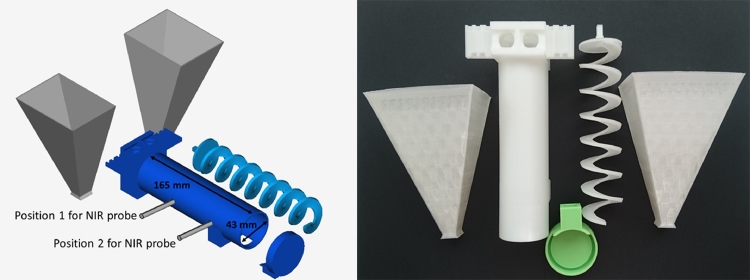
Rapid prototyping based on design and 3D printing enables fast customization of complex geometries to multiple needs. This study utilizes, additive manufacturing for rapid prototyping of elements for continuously operating mixing geometries including interfaces with process analytical technology (PAT) tools, to show that 3D printing can be used for prototyping of both parts of production line and PAT interfacing solution. An additional setup was designed for measuring the dynamic calibration samples for a semi-quantitative near infrared (NIR) spectroscopic model. The powder was filled in a small calibration chamber and in-line NIR spectra of calibration samples were collected from moving material while mimicking the powder flow dynamics in a typical continuous mixer. This dynamic powder mixing system was compared with a static powder calibration model where the NIR probe was placed at different positions on a static sample. Principal component analysis (PCA) revealed that the 3D printed device with dynamic measurement of the NIR spectra had more potential for quantitative analysis. With the prototype continuous mixer, two differently placed process interfaces for NIR spectroscopic monitoring of the powder mixing were evaluated. With this approach, the importance of positioning the process analytical tools to assess the blend uniformity could be demonstrated. It was also observed that with the longer mixing geometry, a better mixing result was achieved due to a larger hold up volume and increased residence time.
基于设计和3D打印的快速成型技术能够根据多种需求快速定制复杂的几何形状。本研究利用增材制造技术对连续运行的混合几何形状的元件进行快速成型,包括与过程分析技术(PAT)工具的接口,以表明3D打印可用于生产线部件和PAT接口解决方案的原型制作。设计了一个额外的装置用于测量半定量近红外(NIR)光谱模型的动态校准样品。将粉末填充到一个小校准室中,在模拟典型连续混合器中的粉末流动动力学的同时,从移动的物料中收集校准样品的在线近红外光谱。将这种动态粉末混合系统与静态粉末校准模型进行比较,在静态粉末校准模型中,近红外探头放置在静态样品的不同位置。主成分分析(PCA)表明,对近红外光谱进行动态测量的3D打印设备在定量分析方面具有更大潜力。使用原型连续混合器,评估了两个不同位置的用于粉末混合近红外光谱监测的过程接口。通过这种方法,可以证明定位过程分析工具以评估混合均匀性的重要性。还观察到,对于更长的混合几何形状,由于更大的滞留体积和更长的停留时间,实现了更好的混合效果。