Mater Research Institute - The University of Queensland, Translational Research Institute, Woolloongabba, QLD 4102, Australia.
Mater Ovarian Cancer Research Collaborative, Mater Adult Hospital, South Brisbane, QLD 4101, Australia.
Theranostics. 2020 Jan 12;10(5):2095-2114. doi: 10.7150/thno.30736. eCollection 2020.
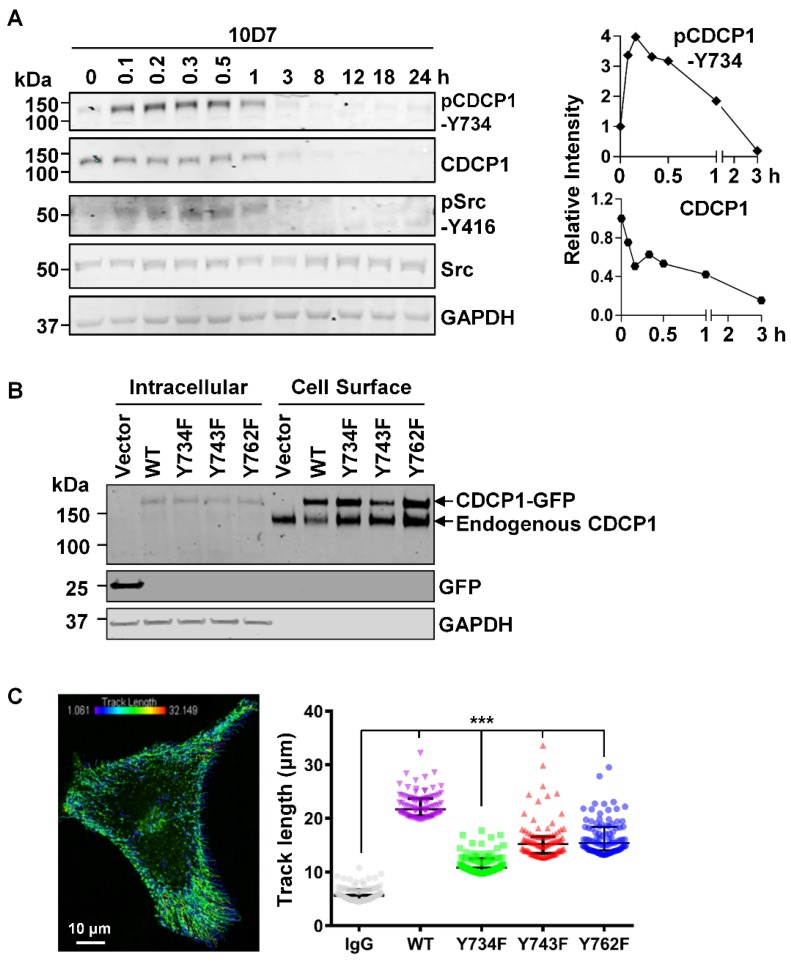
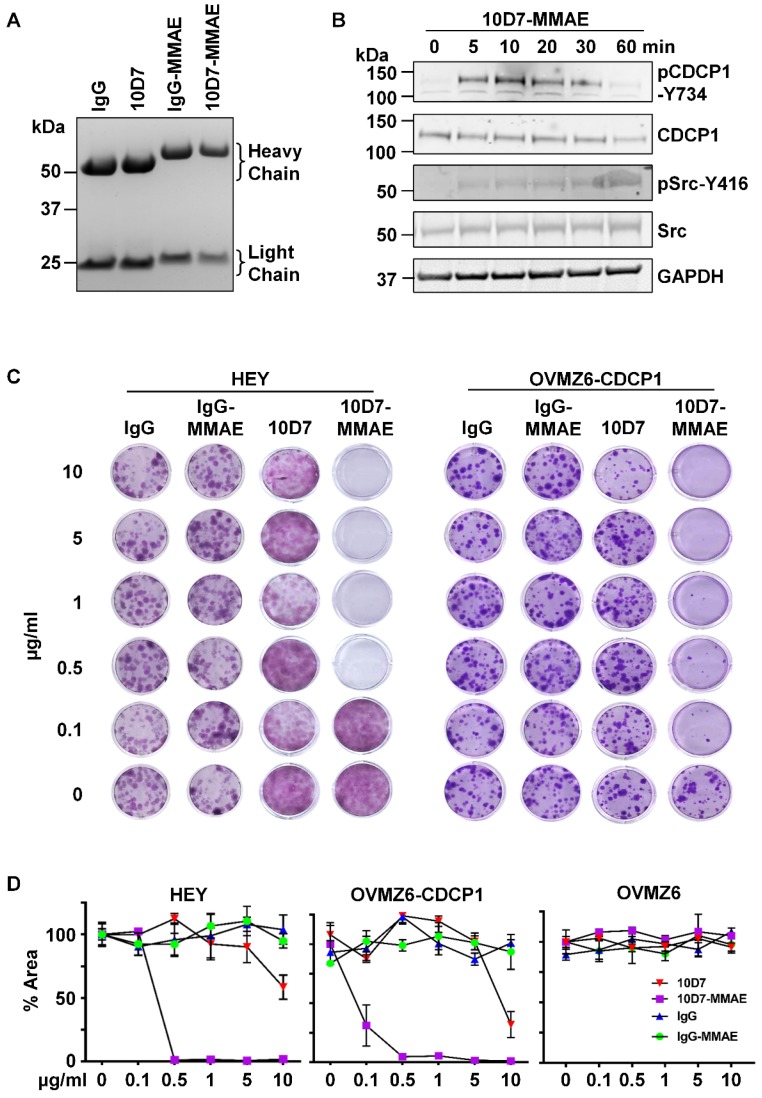
CUB-domain containing protein 1 (CDCP1) is a cancer associated cell surface protein that amplifies pro-tumorigenic signalling by other receptors including EGFR and HER2. Its potential as a cancer target is supported by studies showing that anti-CDCP1 antibodies inhibit cell migration and survival , and tumor growth and metastasis . Here we characterize two anti-CDCP1 antibodies, focusing on immuno-conjugates of one of these as a tool to detect and inhibit ovarian cancer. : A panel of ovarian cancer cell lines was examined for cell surface expression of CDCP1 and loss of expression induced by anti-CDCP1 antibodies 10D7 and 41-2 using flow cytometry and Western blot analysis. Surface plasmon resonance analysis and examination of truncation mutants was used to analyse the binding properties of the antibodies for CDCP1. Live-cell spinning-disk confocal microscopy of GFP-tagged CDCP1 was used to track internalization and intracellular trafficking of CDCP1/antibody complexes. , zirconium 89-labelled 10D7 was detected by positron-emission tomography imaging, of an ovarian cancer patient-derived xenograft grown intraperitoneally in mice. The efficacy of cytotoxin-conjugated 10D7 was examined against ovarian cancer cells and . : Our data indicate that each antibody binds with high affinity to the extracellular domain of CDCP1 causing rapid internalization of the receptor/antibody complex and degradation of CDCP1 via processes mediated by the kinase Src. Highlighting the potential clinical utility of CDCP1, positron-emission tomography imaging, using zirconium 89-labelled 10D7, was able to detect subcutaneous and intraperitoneal xenograft ovarian cancers in mice, including small (diameter <3 mm) tumor deposits of an ovarian cancer patient-derived xenograft grown intraperitoneally in mice. Furthermore, cytotoxin-conjugated 10D7 was effective at inhibiting growth of CDCP1-expressing ovarian cancer cells and . : These data demonstrate that CDCP1 internalizing antibodies have potential for killing and detection of CDCP1 expressing ovarian cancer cells.
CUB 结构域包含蛋白 1(CDCP1)是一种与癌症相关的细胞表面蛋白,通过其他受体(包括 EGFR 和 HER2)放大促肿瘤信号。其作为癌症靶点的潜力得到了研究的支持,这些研究表明抗 CDCP1 抗体抑制细胞迁移和存活以及肿瘤生长和转移。在这里,我们研究了两种抗 CDCP1 抗体,重点研究了其中一种抗体的免疫缀合物,作为检测和抑制卵巢癌的工具。
使用流式细胞术和 Western blot 分析检查了一组卵巢癌细胞系的 CDCP1 细胞表面表达和抗 CDCP1 抗体 10D7 和 41-2 诱导的表达缺失。表面等离子体共振分析和截断突变体的检查用于分析抗体与 CDCP1 的结合特性。使用 GFP 标记的 CDCP1 的活细胞旋转盘共聚焦显微镜跟踪 CDCP1/抗体复合物的内化和细胞内转运。用正电子发射断层扫描成像检测锆 89 标记的 10D7,在小鼠体内腹膜内生长的卵巢癌患者来源的异种移植中。用细胞毒素缀合的 10D7 对卵巢癌细胞和进行了疗效检测。
我们的数据表明,每种抗体都以高亲和力结合 CDCP1 的细胞外结构域,导致受体/抗体复合物的快速内化和 CDCP1 通过激酶Src 介导的过程降解。突显了 CDCP1 的潜在临床实用性,使用锆 89 标记的 10D7 的正电子发射断层扫描成像能够检测小鼠皮下和腹膜内异种移植卵巢癌,包括在小鼠体内腹膜内生长的卵巢癌患者来源的异种移植的小(直径 <3mm)肿瘤沉积物。此外,细胞毒素缀合的 10D7 有效抑制 CDCP1 表达的卵巢癌细胞和的生长。
这些数据表明,CDCP1 内化抗体具有杀伤和检测表达 CDCP1 的卵巢癌细胞的潜力。