Huyghe Nicolas, Baldin Paméla, Van den Eynde Marc
Institut de Recherche Clinique et Expérimentale (Pole MIRO), UCLouvain, Brussels, Belgium.
Department of Pathology, Cliniques Universitaires St-Luc, Institut Roi Albert II, Brussels, Belgium.
Gastroenterol Rep (Oxf). 2019 Nov 25;8(1):11-24. doi: 10.1093/gastro/goz061. eCollection 2020 Feb.
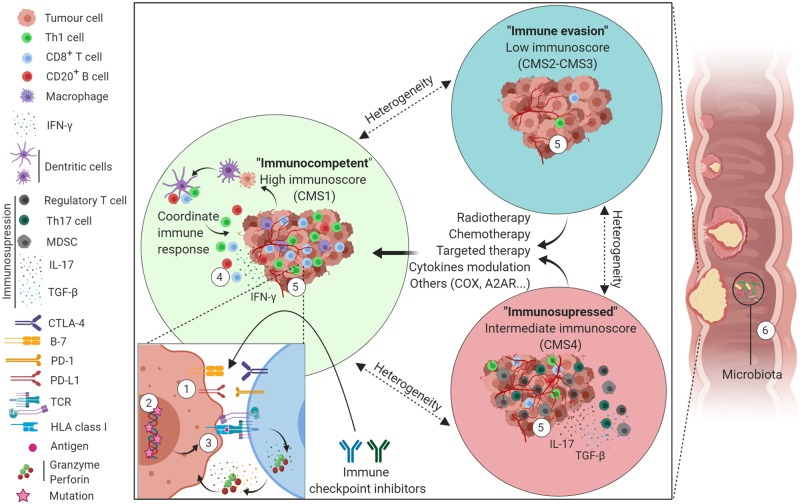
Following initial success in melanoma and lung tumours, immune checkpoint inhibitors (ICIs) are now well recognized as a major immunotherapy treatment modality for multiple types of solid cancers. In colorectal cancer (CRC), the small subset that is mismatch-repair-deficient and microsatellite-instability-high (dMMR/MSI-H) derive benefit from immunotherapy; however, the vast majority of patients with proficient MMR (pMMR) or with microsatellite stable (MSS) CRC do not. Immunoscore and the consensus molecular subtype classifications are promising biomarkers in predicting therapeutic efficacy in selected CRC. In pMRR/MSS CRC, biomarkers are also needed to understand the molecular mechanisms governing immune reactivity and to predict their relationship to treatment. The continuous development of such biomarkers would offer new perspectives and more personalized treatments by targeting oncological options, including ICIs, which modify the tumour-immune microenvironment. In this review, we focus on CRC and discuss the current status of ICIs, the role of biomarkers to predict response to immunotherapy, and the approaches being explored to render pMMR/MSS CRC more immunogenic through the use of combined therapies.
在黑色素瘤和肺癌治疗取得初步成功之后,免疫检查点抑制剂(ICI)如今已被公认为是多种实体癌的主要免疫治疗方式。在结直肠癌(CRC)中,错配修复缺陷且微卫星高度不稳定(dMMR/MSI-H)的一小部分患者可从免疫治疗中获益;然而,绝大多数错配修复功能正常(pMMR)或微卫星稳定(MSS)的CRC患者却无法获益。免疫评分和共识分子亚型分类是预测特定CRC治疗疗效的有前景的生物标志物。在pMRR/MSS CRC中,也需要生物标志物来了解免疫反应的分子机制,并预测它们与治疗的关系。此类生物标志物的不断发展将通过靶向包括ICI在内的肿瘤学治疗选择,改变肿瘤免疫微环境,从而提供新的视角和更个性化的治疗方案。在本综述中,我们聚焦于CRC,讨论ICI的现状、预测免疫治疗反应的生物标志物的作用,以及通过联合治疗使pMMR/MSS CRC更具免疫原性的探索方法。