Wang Jiao, Sun Yichun, Li Zhan, Li Wei, Pang Yuanyuan, Li Jiayu, Wu Qing
Guizhou Key Laboratory for Information System of Mountainous Areas and Protection of Ecological Environment, Guizhou Normal University, 116 Baoshan North Rd, Guiyang 550001, Guizhou, China.
Tong Ji Tang (Guizhou) Pharmaceutical Co., Ltd., Guiyang, Guizhou 550018, China.
J Anal Methods Chem. 2020 Feb 10;2020:8367619. doi: 10.1155/2020/8367619. eCollection 2020.
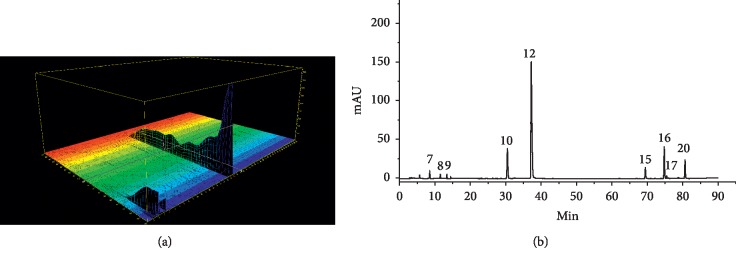
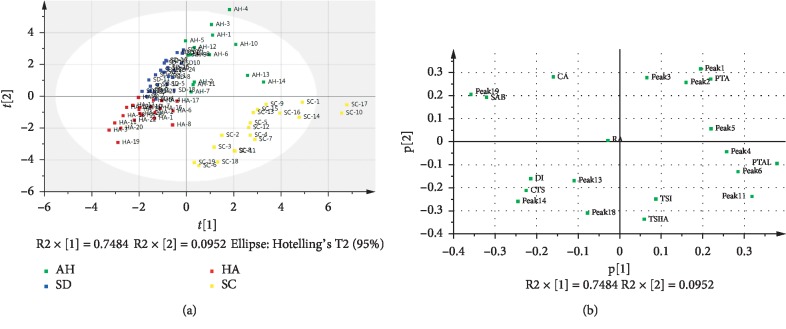
To evaluate the quality of Bunge, high-performance liquid chromatography-diode array detector (HPLC/UV-PAD), near infrared (NIR) spectroscopy, and chemometrics were used to discriminate nine components of samples from four different geographical locations. HPLC was performed with a C18 (5 m, 4.6 mm × 250 mm) column and 0.1% formic acid aqueous solution-acetonitrile with a gradient elution system. Orthogonal partial least squares discriminant analysis was used to identify the amounts of salvianolic acid B. NIR was used to distinguish rapidly Bunge samples from different geographical locations. In this assay, discriminant analysis was performed, and the accuracy was found to be 100%. The combination of these two methods can be used to quickly and accurately identify Bunge from different geographical locations.
为评估[药材名称]的质量,采用高效液相色谱 - 二极管阵列检测器(HPLC/UV - PAD)、近红外(NIR)光谱法和化学计量学方法对来自四个不同地理位置的样品中的九种成分进行鉴别。使用C18(5μm,4.6mm×250mm)色谱柱,以0.1%甲酸水溶液 - 乙腈为流动相,采用梯度洗脱系统进行HPLC分析。采用正交偏最小二乘法判别分析来确定丹酚酸B的含量。利用近红外光谱法快速区分不同地理位置的[药材名称]样品。在该分析中进行了判别分析,发现准确率为100%。这两种方法相结合可用于快速准确地鉴别不同地理位置的[药材名称]。