Montemezzi Pietro, Ferrini Francesco, Pantaleo Giuseppe, Gherlone Enrico, Capparè Paolo
Dental School, Vita-Salute San Raffaele University, 20132 Milan, Italy.
Department of Dentistry, IRCCS San Raffaele Hospital, 20132 Milan, Italy.
Materials (Basel). 2020 Feb 25;13(5):1029. doi: 10.3390/ma13051029.
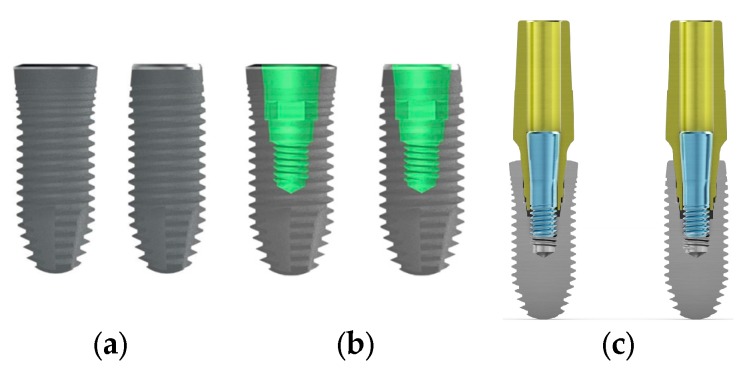
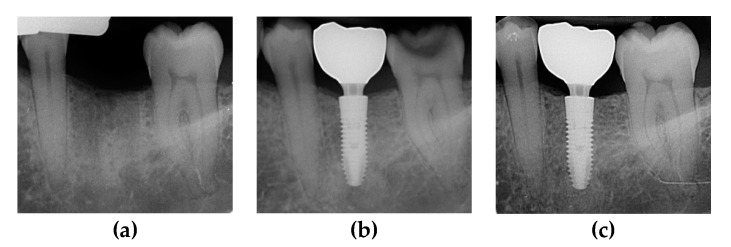
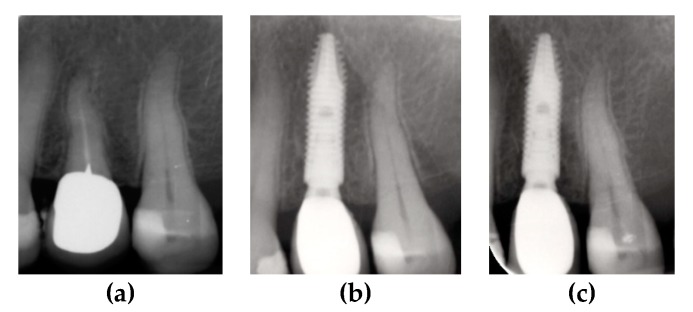
The present study was conducted to investigate whether a different implant neck design could affect survival rate and peri-implant tissue health in a cohort of disease-free partially edentulous patients in the molar-premolar region. The investigation was conducted on 122 dental implants inserted in 97 patients divided into two groups: Group A (rough wide-neck implants) vs. Group B (rough reduced-neck implants). All patients were monitored through clinical and radiological checkups. Survival rate, probing depth, and marginal bone loss were assessed at 12- and 24-month follow-ups. Patients assigned to Group A received 59 implants, while patients assigned to Group B 63. Dental implants were placed by following a delayed loading protocol, and cemented metal-ceramic crowns were delivered to the patients. The survival rates for both Group A and B were acceptable and similar at the two-year follow-up (96.61% vs. 95.82%). Probing depth and marginal bone loss tended to increase over time (: t = 12 vs. t = 24 months) in both groups of patients. Probing depth ( = 0.015) and bone loss ( = 0.001) were significantly lower in Group A (3.01 vs. 3.23 mm and .92 vs. 1.06 mm; Group A vs. Group B). Within the limitations of the present study, patients with rough wide-neck implants showed less marginal bone loss and minor probing depth, as compared to rough reduced-neck implants placed in the molar-premolar region. These results might be further replicated through longer-term trials, as well as comparisons between more collar configurations (e.g., straight vs. reduced vs. wide collars).
本研究旨在调查不同的种植体颈部设计是否会影响无疾病的磨牙-前磨牙区部分牙列缺损患者队列中种植体的存活率和种植体周围组织健康状况。对97例患者植入的122颗牙种植体进行了研究,这些患者分为两组:A组(粗糙宽颈种植体)和B组(粗糙缩颈种植体)。通过临床和放射学检查对所有患者进行监测。在12个月和24个月的随访中评估存活率、探诊深度和边缘骨丢失情况。A组患者植入59颗种植体,B组患者植入63颗。按照延迟加载方案植入牙种植体,并为患者安装粘结金属烤瓷冠。在两年的随访中,A组和B组的存活率均可接受且相似(96.61%对95.82%)。两组患者的探诊深度和边缘骨丢失均随时间增加(t = 12个月对t = 24个月)。A组的探诊深度(P = 0.015)和骨丢失(P = 0.001)显著低于B组(分别为3.01对3.23 mm和0.92对1.06 mm;A组对B组)。在本研究的局限性范围内,与磨牙-前磨牙区植入的粗糙缩颈种植体相比,粗糙宽颈种植体的患者边缘骨丢失更少,探诊深度更小。这些结果可能需要通过长期试验以及更多牙颈部形态(如直颈、缩颈、宽颈)之间的比较来进一步验证。