Department of Orthopaedic Surgery, Aarhus University Hospital, Aarhus N, Denmark.
Acta Orthop. 2020 Jun;91(3):299-305. doi: 10.1080/17453674.2020.1731159. Epub 2020 Feb 28.
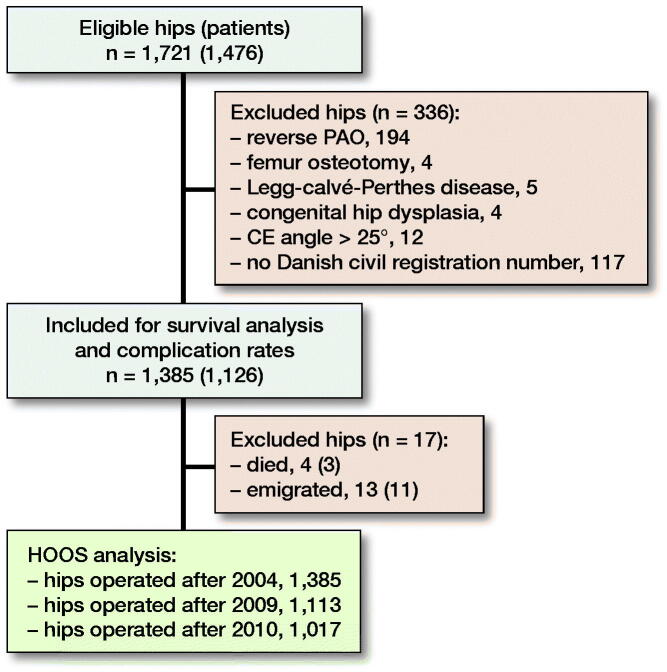
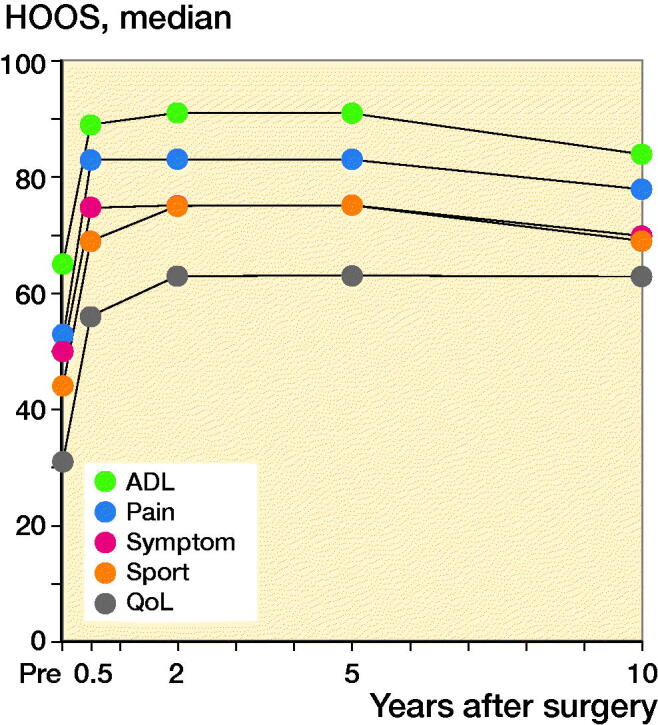
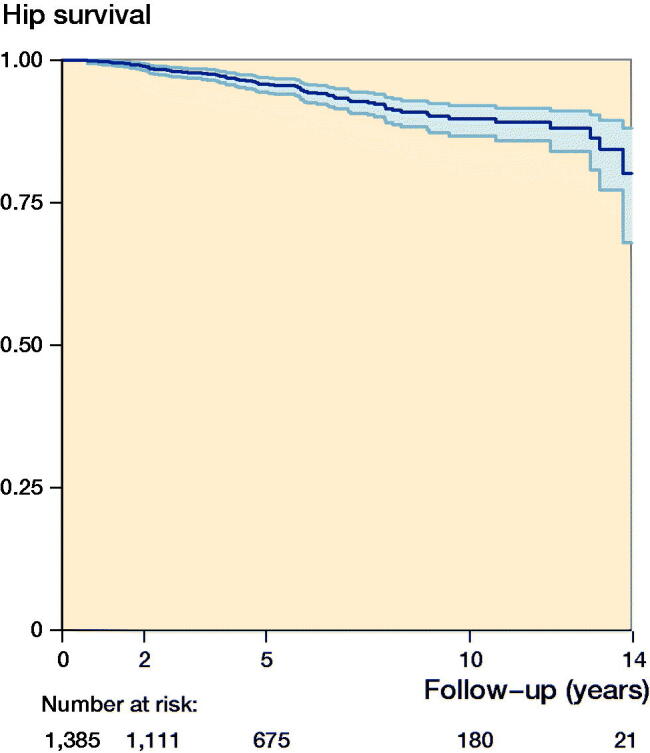
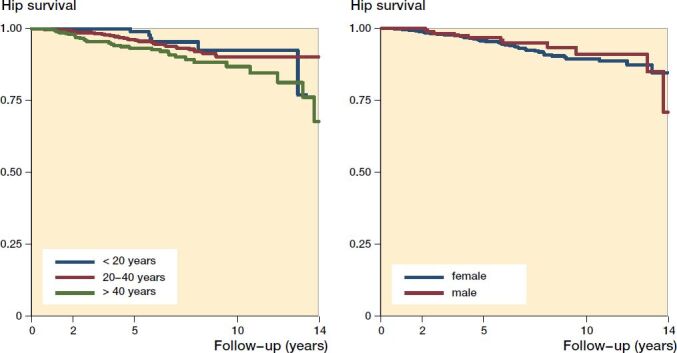
Background and purpose - Few studies have evaluated the long- and mid-term outcomes after minimally invasive periacetabular osteotomy (PAO). We investigated: (1) the long-term hip survival rate after PAO; (2) the risk of complications and additional surgery after PAO; and (3) the hip function at different follow-up points.Patients and methods - We reviewed 1,385 hips (1,126 patients) who underwent PAO between January 2004 and December 2017. Through inquiry to the Danish National Patient Registry we identified conversions to total hip arthroplasty (THA) and complications after PAO. We evaluated the Hip disability and Osteoarthritis Outcome Score (HOOS) obtained preoperatively, and at 6 months, 2-, 5-, and 10-years' follow-up.Results - 73 of the 1,385 hips were converted to THA. The overall Kaplan-Meier hip survival rate was 80% (95% CI 68-88) at 14 years with a mean follow-up of 5 years (0.03-14). 1.1% of the hips had a complication requiring surgical intervention. The most common additional surgery was removal of screws (13%) and 11% received a hip arthroscopy. At the 2-year follow-up, HOOS pain improved by a mean of 26 points (CI 24-28) and a HOOS pain score > 50 was observed in 86%.Interpretation - PAO preserved 4 of 5 hips at 14 years, with higher age leading to lower survivorship. The PAO technique was shown to be safe; 1.1% of patients had a complication that demanded surgical intervention. The majority of the patients with preserved hips have no or low pain. The operation is effective with a good clinical outcome.
背景与目的 - 很少有研究评估微创髋臼周围截骨术(PAO)后的长期和中期结果。我们研究了:(1)PAO 后髋关节的长期存活率;(2)PAO 后并发症和额外手术的风险;(3)不同随访点的髋关节功能。
患者与方法 - 我们回顾了 2004 年 1 月至 2017 年 12 月期间接受 PAO 的 1385 髋(1126 例患者)。通过向丹麦国家患者登记处查询,我们确定了 PAO 后转换为全髋关节置换术(THA)和并发症的情况。我们评估了术前、术后 6 个月、2 年、5 年和 10 年的髋关节残疾和骨关节炎结果评分(HOOS)。
结果 - 1385 髋中有 73 髋转换为 THA。14 年时的总体 Kaplan-Meier 髋关节生存率为 80%(95%CI 68-88),平均随访时间为 5 年(0.03-14 年)。1.1%的髋关节发生了需要手术干预的并发症。最常见的额外手术是螺钉取出(13%),11%接受髋关节镜检查。在 2 年随访时,HOOS 疼痛平均改善 26 分(CI 24-28),86%的患者出现 HOOS 疼痛评分>50。
解释 - PAO 在 14 年内保留了 4/5 的髋关节,年龄较高导致存活率降低。PAO 技术被证明是安全的;1.1%的患者发生了需要手术干预的并发症。保留髋关节的大多数患者无或低疼痛。该手术效果良好,临床效果好。